Into the Dark of the “Monster of Florence”
There’s an unwritten rule in crime reporting — or, as we like to call the genre now, true crime: the longer a case stays unsolved, the greater the collective obsession. The murders of Florence’s young couples have lived inside that rule for more than fifty years, under a name that holds an entire imagination: il mostro, the monster. A dark saga that showed how Italy could give birth to a nightmare with cinematic contours right at the tourist epicenter of its natural and artistic beauty.
It all seems to begin in 1968, on an ordinary evening in the countryside near Signa. A crime of honor, an old-fashioned act that would open — without knowing it — the door to an abyss. Six years later, the same shots from a Winchester .22, an “H” stamped on the shell casings, ring out again in the Mugello, against a young couple surprised in their intimacy. But it’s in the 1980s that the fear takes shape. It’s a moment of transition, of metamorphosis. The Italy of the riflusso — the retreat from politics — was looking for a new center of gravity, far from the bullets and the rage of the piazzas: no longer politics as a shared destiny, but the individual and their desires; no longer class struggle, but a refuge in private life. Young couples parked in the countryside were the naive symbol of that turn.
The monster is born in this twilight. But telling the story today doesn’t mean simply listing the facts: eight double homicides, sixteen innocent victims, a weapon never found, and barbaric excisions of trophies. From 1981 to 1985 it became an annual, codified appointment — almost always in summer but never in August, almost always on weekends and on moonless nights. A ritual built from seemingly random details, from mistakes offset by fresh escalations. And then the trials, remembered mostly for their folkloric drift.
The true essence of the monster lies in the hypnotic effect it produced — and still produces — on anyone it has touched, from the first investigators to the last of the curious. Everyone, before long, understands clearly that clarity does not exist in this story. What exists are scattered fragments, intuitions that flare up and go out, passing flashes like the headlights of a car on a road drowning in dark. Or like Lucas Cranach’s diptych of Adam and Eve at the Uffizi: the primordial couple painted on two separate panels, forced to look at each other without being able to touch. The perfect allegory of a modus operandi — the brutal separation of bodies, the interruption of intimacy that turns love into death.
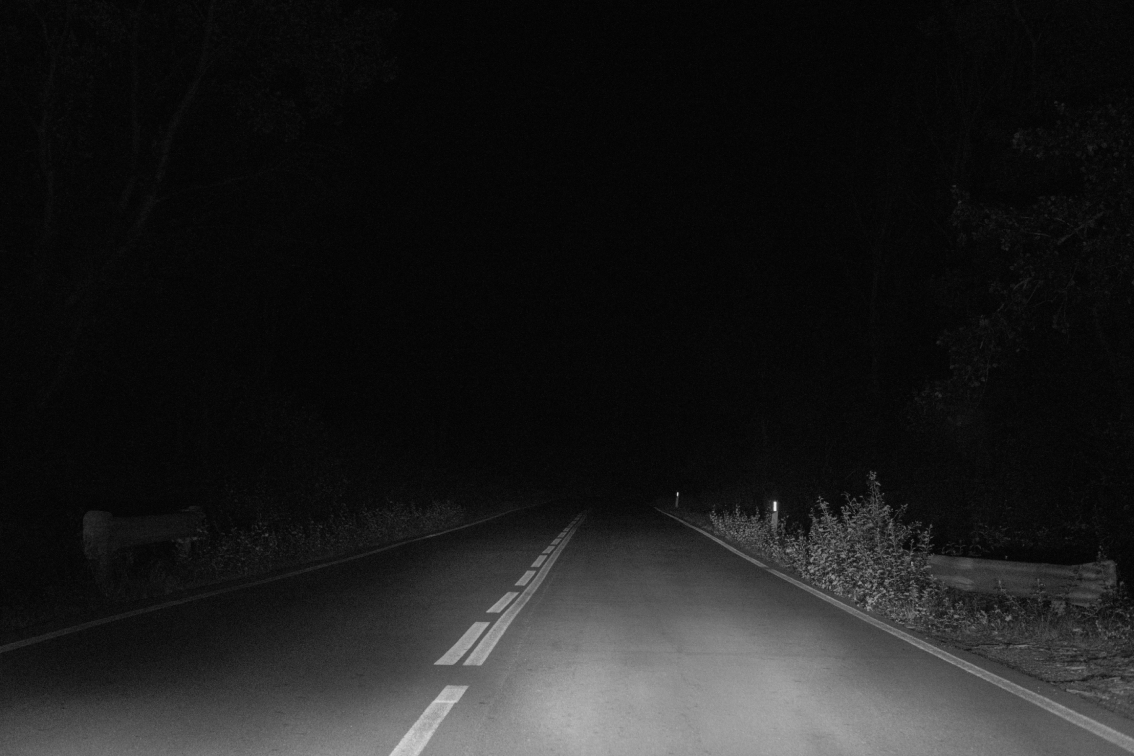
Night never ends in me is born from this visual spark. To photograph those secluded places after dark is to take on, if only for an instant, the same posture as the men who in Florence were called the “Indians” — the voyeurs who prowled the lovers’ lanes. It’s an inevitable short circuit, almost violent in its immediacy: voyeurism turned into a hunt, the lens as the eye of the old anti-monster campaign, “Occhio, ragazzi” (“Watch out, kids”). In the gesture, the core of the story reactivates: the gaze that precedes violence, that prepares it, that makes it possible. At the same time, you feel watched by a presence looming at your back.
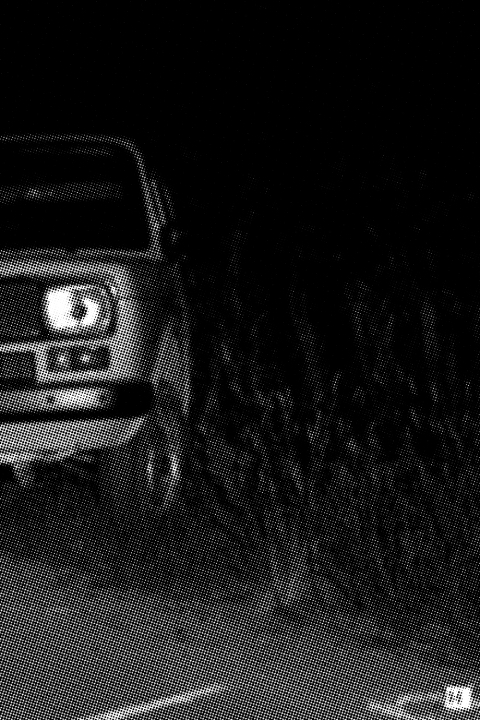
The images don’t recreate the crime scenes; they fix them in their present. The places are the same as back then, and yet time has turned them into something ambiguous. At Mosciano di Scandicci, the cypress struck by lightning that once marked the scene is gone. The Scopeti clearing is no longer a dirt widening that invites you to pull over or camp. The wedge on the Baccaiano straightaway has been swallowed by vegetation. Country dirt roads, remote lay-bys where nobody stops anymore, curves where the night thickens like solid matter: places where silence and darkness tell the story better than any words. Because the monster, above all, is a black hole — in the news that never closes, in the unfinished justice, in the collective psyche that never processes the grief.
To read, to look at, to investigate the monster means accepting to be drawn into a spiral with no way back. Every detail becomes meaning, every fragment seems to open new trails to follow. It’s a labyrinth in which you no longer look only for the truth, but for some further, deeper meaning. In the archives of those years, among the thousands of anonymous letters sent to investigators and newspapers, there’s one with a line that stays with you: “Night never ends in me.” Almost certainly written by a fantasist, it sounds stolen from a decadent poem — and instead it becomes the perfect summary of our relationship with the monster. Those nights aren’t over yet, and deep down we don’t want them to be. And so, if the night never ends, we may as well try to look inside it.
Text and photos by Simone D’Angelo.