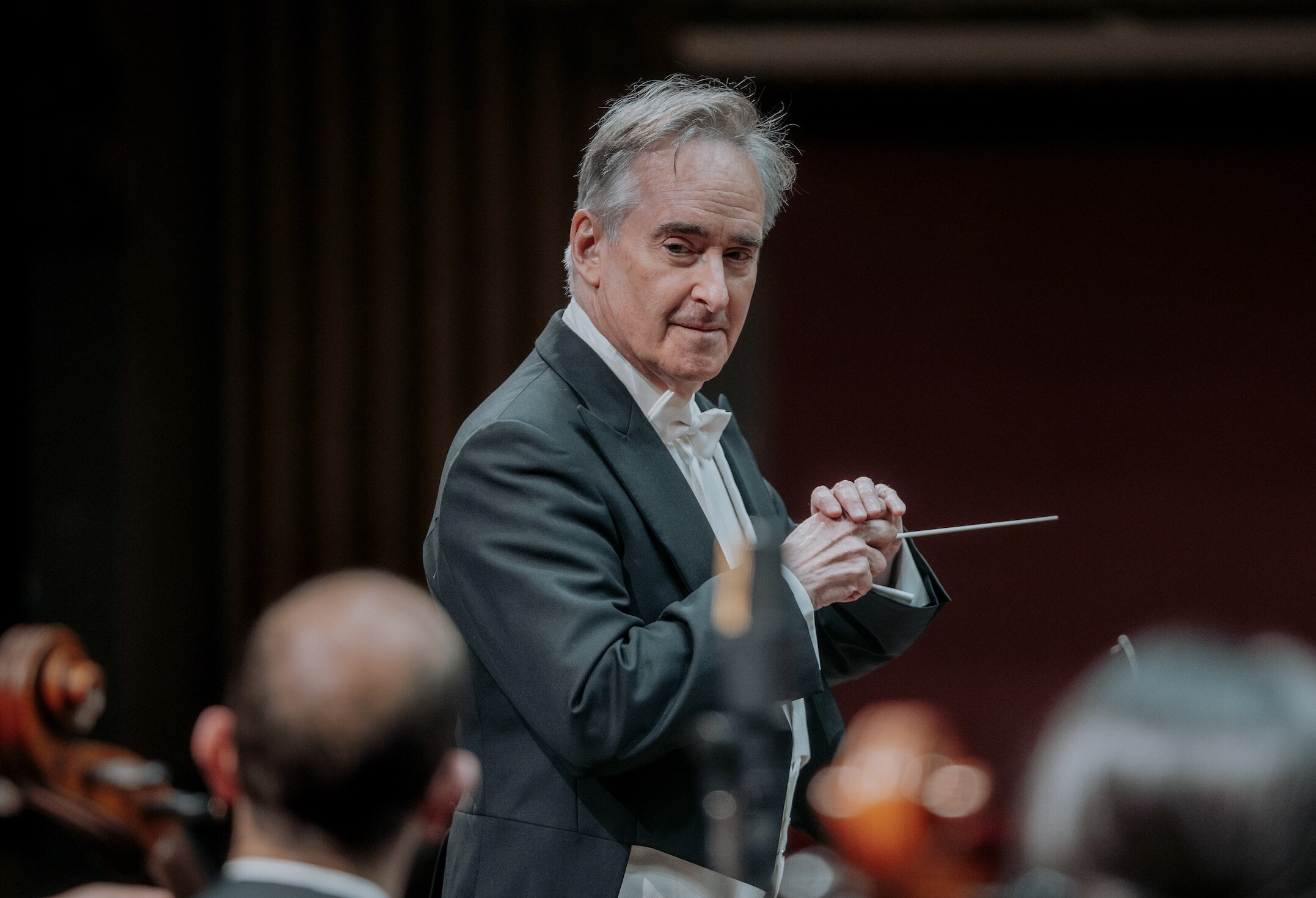
What do we carry with us from the places we come from, even when life takes us to the other side of the world? It’s one of the questions running through James Conlon: Between Italian Roots and American Wings, the documentary directed by Edoardo Zucchetti and produced by the Fondazione Orchestra della Toscana, in collaboration with HEYOKArts.
On Friday, November 20, at 6:30 p.m., the film will be screened at Florence’s Teatro Verdi, with free admission by reservation through Eventbrite.
Its protagonist is James Conlon, one of the most respected conductors on the international scene. But don’t expect a traditional biography made of dates and accolades: the documentary opts for a first-person account, letting the Maestro’s own voice and memories guide the viewer through his family history, his career and his reflections on what it means to conduct an orchestra.
The title already says a lot. The Italian roots belong to the Conlon family, whose grandparents came from Calvello, in Basilicata, in southern Italy; the American wings point to his upbringing in New York and to a career that has taken him to stages around the world. Florence, New York, Calvello and Los Angeles thus become the stops on a personal map, where places cannot be separated from memory.
A story that also runs through Florence
Conlon’s bond with the city goes back to 1985, when he made his debut at the Maggio Musicale Fiorentino, Florence’s historic music festival, conducting Giuseppe Verdi’s Don Carlo. His relationship with Florence has continued for more than forty years since then, together with his collaboration with the Orchestra della Toscana, of which he is honorary conductor.
His career has taken him from the New York Philharmonic to the Rotterdam Philharmonic, from the Opéra National de Paris to the Metropolitan Opera, where he has conducted more than 270 performances. In 2026 he wrapped up his twenty-year tenure as Music Director of Los Angeles Opera.
Alongside his work on the podium, he has devoted a significant part of his career to rediscovering composers persecuted or silenced by the Nazis.
It’s no coincidence that a central part of the documentary was shot right at the Teatro Verdi. Over three days in November 2024, the crew followed Conlon through dressing rooms, backstage, rehearsals and onstage, stepping into the spaces where music takes shape before it reaches the audience.
When music becomes an encounter
In the film, the conductor’s work also becomes a chance to reflect on listening, on gesture and on the relationship with the musicians. Giving shape to this story are performances by the Orchestra della Toscana under Conlon’s baton: excerpts from Act II of Christoph Willibald Gluck’s Orfeo ed Euridice, Wolfgang Amadeus Mozart’s Symphony No. 40 and Franz Joseph Haydn’s Symphony No. 103, the “Drumroll.”
Three pieces from the eighteenth-century repertoire that accompany the story and become an integral part of it. Music is not only something you listen to: it is an experience built together, in which every performer contributes to something that takes shape only through the relationship with the others.
The film is directed by Edoardo Zucchetti, a Florentine filmmaker working across theater, opera and film, who has collaborated with the ORT, the Orchestra della Toscana, since 2017. His previous work includes Patti in Florence, which opened the Festival dei Popoli, Florence’s documentary film festival, in 2020, and Pagliacci by Zeffirelli. A Step into the Future, presented at the Rome Film Fest in 2023.
The film leaves us with a reflection from Conlon, who describes music as a “spiritual community.” It’s a line that sums up the meaning of the documentary: a story about one’s origins, but also about music’s power to create bonds across every border.