When a sign loses its meaning, what is left of the story it was meant to tell? And how much of a language can survive once the structures that made it readable have dissolved? These are the questions running through Alfabeto immaginario (Imaginary Alphabet), Bernardo Tirabosco’s solo show curated by Elisa Perissinotti, on view through November 29 in the spaces of Marameo, inside the Hotel Torre Guelfa in Florence.
The artist’s research revolves around the possibility of recovering, through matter, the traces of a time that can no longer be reached directly. The artistic gesture thus takes on an archaeological dimension: it does not rebuild a past in its entirety, but brings fragments, impressions and residues of it to light, handing them back as ambiguous testimonies. The surface becomes a field of sedimentation, where memory and invention overlap until the line between artifact and imagination grows uncertain.
Eight works and lead matrices
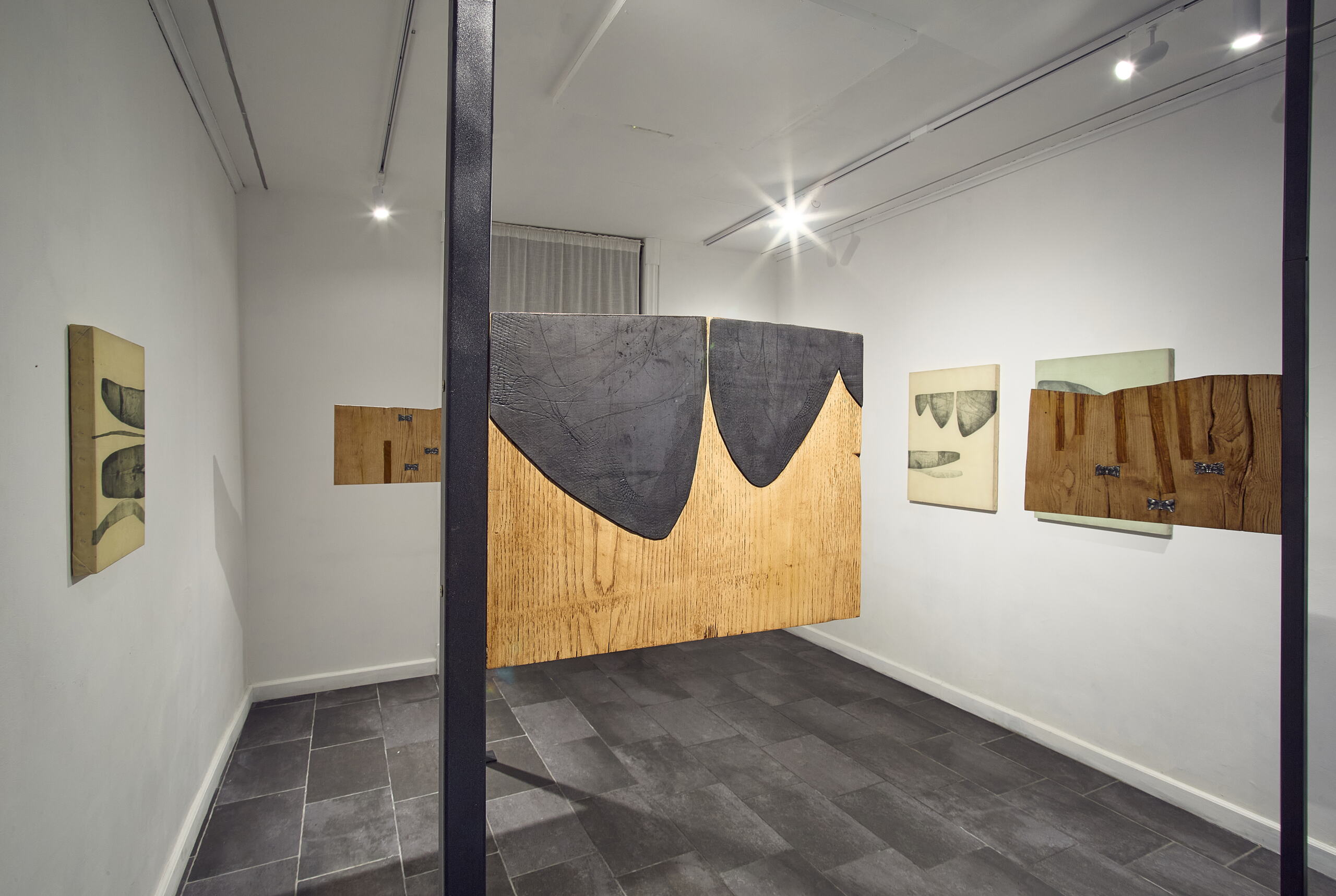
For Alfabeto immaginario Tirabosco created eight works conceived specifically for the exhibition space: three wooden panels and five canvases on waxed fabric. Using lead matrices, the artist presses onto these surfaces a series of graphic traces that seem to belong to an unknown writing system. Not a code to be deciphered, but a repertoire of forms that evokes the possibility of a language, of a set of lost meanings, or of a story still waiting to be unearthed.
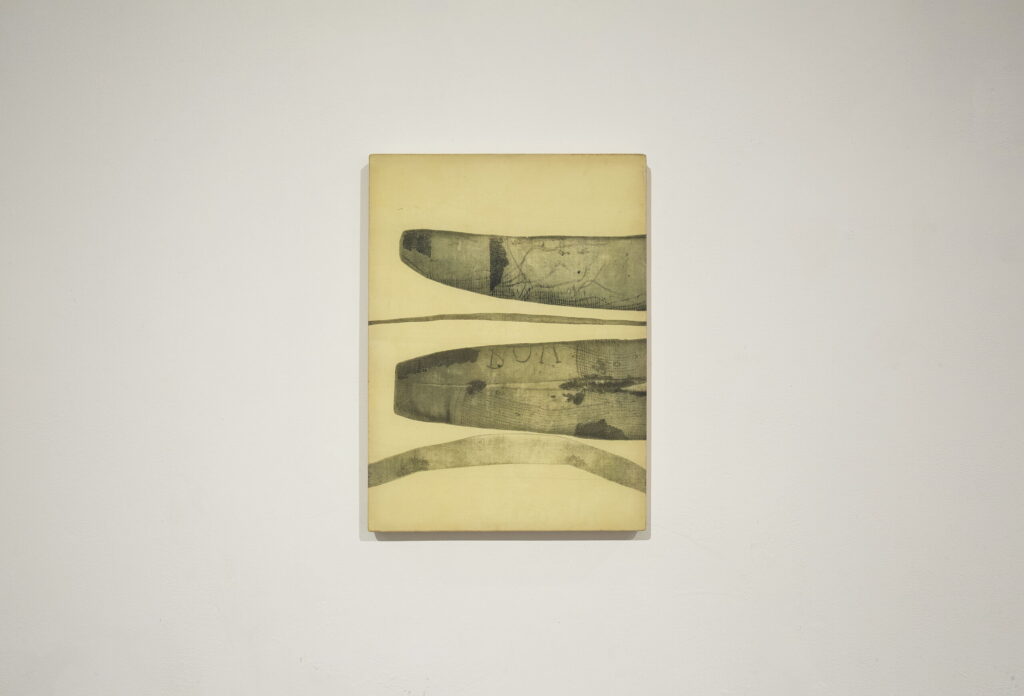
As curator Elisa Perissinotti observes, the inscriptions that fill the surfaces seem to echo “a word now devoid of sound.” The signs do not lead to a single translation, but suggest relationships of order, combination and opposition. It is precisely in this suspension that the alphabet evoked by the title takes shape: a system that is plausible and unreal at the same time, in which the forms keep the appearance of a linguistic structure while having lost any certain correspondence.
Wooden panels and grotesque masks
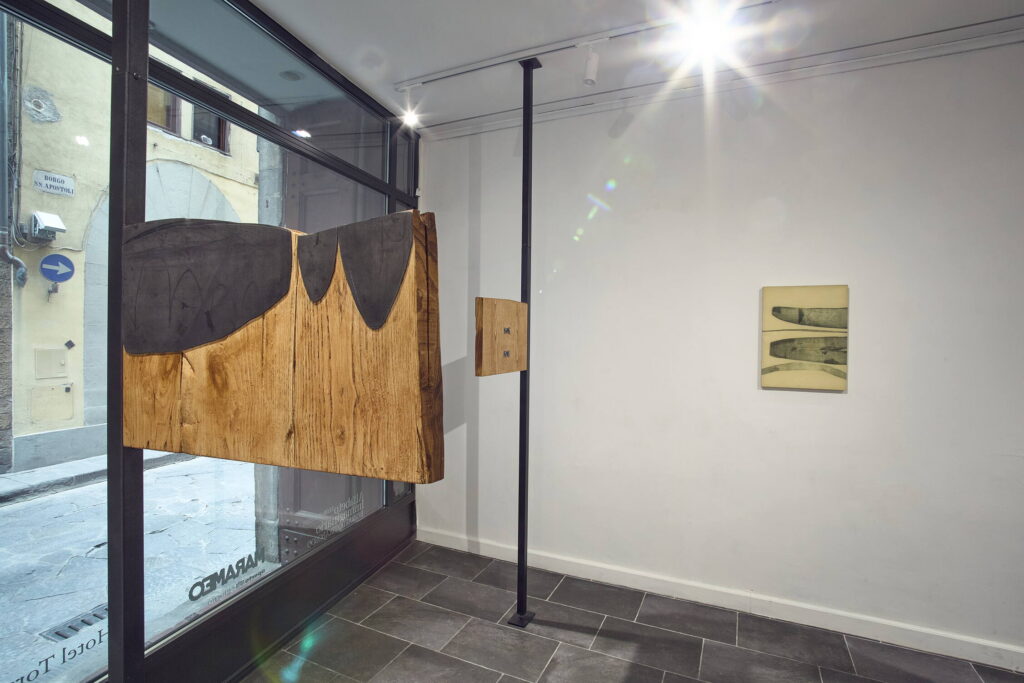
The difference between the supports pushes this tension further. In the five canvases, the impressions keep a fragile, two-dimensional quality; on the wooden panels, by contrast, the traces gain volume, turning into a landscape of reliefs and textures. On the back of the panels, small dovetail inserts also hold grotesque masks, figures of Renaissance descent stripped of their ornamental function. With their histrionic gazes, the faces take on an unsettling quality, as if they were relics from an unknown age.
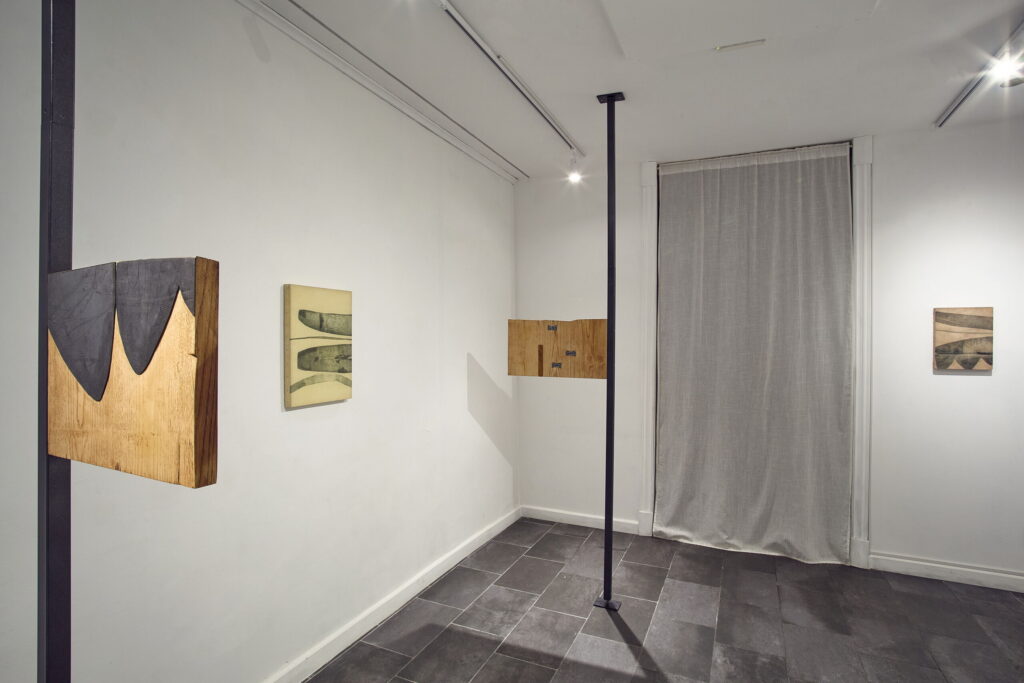
In Tirabosco’s practice, the choice of materials is never just a formal matter. Wax, soap, wood, iron and lead become the means to explore the tension between permanence and change, dissolution and re-emergence. The works take shape as layered bodies, able to hold on to the traces of a process and give them back in ever-new forms. In Alfabeto immaginario this research focuses on the relationship between image and writing, questioning whether a form can go on evoking a meaning even when its origin can no longer be recognized.
The catalog launch
A closer look at the project will come with the presentation of the exhibition catalog, scheduled for Saturday, November 21, at 6:00 p.m. at Spazio Marameo. Edited by the cultural association Eterotopie and Elisa Perissinotti, in collaboration with Osservatoriomaree, the volume gathers and documents the body of work Tirabosco produced for the Florence show. The limited edition will be hand-bound and come with an original print by the artist.
The event will also be a chance for an open conversation with Tirabosco, to delve into the processes and reflections that accompanied the making of the works. The catalog thus becomes part of the exhibition not only as a documentary tool, but as one more way to approach the artist’s research and the layers that define his language.