A New Edition of Orlando Furioso from the National Library of Florence
Florence and its National Central Library are a defining stop in the lives and careers of countless scholars — Roberto Rampone among them. During his university years in the Tuscan city, Rampone delved into the figure of Antonio Panizzi: the voice of a Carbonaro who had to flee the Duchy of Modena after it passed laws against the outlawed secret societies that had railed against the Duchy itself; the inventor of modern library cataloguing; a champion of the Copyright Act; a promoter of Italian culture abroad; the man who, having joined the British Museum Library as first assistant librarian, rose to become its Principal Librarian and, for his achievements, earned the title Prince of Librarians — as well as one of the very first Senators of the Kingdom of Italy.
Here begins Roberto Rampone’s bond with one of the most ambitious translation projects ever undertaken in Italy. Through his extraordinary work of translation and research, Rampone has given back to Italy a work fundamental both to chivalric literature and to the history of library science — a tangible example of how a passion for culture can become a contribution of inestimable value, one that unites past and present.
Orlando Furioso, from Antonio Panizzi to Roberto Rampone
Antonio Panizzi (1797–1879) was not only a pioneer of modern library science but also a keen scholar of Italian literature, with a particular interest in chivalric poems. His most monumental work — Orlando Innamorato di Bojardo; Orlando Furioso di Ariosto; with an Essay on the Romantic Narrative Poetry of the Italians; Memoirs and notes by Antonio Panizzi, published between 1830 and 1834 — is a tribute to Italian romance poetry.
In this remarkable nine-volume critical edition, Panizzi not only reproduces the complete texts of the two masterpieces but enriches them with an introductory essay on the birth of chivalric poetry, in-depth philological notes and erudite commentary that shed light on the historical and literary details of Boiardo’s and Ariosto’s works. Thanks to Roberto Rampone’s translation, this fundamental work is at last accessible to an Italian readership too, restoring Panizzi’s stature as a man of letters and the priceless value of the chivalric poems in the history of Italian literature.

Translating Antonio Panizzi’s work
Rampone has recently published two important works that illuminate Antonio Panizzi’s literary profile:
- Roberto Rampone, Antonio Panizzi letterato: fra Bojardo e Ariosto;
- Antonio Panizzi, Orlando Innamorato di Bojardo; Orlando Furioso di Ariosto; with an Essay on the Romantic Narrative Poetry of the Italians; Memoirs and notes by Antonio Panizzi. London: William Pickering, 1830–1834, 9 vols. Italian translation and edition by Roberto Rampone.
The latter is a monumental work in five volumes that, for the first time, renders in Italian the English edition prepared by Panizzi. The project is the first complete translation of the work, condensed from the nine volumes of the original English edition to the five of the Italian one.
The project’s origins date back to Rampone’s university years in Florence, when he proposed the translation to Professor Mauro Guerrini, one of Italy’s foremost scholars of library science. It was thanks to the professor’s support that a long, meticulous undertaking began — one aimed at bringing back to Italy a work born from the pen of an extraordinary Italian.
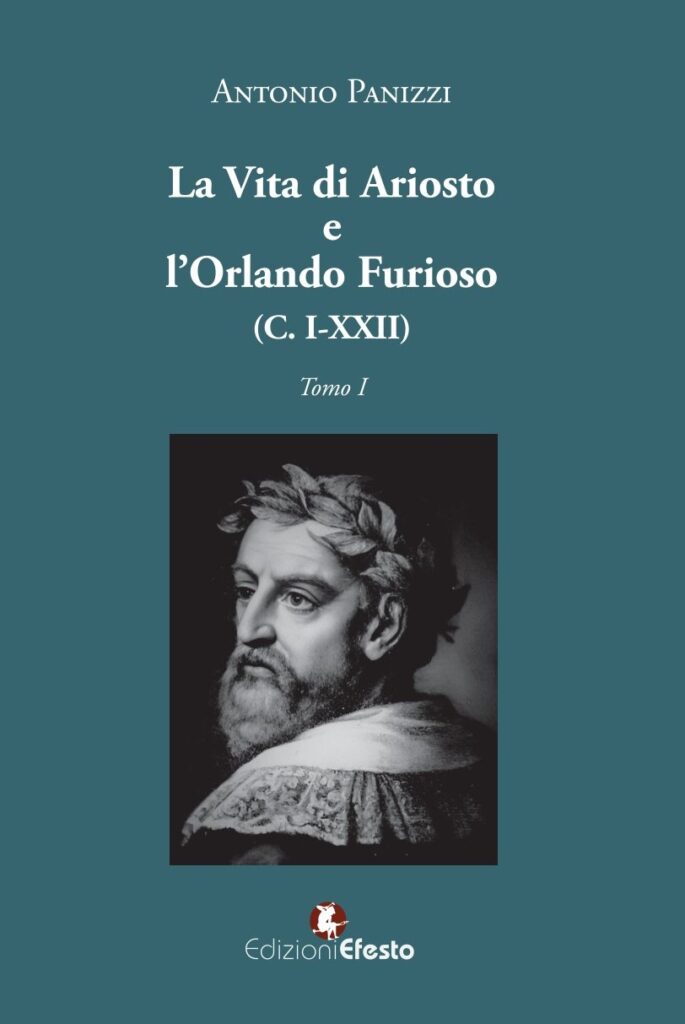
Panizzi’s London edition is a cornerstone of chivalric literature, bringing together Matteo Maria Boiardo’s Orlando Innamorato and Ludovico Ariosto’s Orlando Furioso — Ariosto’s epic, first published in 1516 and revised into its definitive form in 1532. In the volumes translated by Rampone, Panizzi’s work is rendered with philological precision and enriched by his extraordinary notes and commentary:
- Volume I: an introductory essay on the birth of romance poetry, which travels through the history of bards and court jesters and brings into focus the emergence of the chivalric epics;
- Volumes II–V: the Life of Boiardo and the complete publication of Orlando Innamorato;
- Volumes VI–IX: the Life of Ariosto and the complete publication of Orlando Furioso.
The cultural value of the project
The Italian translation is the fruit of nearly ten years of study and dedication. Rampone set out to give the Italian public back a fundamental part of its literary history, bringing to light the work of the “Prince of Librarians” — a figure central not only to library cataloguing but also to the promotion of Italian culture abroad. Begun during Rampone’s Florentine years, the translation is not only a homage to Panizzi but also a tribute to Italian culture and to Florence, the city that inspired its creation.
The author: Roberto Rampone
Roberto Rampone, born in 1991 in Oristano, is a concrete example of a passion for culture, literature and writing. His education began in his hometown, where he earned his diploma at the I.T.C. No. 2 “Sergio Atzeni,” in the “I.T.E.R. Turistico” tourism track, in 2010. His true calling later led him to the University of Florence, where he graduated first in Philosophy in 2017 and then in Archival and Library Sciences in 2021.

From childhood, Rampone nurtured a deep love of writing and music — passions that stayed with him over the years and led to his first publications with the E.P.D’O publishing house: Contemporaneità (2010), La Nostra Storia (2012) and Grazie a una Storia (2014). These three books gather nearly 200 poems spanning a wide range of everyday themes.
Today, Rampone continues to champion culture through cultural articles on the blog Benhouse Oristano, book reviews on Shardano Store — where he hosts the literary program Shardano culturale — and his collaboration with the Notiziario Librario di Arte e Cultura published by E.P.D’O.