ARNO: Roberto Ghezzi Lets the River Paint Itself
Sixty years after the Flood of 1966, ARNO – Stories of Reconciliation between Florence and Its River turns the river into the author of a collective, ever-evolving work. While artist Roberto Ghezzi’s canvases still lie submerged in the Arno, contemporary art and scientific research come together to build a new story of the bond between Florence and its river.
Sixty years have passed since the Flood of Florence on November 4, 1966, when the Arno broke its banks and swallowed the city. In a matter of hours the historic center was overrun with water and mud: museums, libraries, churches, workshops, and homes suffered incalculable damage, while thousands of artworks and books came close to being lost. The images of the “mud angels” — who arrived from every corner of the world to help rescue the city’s heritage — became the symbol of a tragedy that still holds a central place in the city’s collective memory.
Sixty years on, that same river returns to the center of a reflection that looks to the past without stopping at commemoration. The Arno is no longer merely the protagonist of one of the most painful pages in Florence’s history, but becomes an interlocutor, a living archive, even an author. The project ARNO – Stories of Reconciliation between Florence and Its River, conceived by artist Roberto Ghezzi, springs precisely from this reversal of perspective: letting the river tell its own story, and letting the traces of its matter build a narrative that can speak even to those who did not live through 1966.

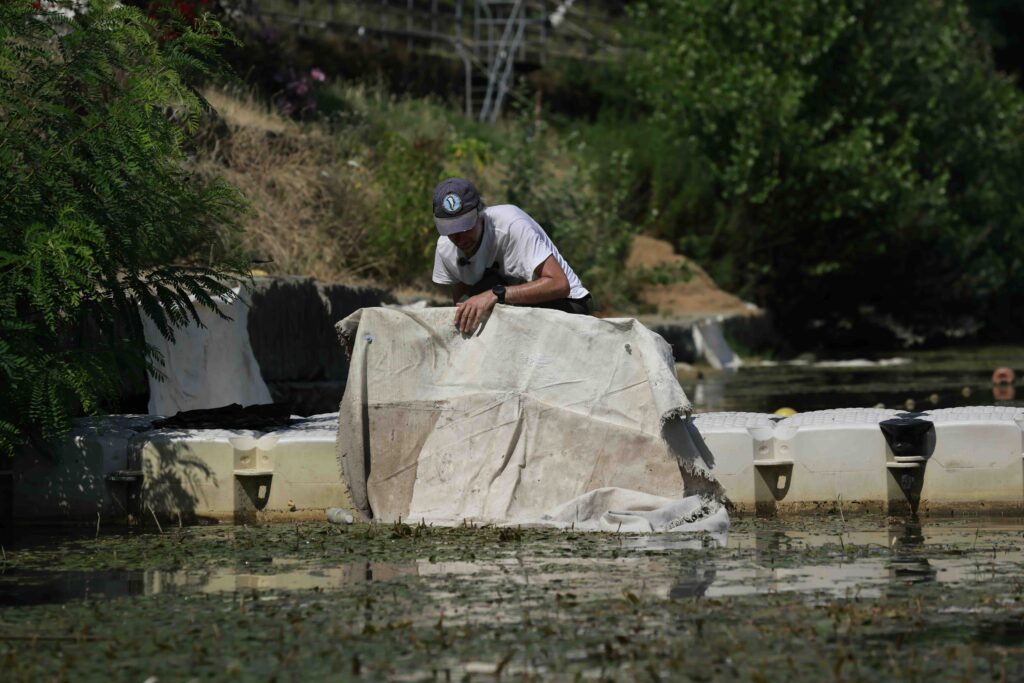
For about a month now, a series of canvases has been submerged in the waters of the Arno, off the ASD Canottieri Comunali Firenze on Lungarno Francesco Ferrucci, slowly transforming. Unlike a traditional painting, here it isn’t the artist’s hand that builds the image. It’s time, the currents, the sediments, the microorganisms, the algae, and everything the river carries that acts on the surface of the fabric. The work is still ongoing, and the outcome remains unknown (for a little while longer): the piece is taking shape in these very weeks.
This practice is called Naturografia, a term coined by Ghezzi to describe a body of research developed over more than twenty years in some of the planet’s most extreme ecosystems — from Greenland to Patagonia, from the Svalbard Islands to Mongolia. The canvases, made of linen and cotton and prepared with environmentally compatible materials, are entrusted to natural processes with no attempt to control their outcome. The landscape thus stops being the object of representation and becomes the true author of the work.
In the case of the Arno, this research takes on a deeply symbolic meaning. The same river that sixty years ago left the mark of mud on the city today deposits a different memory onto the canvases. Sediments, organic materials, and invisible traces build images that do not illustrate the landscape but are a direct manifestation of it. It is a gesture of reconciliation that does not erase the historical trauma, but transforms it into an occasion for listening and understanding.
As Roberto Ghezzi puts it, the wish is to let the river give back its own memory and identity, without imposing a predetermined aesthetic result. The beauty of the Naturografie lies precisely in their unpredictability, in the willingness to hand creation over to the action of time and nature.
Art and scientific research
Alongside the artistic dimension, an important strand of scientific research also unfolds. When the canvases are recovered, between September and October, they will be analyzed by the National Research Council (CNR), the Department of Earth Sciences at the University of Florence, and the Department of Conservation and Restoration of Cultural Heritage at the University of Tuscia. The sediments, microfibers, and materials deposited on the surfaces will become objects of study, offering new information on the Arno’s ecosystem and documenting the river’s environmental changes.
Art and science thus travel the same path. The Naturografie are not only works to contemplate, but instruments of observation capable of putting different languages into dialogue and suggesting new ways of reading the landscape, biodiversity, and the relationship between humankind and the environment.
The final exhibition
The project will culminate in the widespread exhibition ARNO – Stories of Reconciliation between Florence and Its River, scheduled from November 4, 2026 to January 4, 2027, marking the sixtieth anniversary of the Flood. The main core of the show will be hosted by the MAD Murate Art District, curated by artistic director Valentina Gensini, where the Naturografie will be presented together with the project’s photographic and audiovisual documentation and the results of the scientific research. Among the venues already confirmed is the Church of San Salvatore in Ognissanti, while other sites across the city, symbolically tied to the memory of the flood, will be announced in the coming months.
Conceived by Roberto Ghezzi, coordinated by gallerist Niccolò Mannini, and organized by project manager Debora Daddi, the project offers a reflection that goes beyond a simple historical anniversary. Sixty years after the Flood, it does not limit itself to recalling what the Arno took from the city, but invites us to observe what the river can still generate. Today, as the canvases quietly continue their process beneath the surface of the water, Florence waits to see what image will emerge from this long dialogue between nature, memory, and time. An image that will not be a portrait of the Arno — it will be the Arno itself that made it.
The artist: Roberto Ghezzi
Roberto Ghezzi (Cortona, 1978) trained in his family’s sculpture studio and later at the Accademia di Belle Arti in Florence. Active since the late 1990s, he has developed a body of research centered on the relationship between art, the natural landscape, and environmental processes.
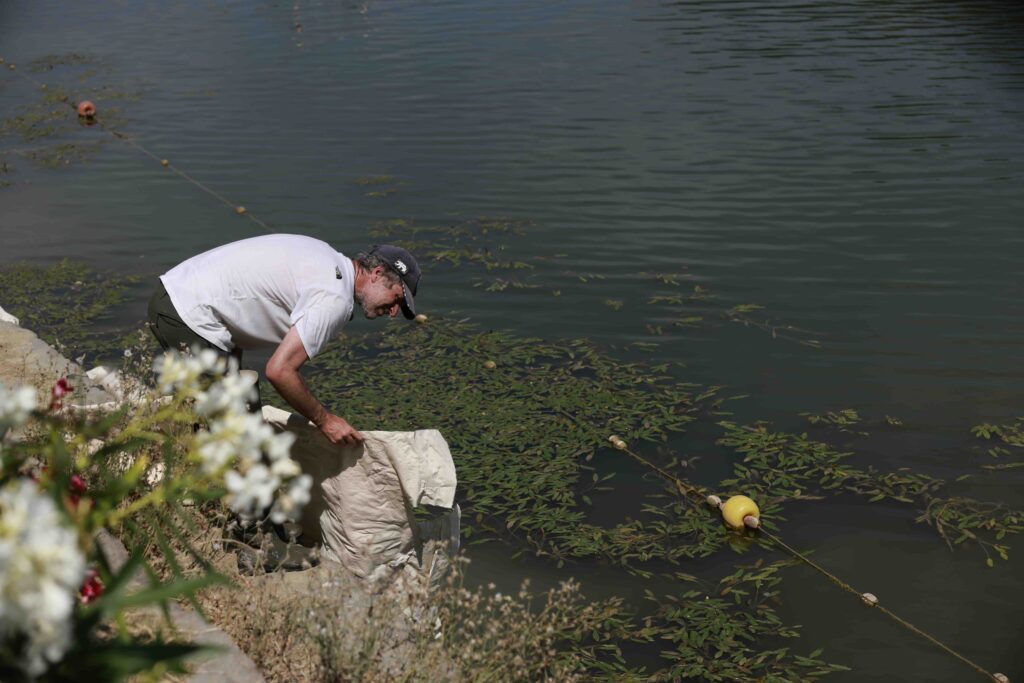
In the early 2000s he launched the Naturografie© project, an artistic practice that turns natural elements into the authors of the work. By submerging supports prepared by the artist in terrestrial and aquatic ecosystems, it is time, sediments, microorganisms, and the elements that determine the final visual result.
His research, which brings contemporary art into dialogue with scientific observation, has developed in natural settings all over the world — from Alaska to Patagonia, from Greenland to Tunisia, all the way to the Svalbard Islands and Cambodia. He has taken part in numerous international exhibitions and residencies, including the Italian Pavilion at the 19th Venice Architecture Biennale, the National Gallery of Modern and Contemporary Art in Rome, the Museum of Contemporary Art of Skopje, the Italian Cultural Institutes of Oslo and Copenhagen, and the End of the World Museum in Ushuaia.