Collodi Beyond Pinocchio: A Florence Exhibition Reveals the Man Behind the World’s Most Famous Puppet
Everyone knows Pinocchio. The lies, the nose that grows, the Cat and the Fox, the Talking Cricket, and that longing to finally become a real boy. Far less familiar is the story of the man who invented him: Carlo Lorenzini, a journalist, satirist, and sharp observer of the political and social contradictions of 19th-century Florence.
Two hundred years after his birth, the Gabinetto Scientifico Letterario G.P. Vieusseux, Florence’s historic library and literary institute, is dedicating an exhibition to him: “C’era una volta… Un Re! Carlo Lorenzini detto ‘Collodi’ tra satira, giornalismo e letteratura per l’infanzia” (roughly, “Once upon a time… a King! Carlo Lorenzini, known as ‘Collodi,’ between satire, journalism, and children’s literature”), housed in the Archivio Contemporaneo Alessandro Bonsanti at Palazzo Corsini Suarez, via Maggio 42, in Florence.
Open from October 16, 2026, to June 15, 2027, and curated by Elisa Martini and Benedetta Gallerini, the show brings together original documents, period newspapers, first editions, and works of art to trace the path that led Lorenzini to create one of the most famous characters in world literature.
Above all, it invites visitors to discover how much of the Florence of his day lies hidden behind the puppet’s adventures.
Before Pinocchio, there was Carlo Lorenzini, journalist and satirist
Before he turned to children’s literature, Carlo Lorenzini was known for his journalism and for writing that turned an ironic eye on politics and social mores.
He wrote for papers such as Il Lampione, Lo Scaramuccia, and Il Fanfulla, chronicling the tensions and transformations of Italy during the Risorgimento, the movement that unified the country.
The exhibition brings this side of his life back into view, and it is essential for understanding how Pinocchio came to be.
Behind the puppet’s adventures, in fact, you can recognize many of the themes that ran through Lorenzini’s articles: a distrust of swindlers, a critique of empty promises, the relationship with authority, the value of education, and the contradictions of a society undergoing sweeping change.
Among the documents on display is a particularly telling trace of the writer’s bond with Florence: Carlo Lorenzini’s autograph signature in the Vieusseux members’ register, dated June 30, 1865.
That year, Florence had just become the capital of the Kingdom of Italy. The Vieusseux was one of the city’s main places for reading, debate, and encounters in its intellectual life.
A name written in a register, then, speaks of a direct link between Collodi and one of the most important cultural circles of 19th-century Florence.
The 1883 first edition of Pinocchio, kept at a school in Sesto Fiorentino
Among the most precious pieces in the exhibition is the first edition of The Adventures of Pinocchio, published in Florence by Paggi in 1883.
What makes it even more remarkable is where it comes from: the volume is on loan from the library of the Cavalcanti middle school in Sesto Fiorentino, which looks after a genuine treasure of Italian publishing history.
Alongside the first edition, visitors can also see the 1881 Giornale per i bambini, a children’s weekly, lent by the Fondazione Spadolini.
It was in the pages of this very publication that Pinocchio first appeared, on July 7, 1881.
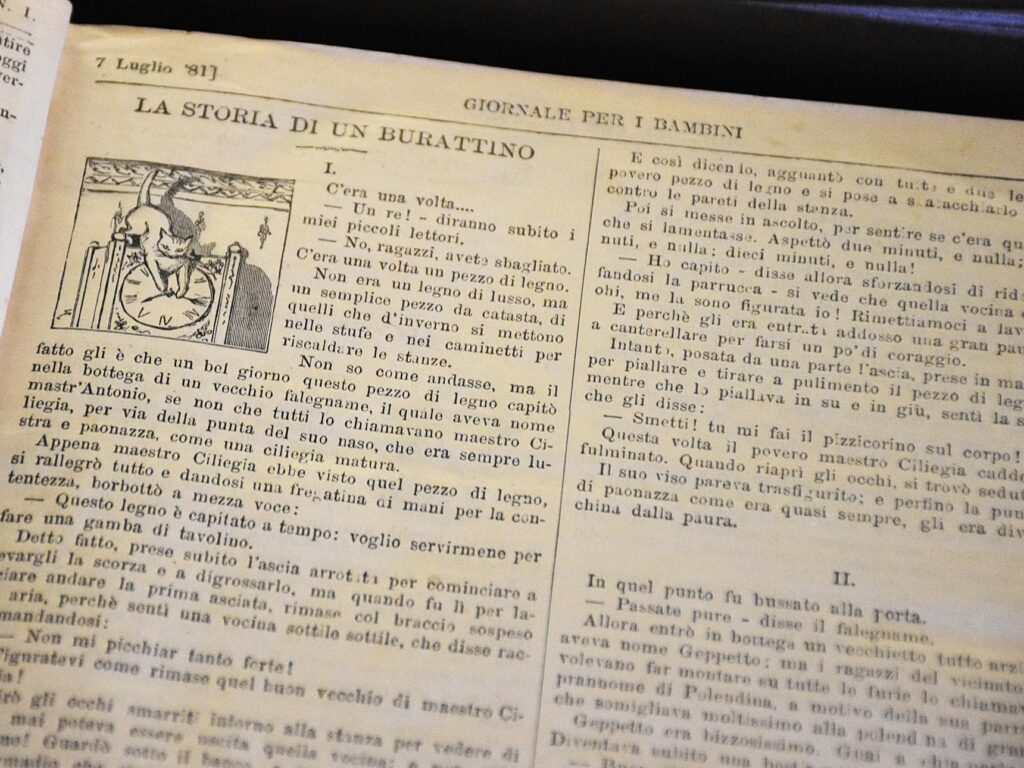
His adventures were first published in installments, with pauses and restarts, until January 1883. Only afterward was the story gathered into a book that would go on to win over generations of readers.
It’s a publishing journey that may seem surprising today, given how familiar the character has become in the collective imagination.
The books that survived the 1966 Florence flood
The exhibition is also a chance to tell an important chapter in the history of Florence’s cultural heritage.
During the 1966 flood, the Gabinetto Vieusseux suffered severe damage to its book collections. Many volumes were swamped by the water and later went through long restoration work.
Among the Collodi-related books that survived the disaster is the first English edition of Pinocchio, published in 1892, proof of how quickly the work spread around the world.
Especially meaningful is a copy of I racconti delle fate, Charles Perrault’s fairy tales, translated by Carlo Lorenzini.
Damaged by the flood and later recovered, the volume still bears the marks of the water.
It offers a close-up look at what the flood did to books, and at the work carried out to save a vital part of the city’s cultural memory.
Pinocchio in art: Vinicio Berti and Venturino Venturi
Pinocchio’s success quickly spilled beyond literature, conquering film, theater, and the visual arts.
Part of the exhibition is devoted precisely to artists’ interpretations of the character.
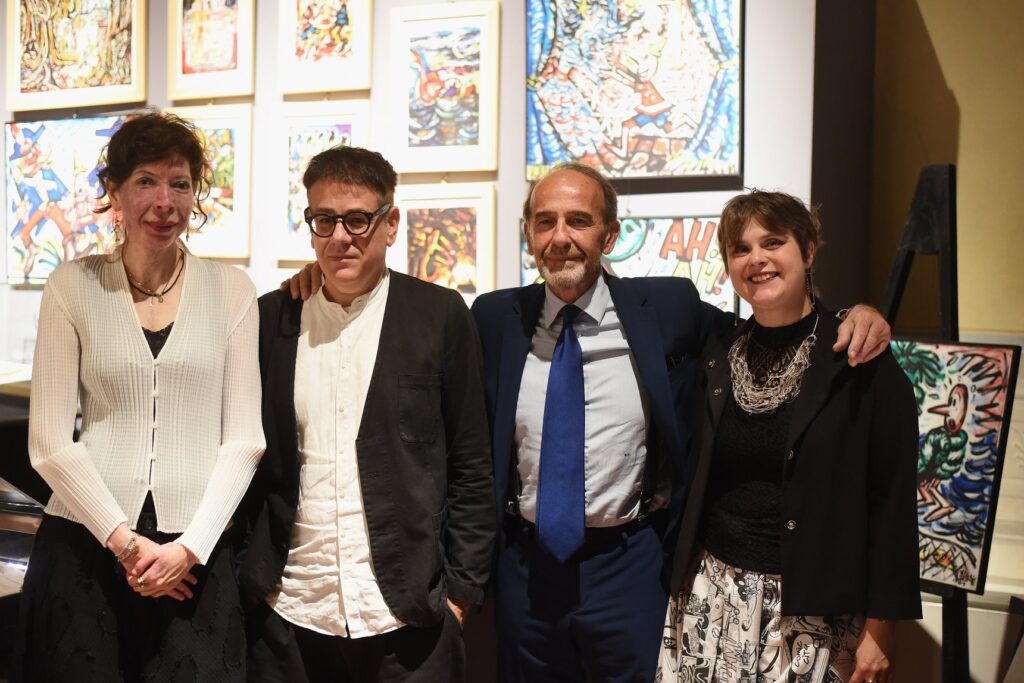
Of particular interest is the group of works from the Archivio Vinicio Berti: lithographs, oil paintings, and commentary the artist created for a 1981 edition of Pinocchio, shown in an exhibition for the first time.
It’s a chance to see how one of the leading figures of 20th-century Italian art reimagined the famous puppet in his own visual language.
The show also includes an iron sculpture by Venturino Venturi depicting Pinocchio, conceived as a preparatory study for the statue he later made for the Parco di Collodi, the Pinocchio park in the Tuscan village of Collodi.
Two testaments to the character’s power to keep inspiring artists and new readings, well beyond the pages of the novel.
When Pinocchio already had sequels
Another curious chapter of the exhibition concerns the so-called Pinocchiate, the unofficial Pinocchio spin-offs.
In the decades after the novel came out, the puppet’s success prompted many writers to invent new adventures, continuations, and parallel stories.
Today we would call it a matter of sequels and spin-offs, but the phenomenon has its roots in late 19th-century literature.
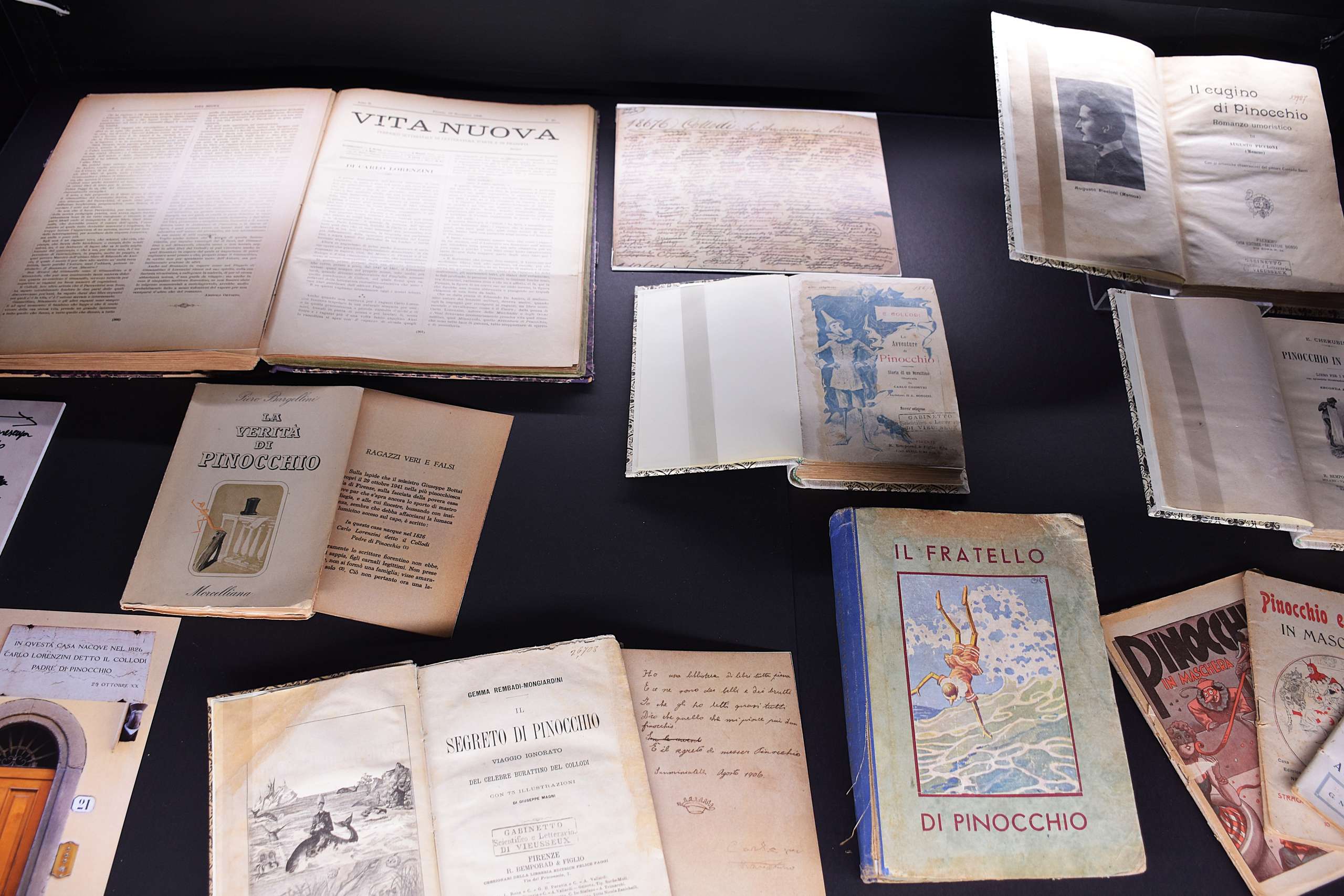
The titles featured include Il segreto di Pinocchio (Pinocchio’s Secret) by Gemma Mongiardini Rembaldi, Il cugino di Pinocchio (Pinocchio’s Cousin) by Momus, the pen name of Augusto Piccioni, and Pinocchio in Affrica (Pinocchio in Africa) by Eugenio Cherubini.
For the bicentennial, the Gabinetto Vieusseux has announced a facsimile reprint of these three little-known works.
It’s a choice that brings back into view a publishing phenomenon that, in some ways, anticipated how the most popular characters still live on today through new stories and reinterpretations.
Why Collodi is worth rediscovering today
The Vieusseux exhibition has one particular merit: it reminds us that Pinocchio was born from the sensibility of an author deeply immersed in his own time.
His adventures speak of lies, deceit, desire, poverty, education, and responsibility. These themes belonged to 19th-century Italy, yet they remain recognizable in today’s society.
The Cat and the Fox, with their promises of easy money, are hardly strangers to anyone living in the age of online scams and get-rich-quick schemes.
But the exhibition also tells us something about Florence: its years as capital, the liveliness of its satirical press, the role of its intellectual circles, and the relationship between literature and city life.
Visiting this exhibition means going back to the origins of a story we all think we know, and discovering that behind that wooden puppet stood a writer far more complex, ironic, and surprising than we remember.
Collodi exhibition in Florence: dates, venue, and booking
Title: “C’era una volta… Un Re! Carlo Lorenzini detto ‘Collodi’ tra satira, giornalismo e letteratura per l’infanzia”
When: October 16, 2026, to June 15, 2027.
Where: Archivio Contemporaneo Alessandro Bonsanti – Gabinetto Vieusseux, Palazzo Corsini Suarez, via Maggio 42, Florence.
Curators: Elisa Martini and Benedetta Gallerini.
Visits: Thursday afternoons at 3:00 p.m., by guided tour only.
Booking required: prenotazioni@vieusseux.it.
Information: Gabinetto Vieusseux.