The Lost Cinemas of Florence
It is the autumn of 1894. In what was then called Piazza Vittorio Emanuele — today’s Piazza della Repubblica — an anonymous photo-technician from the Istituto Geografico Militare is wandering from shop to shop. The square is brand new, the product of the Risanamento that changed the face of Florence for good. At its center stands the already much-derided equestrian statue of the king, “Emanuele a corpo sciolto” (as Vamba quipped). A little farther on, framing the whole perimeter with a bourgeois and rather cloyingly cosmopolitan taste, rise those grand buildings that still overlook it today — the “eyesores” that Telemaco Signorini could never stomach. The man steps into a shop and takes an interest in a mysterious contraption: the curious Kinetoscope, patented a few years earlier by Thomas Alva Edison. He tries to strike up a conversation with the shopkeeper, asking how the device works. Met with a firm refusal, he refuses to give up. On the contrary: he goes home and begins to work out a project of his own. Filoteo Alberini, for his part, is no stranger to such undertakings. And so, within a few months, his “kinetograph” is ready. Submitted for the judgment of the Lumière brothers themselves, the project will run into a series of fatal bureaucratic delays. Alberini will have to wait more than a year before the Ministry of Industry and Commerce grants him the patent. In the meantime, the Lumière brothers will already have staged the first cycle of film projections in history: the legendary show, before an audience of just thirty-three people, held at the Salon indien du Grand Café in Paris on December 28, 1895. The bond between Florence and the Seventh Art, as it happens, begins right here: with a dispute over who invented what, against the backdrop of a city in sudden and seemingly unstoppable change. And it is surely no accident that Europe’s first true cinema was born here, in this same square that set the scene for Alberini’s discovery.
Lumière, the Sala Edison and the Gambrinus
It is 1899, in fact, when Alberini opens his Reale Cinematografo Lumière, soon eclipsed — the very next year — by Remondini’s Sala Edison. The brief life of Florence’s oldest cinema almost seems to foreshadow what is to come, like a warning. And here we are, well over a century after the closure of Alberini’s hall, taking stock. Imagine following a melancholy Via Crucis, divided into ten stations, along the symbolic route of an entirely Florentine saga. Starting right in Piazza della Repubblica, a stone’s throw from where the new Giunti bookshop recently opened inside the Odeon, stands a building with a long history on its shoulders. At Via de’ Brunelleschi 1, on the corner of Via del Campidoglio and Via de’ Vecchietti, stands the building that for a long time housed the Cinema Centrale Gambrinus. Under the arcades of the Palazzo dell’Arcone di Piazza, back in 1894, Filoteo Alberini himself could have stopped for a drink at the celebrated Caffè Gambrinus Halle — which in 1922 would become a projection hall with some eighteen hundred seats. Refurbished in 1948 and gutted by a fire in 1950, the Gambrinus was then restored, surviving virtually unchanged until 2007. Since then, after the cinema closed for good, the building became the subject of a plan by Carlo Carbone and the Studio Architettura Acustica, who in 2011 turned it into the Florence outpost of the famous Hard Rock Cafe.
Cinema Capitol
Crossing the great square and turning into Via Calimala, you soon reach Piazza della Signoria, and from there, in a matter of moments, the Loggia del Grano. The elegant building, nineteenth-century in design, was raised in 1868 to house a theater. Bought in the early twentieth century by the actor Tommaso Salvini, it would go through several transformations: first into the Folies Bergère concert hall (1910), then into the Imperiale variety cinema (1935). After a major reconstruction, in 1957 it reopened its doors as the Cinema Capitol. Having survived three decades of Florentine life and as many urban master plans, the Capitol then faded into a sad decade of abandonment before being bought by a company of the Benetton Group and morphing into a shopping-and-leisure complex. The cinema’s spaces, left largely empty, were recently reborn as a Coin department store (December 2022). Crossing the Arno at the Ponte Vecchio, meanwhile, you reach an area that feels especially emblematic of the city’s architectural fortunes over the twentieth century. The first buildings that fill our gaze, as soon as we land in the Oltrarno, are the fruit of a highly controversial series of postwar interventions, meant to heal a district badly hit by Allied bombing. Faced with an almost limitless range of possibilities, the choice at the time was compromise: to safeguard and enhance, yes, but also to speculate on the urgent need for new commercial spaces. And so, in a jumble of high-density buildings of dubious architectural merit, rose the Via de’ Guicciardini we know today.
The Arlecchino, the adults-only cinema
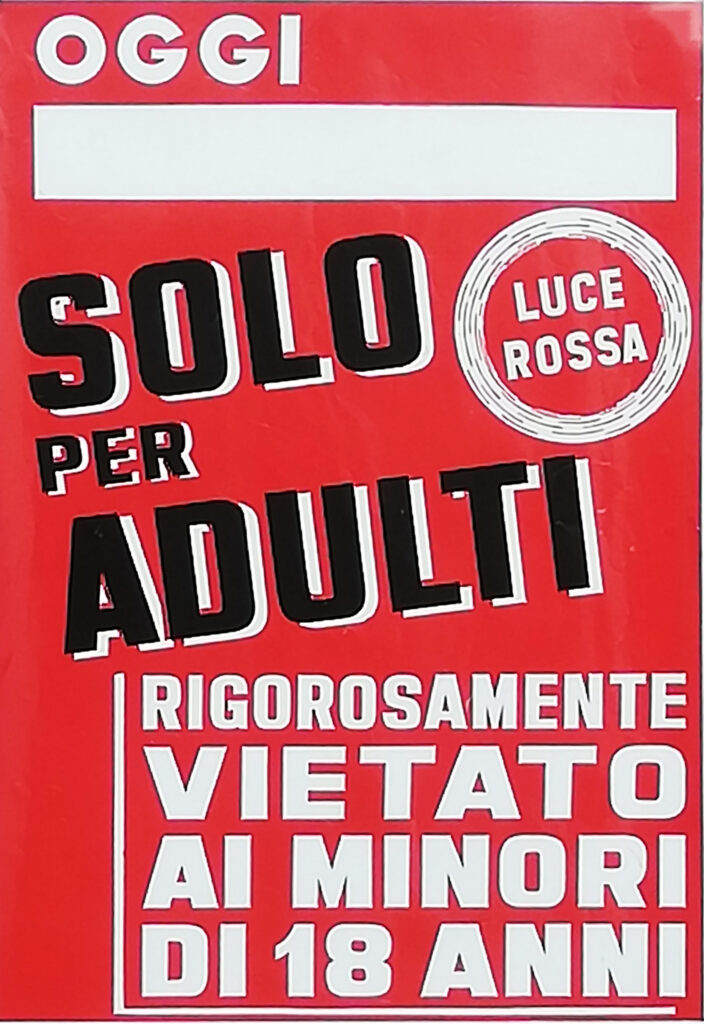
And on a street running perpendicular to it, Via de’ Bardi, there was once a much-loved adult cinema. The Arlecchino was born in 1959, amid the same architectural climate just described, and carved out a special place in the memory of many Florentines. The building that housed it — turned into a Conad “Sapori e Dintorni” store in 2010 — is considered an interesting blend of commercial needs and design.
Cinema Eolo
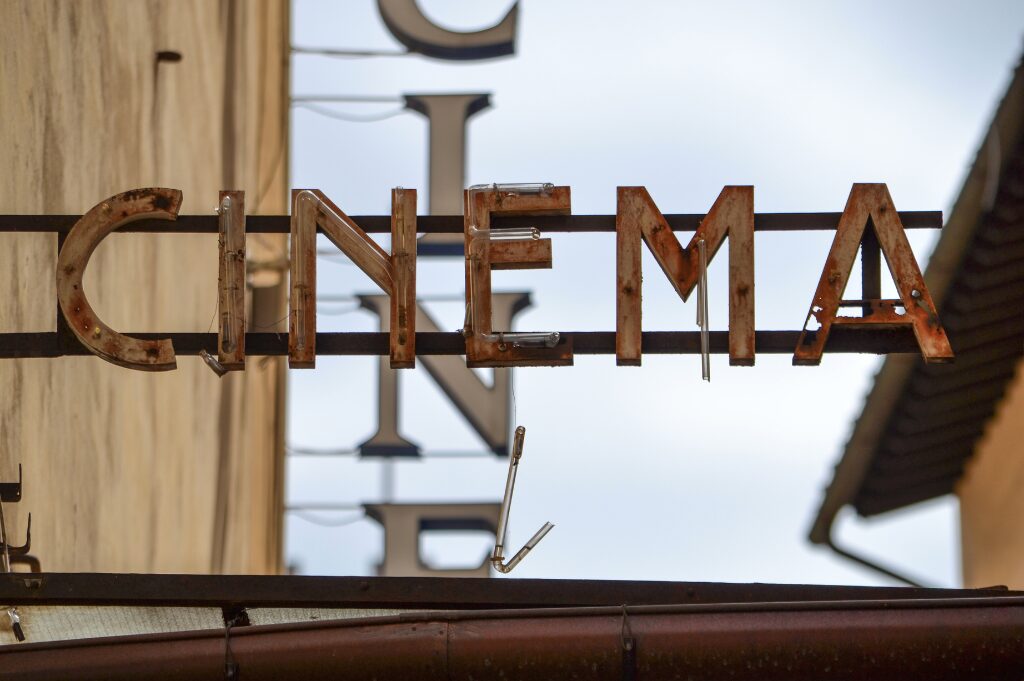
Once on this side of the river, in any case, you need not walk far before stumbling on more cinematic relics. Quite the opposite: just head straight along Borgo San Jacopo, waiting for it to flow into Via Santo Spirito and then Borgo San Frediano. Here, within a few dozen meters, we find the remains of two halls dearly loved by the neighborhood. The first we come to is the former Cinema Eolo, built in the 1950s by the architect Bruno Sacchi and the city’s first two-screen cinema. It too slid into abandonment and, sadly, enjoyed a brief season as a bingo hall before closing for good. Even walking past it today, you can’t help feeling faintly bitter at the dismal sight of its name still printed on the facade’s peeling paint. Set in one of Florence’s most sought-after areas, the complex is likely destined to become a thirty-five-room hotel, complete with a restaurant and a prestigious rooftop spa (at least according to the renderings of a few architecture firms said to be working on it).
Cinema Universale
Past Porta San Frediano and onto Via Pisana, however, you catch sight of the unmistakable silhouette of the Cinema Universale: a fleeting vision, though, because you need only draw closer to realize that nothing remains of the cinema but all the legends that keep its memory alive. People tell all sorts of stories about the Universale. Born in the second postwar period and evolving over time into a hub of gathering, sociability, humor and politics, it sits at the heart of a dense body of anecdote whose spell many Florentines keep feeding. They say you could ride in on your Vespa, that films were chosen by a show of hands from the audience, and that all of Tuscany’s most delicate wit was on constant display there. That idyll of rowdy heckling — abburracciugagnene, as the locals put it — and joints came crashing down in 1989, when the cinema closed for good. Reopened in 2000 as a nightclub, it shut its doors again after just seven years, amid quarrels and grudges of every kind. Today the former Universale is nothing more than an anonymous residential apartment block.
The Aldebaran and the Fulgor
From Via Pisana, across the Ponte alla Vittoria, you return to the other bank of the Arno and to more fossils. From Porta al Prato a fork opens up: turn left and reach Via Baracca, where the Aldebaran once stood? Or turn right, along Via Il Prato, until you hit the Fulgor on Via Maso Finiguerra and the Ariston in Piazza degli Ottaviani? Telling all three in a few lines isn’t easy, but it’s certainly worth a try. The Aldebaran, at the corner of Via Clementi, today simply no longer exists. After a glorious run as a porn cinema, it closed in 2007 and was demolished shortly after. In its place now stands a residential complex of forty-two apartments. Back toward the center, meanwhile, you reach two old keepsakes: first the Cinema Fulgor, which pulled down its shutters back in 2016. Its situation is a particularly delicate one, given the administrative limbo the building became tangled in. Following the arrest of Massimo Ferrero — former president of Sampdoria — for corporate crimes and bankruptcy, the tug-of-war between the owners and the city council went through long stretches of stalemate. Recently the former Fulgor was floated as a possible site for the Florence mosque, after the closure of the historic one on Borgo Allegri. That use — not entirely incompatible with the planning constraints requiring 60% of the old cinema function to be preserved — nonetheless remained purely hypothetical.

The Cinema Ariston, now a railway museum
Today, strolling along Via Maso Finiguerra, you see nothing but an old, crumbling building whose facade still bears a laconic sign reading Chiuso per ferie — “Closed for the holidays.” The story of the Cinema Ariston, a few meters away, is a very different one. Born in 1938 as the Cinema Trionfale, then the Ottaviani (1946) and finally the Ariston (1953), it fell into decline in the 1990s, when Vittorio Cecchi Gori acquired it along with the Eolo already mentioned. The Ariston’s crisis is, in fact, almost a mirror of its twin’s: after closing for good (2000), it too enjoyed a brief spell as a bingo hall. Bought by the Marquis Giuseppe di San Giuliano for more than five million euros, it reopened in 2022 as HZERO, the museum of trains and model railways, home to one of the largest layouts in Europe (a good three hundred square meters of tracks, stations and miniature cities…). Past Piazza Santa Maria Novella and the station, we come to the final stops on this route. Loud, lively, traffic-choked Via Nazionale conceals within it two more historic, disused cinemas. The first, almost infamous, is the erotic Cinema Italia, bought along with the Arlecchino by Conad and likewise turned into a Sapori e Dintorni store (2010). Since adult cinemas were not bound to preserve a cultural use, it closed after a string of troubles (including a 2007 investigation into a shady male-prostitution ring operating inside).
The Cinema Apollo, formerly the Rex, formerly the Politeama
A few steps more and we reach the last stop of the tour. It was 1864 when, in a Florence still becoming the capital of Italy, the Politeama was built, an open-air theater “made up of benches and canvases set in the middle of a pleasant, almost improvised garden” (La Nazione, July 10, 1864). Demolished in 1936, it was transformed into the Cinema Rex, to a design by the great modernist architect Nello Baroni, before being renamed the Apollo in the immediate postwar years (we told you about it in a dedicated piece here). Badly damaged by the flood of ’66, the Cinema Apollo was then restored by Italo Gamberini, only to enjoy a brief moment of glory in 1986. That year, with the Teatro Verdi closed for maintenance work, the Apollo stood in for it, hosting over a few months the most varied array of artists, including concerts by Tina Turner, Kraftwerk and Gianni Morandi. That fleeting “shot of life” was cut short by a storm that tore off the roof, beginning a decline that ended in closure and, in 2009, in the demolition of every unlisted element and the reopening as the Hotel Mercure (2015). That storm, in hindsight, seems to join the list of dark omens that hang forever over Florence’s cinemas — ever since the birth of Alberini’s very first hall.