Two New Shows at Centro Pecci in Prato: Rotte and Carnale
Between collecting and photography, “ROTTE” and “CARNALE” tell the art and society of the late twentieth century. From May 31, 2026, the Centro Pecci for Contemporary Art in Prato opens two new exhibitions, running through August and through November respectively. The first is ROTTE – Arte di rottura dalla donazione Carlo Palli (“Routes / Ruptures — Breakaway Art from the Carlo Palli Donation”), an introduction to the many-sided collection of the celebrated Prato art dealer. The second is Verita Monselles: CARNALE (“Carnal”), which brings the public face to face with the creative, human legacy of an artist too often forgotten.
The timing of the two shows is no accident. In both cases they close a symbolic circle exactly two decades long: 2005 saw both Carlo Palli’s first major bequest (b. 1938) and the last important Italian exhibition on Verita Monselles (1929–2004). By pairing the histrionic taste of a seasoned collector with the photography and video installations of a volcanic, controversial artist, the curators set every work in dialogue — with each other and with the permanent collection — leaving the visitor with an organic sense of wonder, creative conversation and cosmopolitan suggestion.
“Rotte”: the Carlo Palli collection
Before we get to what’s inside the two shows, it’s worth recalling the protagonists who made them possible. Carlo Palli — a Prato entrepreneur and collector — has a sixty-year career behind him: he ran important galleries (among them the historic spaces at Lido degli Estensi and Roccaraso), took over Prato’s Galleria Metastasio in 1979, worked for years with Farsetti Arte, and directed the modern and contemporary art department at Finarte in Venice.
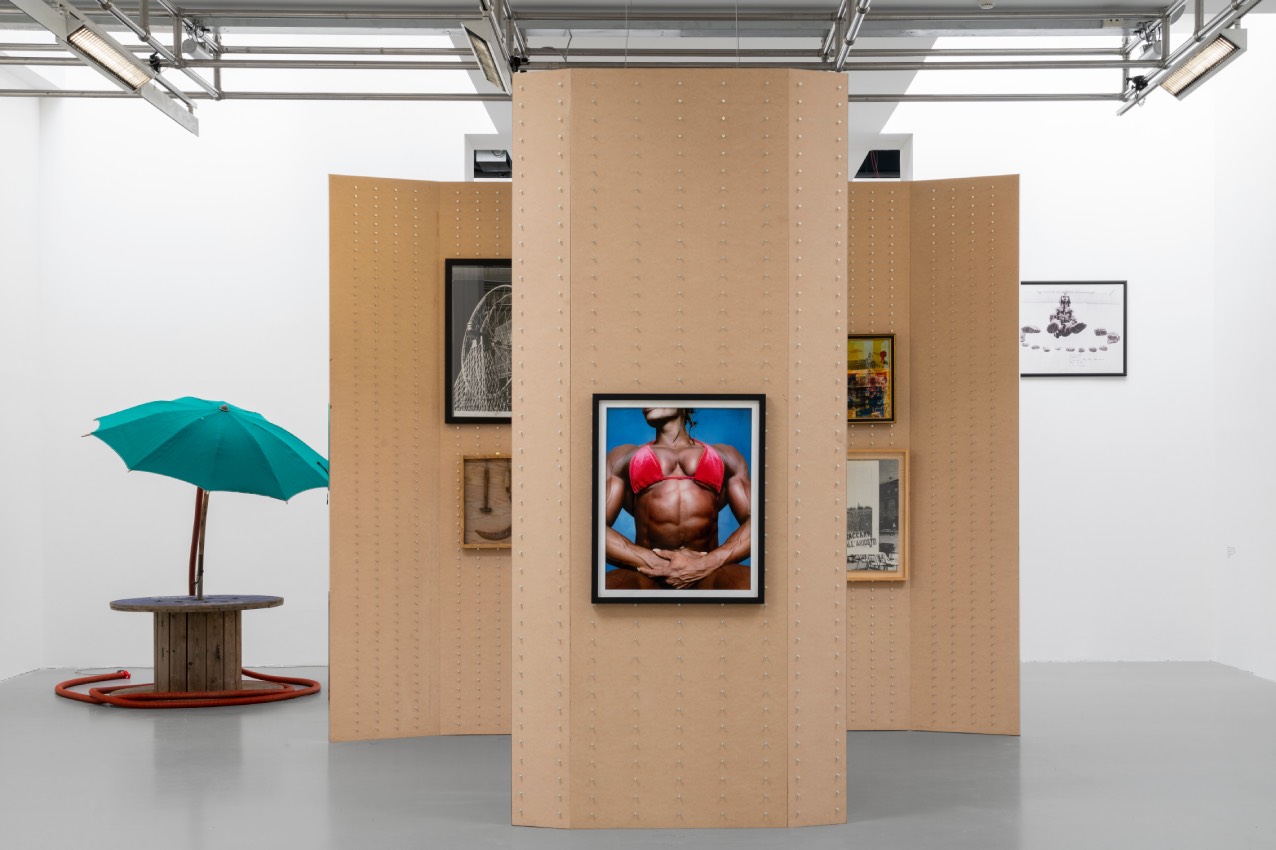
“ROTTE” is curated by Stefano Pezzato, head of the Centro Pecci’s collection and archives, with an exhibition design by Ibrahim Kombarji. It offers a path chosen from 180 works from Carlo Palli’s private collection, 380 works and documents from his personal Fluxus collection, and 230 works of Visual Poetry and its surroundings — the sum of all the collector’s donations to the Centro Pecci over the past twenty years. For the occasion, nine large rooms of the original museum, designed by architect Italo Gamberini, trace the “routes” the collector loved best, steering above all toward art that breaks with the rules: the poetic-visual revolution of Gruppo 70; bodies, icons and actions that embody the Neo-avant-gardes; work built on creative process and text; painting and its more recent variations; the interdisciplinary, playful attitude of Fluxus; objects reimagined by Nouveau Réalisme and environments reworked by the Radicals — plus figures such as the father of Actionism Hermann Nitsch, the inventor of Eat Art Daniel Spoerri, the “writer” of paintings and objects Ben Vautier, the poet and performer Ketty La Rocca, the avant-garde musician and composer Giuseppe Chiari, and the “erasing” poet Emilio Isgrò, to name only a few.
“Carnale”: the artistic legacy of Verita Monselles
Verita Monselles, on the other hand, was born in Buenos Aires but arrived in Tuscany back in the 1930s. Not yet fifteen, she would run away from boarding school and go underground with the partisans. It was the start of a wandering, never-ordinary life that would carry her to Livorno, Naples and finally Florence — an existence given over to the search for new expressive languages, built on an affectionate, constant relationship with the body, and the female body in particular.
In spatial and emotional continuity with the first show, “CARNALE” returns to public and critical attention a voice that still feels current — one that sets radical political positions against the languages of fashion and advertising, ever more pervasive in the collective imagination. Monselles’s work invites the viewer to question the body, gender identity and desire, holding a gaze that is at times sentimental and always ironic.
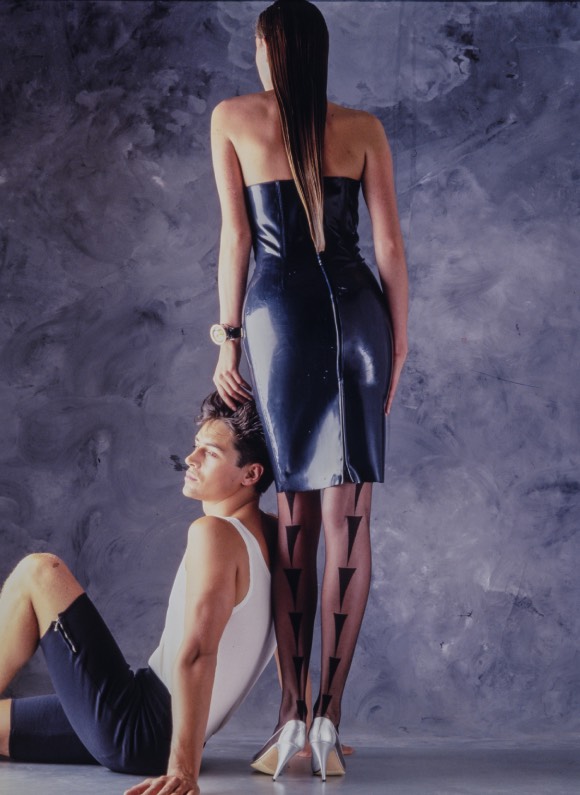
The show opens with a selection of three photographs from different areas of her output. Amore, amore (1974) portrays a model holding a doll while looking straight into the camera; published the following year on the cover of Effe, the historic feminist magazine, it is emblematic of an early phase in which human figures are read as characters, subjected to preassigned roles, the product of social convention. Beside it, an image steeped in the aesthetics of fashion, where the recurring motif of the fishnet stocking traces the lines of a woman’s body. Finally, the portrait of a woman’s face turning into a moon (Untitled, 1980s) prefigures the metamorphoses and cosmic visions — bright colors, the kitsch aesthetic of the decade — that run through her work.
After the entrance corridor, the layout recreates the set of an interior space: photo-studio lights cast the shadows of leaves and flowers suspended from the ceiling, echoing Monselles’s idea of still life and staging. The show then unfolds in tightly linked groups of photographs. On the right, a set of works reflects on still life; on the opposite wall, a wide sequence gathers her most iconic pictures from the 1980s and ’90s — Cavalli (1982), Blu delirante nel volo dell’oblio / Farfalle (1982), Io t’amerò, se tu m’amerai (1982), Fiore rosso (1982), Io e lui (1982), Caldo pensiero (1999). They share a common visual language: vivid color, nude and exposed female bodies, made-up faces, fabrics and textiles, the near-total removal of scenography, and above all an interplay with organic, plant and animal elements. The show closes with Rosematic (1984), a video recently rediscovered by her heirs, in which models and figures close to her animate the photographs in dynamic tableaux of metamorphosis — turning into butterflies, flirting with flowers and with the camera itself.
We encourage you to visit the Centro Pecci to take in both shows in full — two authentic protagonists of twentieth-century culture, told through paths that differ yet are never far apart. Tuscan culture, certainly, but international in reach and strikingly relevant today.