The urban art of LDB: an interview with the artist from Pistoia
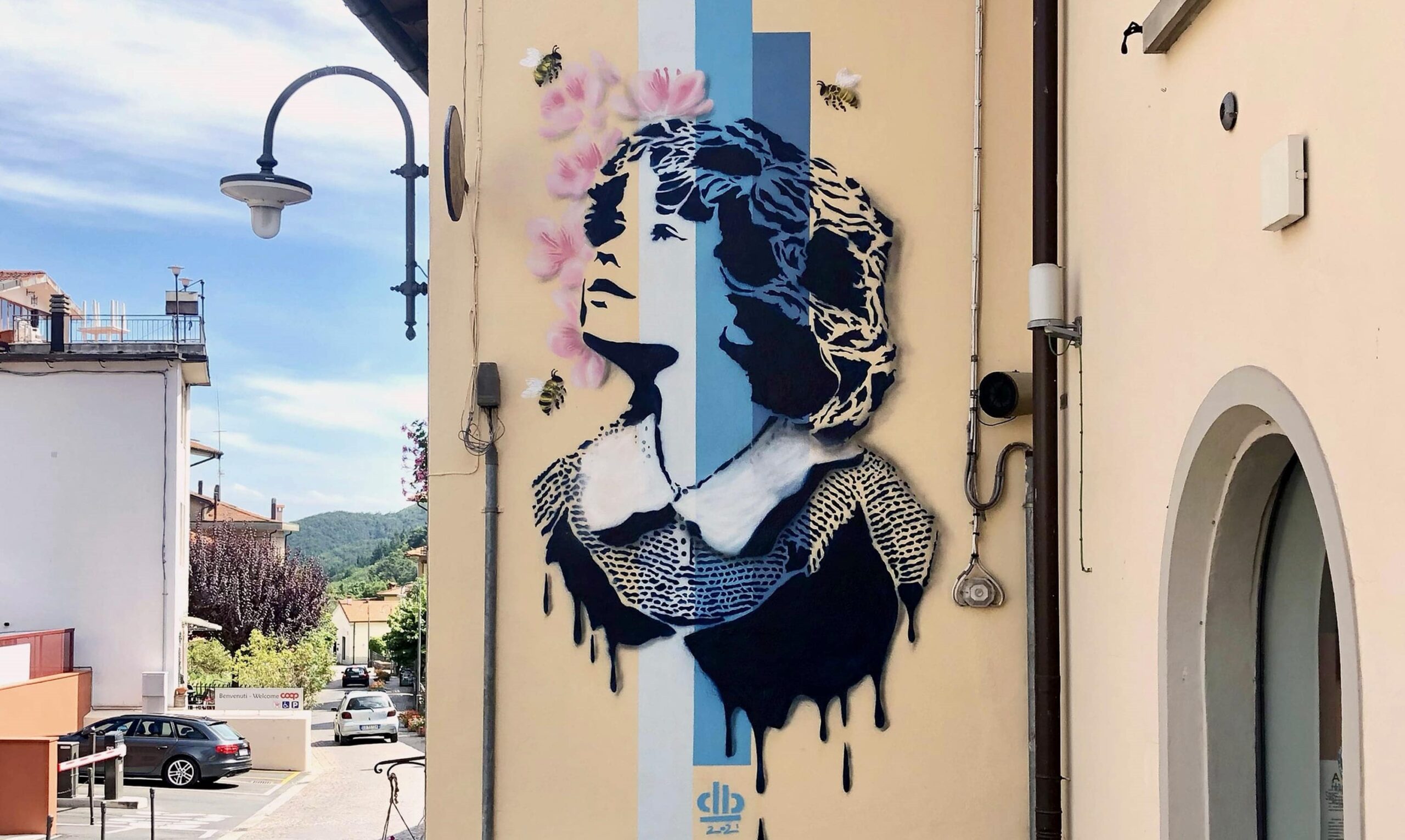
There are often children in the stencils of Lorenzo — LDB by his artist name — our Tuscan Banksy. There is kindness, respect for others and for the environment, a love of life. None of which makes his messages any less powerful — quite the opposite. They go straight to the heart, they touch the soul, they make you think.
Born and raised in Pistoia, he has never strayed far from his city, to which he is deeply attached — above all for the artistic heritage it holds. His is the life of an ordinary young man, without great excess: after secondary school he decided to enrol at the Faculty of Architecture in Florence and, although he never finished the course, that step — personally and professionally — has shaped the way his life has unfolded ever since.
“My artistic side is tightly bound up with those years of study,” he tells us, “because they gave me both the chance to approach the city more consciously and to sharpen my grasp of certain digital tools I rely on.”
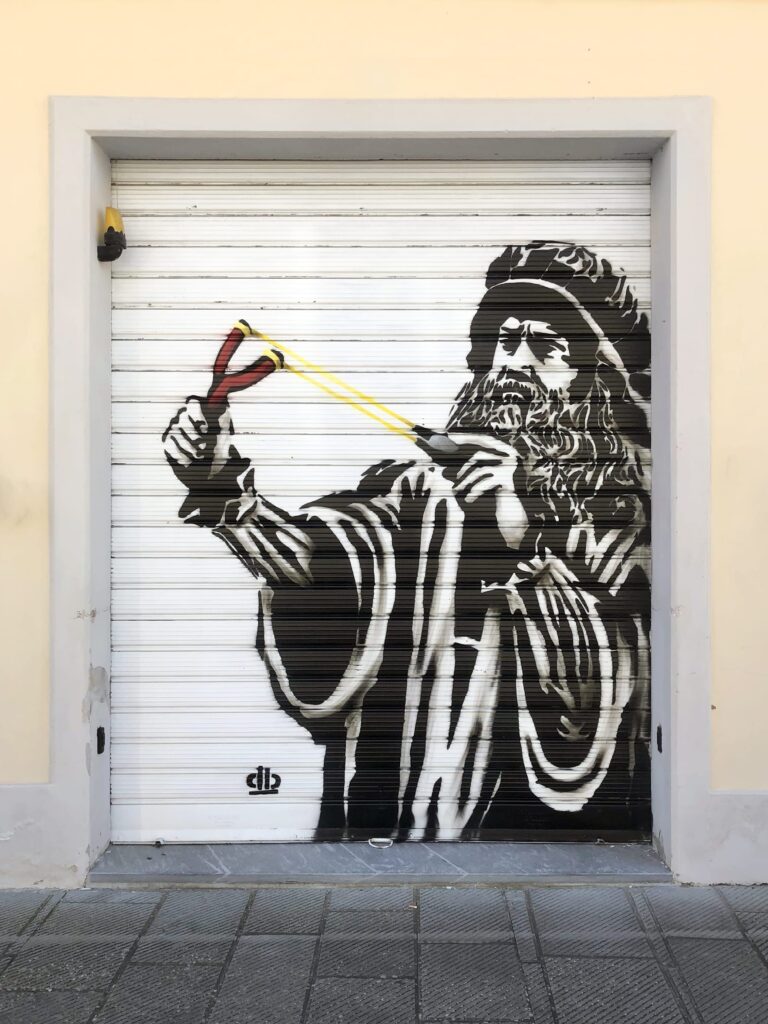
When did your passion for urban art begin?
My first attempts came in the last years of secondary school, around 2005 or 2006, when images of Banksy’s work began to circulate — and he really was a seductive influence for me: something genuinely new, and at the time I knew nothing at all about urban art. This extraordinary artist’s genius struck me straight away and, together with a friend my own age, we sat down — I remember it well — at a desk in my house to draw and sketch out ideas, then transfer the chosen subject onto a “stencil”.
What came out was a very simple piece, almost a rebus, showing an alarm clock with a “TI” at its centre: a kind of message, an encouragement to wake up. Very teenage stuff — and yet we had put real effort into finding a subject that actually meant something. Here in Pistoia, something of that first work still survives, even though we’re talking about twenty years ago or so.
Later my friend and I went our separate artistic ways, but I carried on developing my passion for urban art on my own, working it through a range of techniques.
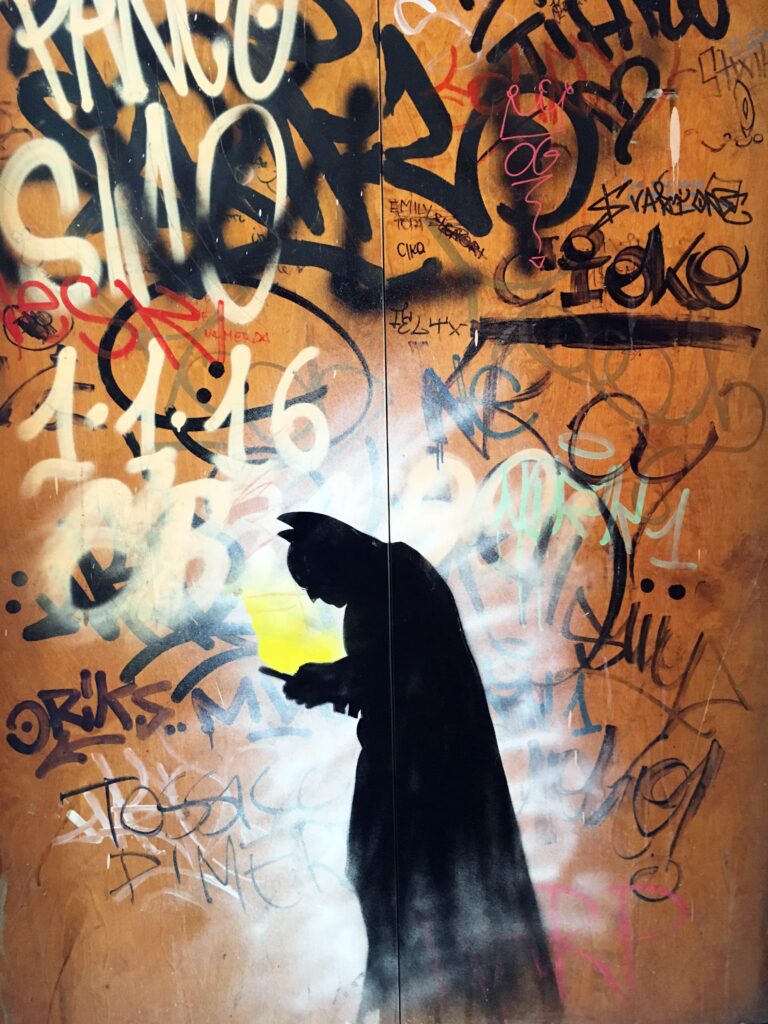
Such as?
I’ve tried a bit of everything, from more painterly freehand pieces to posters, right through to installations in the vein of Biancoshock, a conceptual artist I follow and admire a great deal. In any case, beyond obviously carrying a message, I always try to add a little beauty — if you can call it that — or at least to do something to improve the places that need it. That is fundamental to my artistic research.
As I said, architecture ties into this idea too: looking at the city with an improving eye, trying to make something that isn’t an end in itself but takes in more than the aesthetic side alone.
When you started out as a street artist, did you too roam around hooded at night?
In the early days, without a doubt — partly out of fear of doing something unauthorised, partly because the night is simply more comfortable. It was a way of chasing that adrenaline you need at first, but which, as you grow, you no longer require — personally I prefer to work in broad daylight, for strictly technical reasons.
We’ve noticed your works are always made on “discreet” surfaces — clearly you have no intention of damaging buildings. Do you consider yourself a respectful street artist?
One of the few rules I set myself is not to make certain situations worse, and not to impose my ego. Even if I had a fine idea that called for a surface of real value, I’d let it go. I think that to beautify something you have to work in a clearly considered, deliberate way. The freshly painted wall of a just-renovated building holds no interest for me.
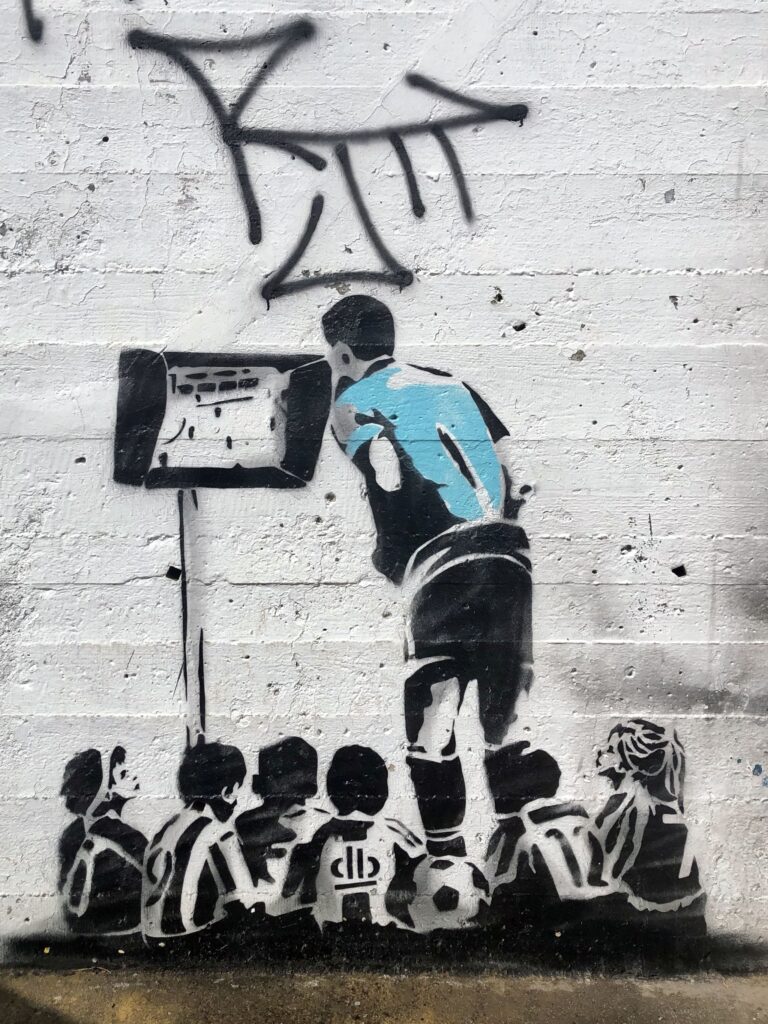
How do people react when they see you at work with your spray cans — do they ask what you’re doing, or whether you have permission?
Honestly, it’s never happened; if anything, what I’ve noticed is that people tend to stay indifferent. It’s rare for anyone to stop and ask me to explain myself. Naturally you have to weigh the context, the surface you mean to work on. If it were an important wall — which, as I said, I’d never touch — then someone might rightly object; but if I choose an insignificant wall, I’d feel able to reply that, when it comes down to it, I’m only trying to make it look better.
Many cities take pride in their street-art heritage. Pisa, to stay in Tuscany, is home to Keith Haring’s last mural — hence the idea of calling in a new generation of artists to improve certain neighbourhoods.
In my view this kind of art can’t do without the spontaneity of the act made on the spot — you don’t necessarily always need permits to go out and realise what you’ve thought up or planned… Real street art is still the kind made on impulse, freely. The important thing is not to overdo it, and your conscience stays clean. Everything else is at your own risk.
In your view, what matters more in a work of art — the idea or the technique?
I’d describe myself as an artist with little technique — though I did study it and now have it under control — so for me the idea is everything. Given the age we’ve entered (I’m thinking of Artificial Intelligence, which now does everything), the idea is the one thing no one can take from us, for now.
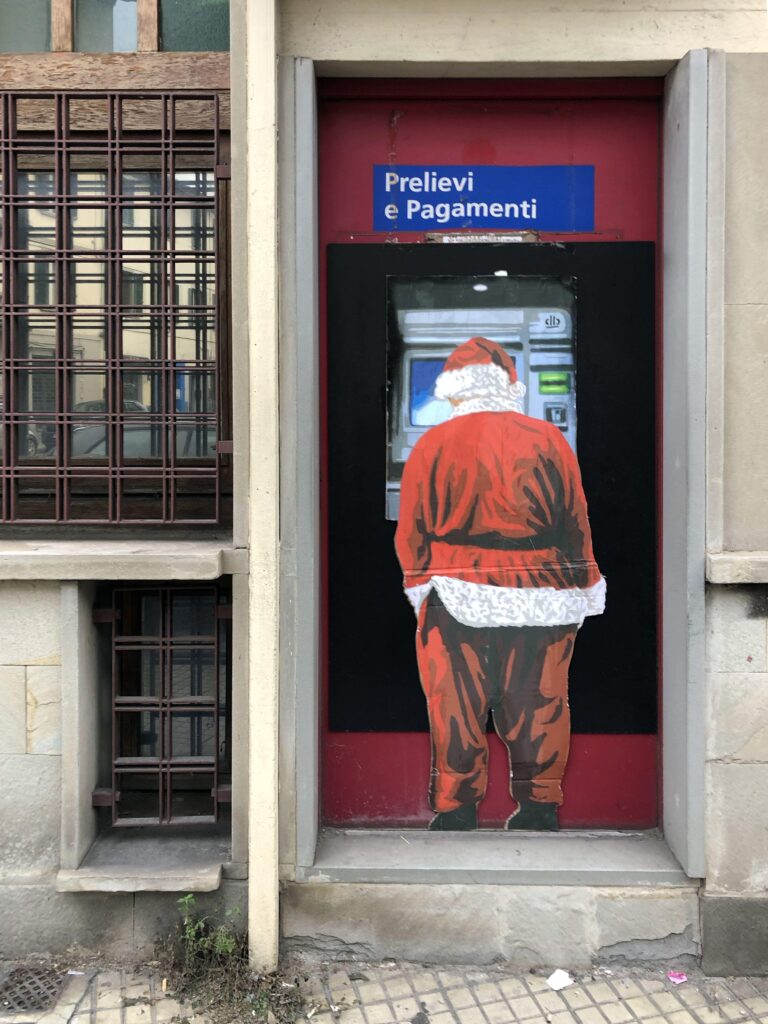
How far has your “reach” extended — how far have you gone to leave a trace of yourself and your work?
Some of my works have been lost; in any case they’re mainly in the areas around my city, then Florence, Bologna… always within our national borders. That said, the project titled “Non sono un murales, segni di comunità” (“I’m not a mural — signs of community”) brought me a fair amount of visibility. It was a commission from ACRI, the association that brings together Italy’s banking foundations, which chose my work — a woman tying a child’s shoelaces — as the basis for a subject that could stand for dedication. The project’s official site has all the details, photos from the event and a map of every place the works were made.
A single event spread across one hundred and twenty places in Italy, with around a thousand people taking part — children, teenagers, artists, teachers, prisoners, disabled people and migrants — who, through guided workshops, created murals (some of them very large) on schools, play centres, social facilities and community hubs in difficult neighbourhoods, and on assets confiscated from organised crime (even on the sails of boats seized from mobsters), then repurposed by reinterpreting my stencil.
The aim was to convey a shared message that others could reproduce too: some very interesting pieces came out of it. It was the most important work I’ve taken part in over the past few years — a genuinely fine thing, above all for the social intent behind it.
This event let you connect with thousands of young people. If you were asked to repeat an experience of that resonance, would you seize the chance to give them a warning — about some of the negative behaviours of the younger generations — or an encouragement for the future ahead of them?
Let me say first that I love being around young people; I often run art workshops and I have to say I always come away pleasantly surprised and emotionally enriched. I believe young people should be listened to, and I’m convinced that much of their unease is our own doing. That is exactly why, when I present my art, I don’t try to do it in order to teach, still less to admonish.
We tend to think of the artist as a sage or a bearer of truth but, as I’ve tried to make clear so far, I don’t feel I belong to that category. I try to use my art as a vehicle to reach their worlds, which are often full of ideas and new horizons. Essentially, especially in settings aimed at young people, the impulse is to offer something that carries small questions within it — and never trite answers.
Which social issue do you fight for most? Which theme is closest to your heart, the one you feel you never do enough for?
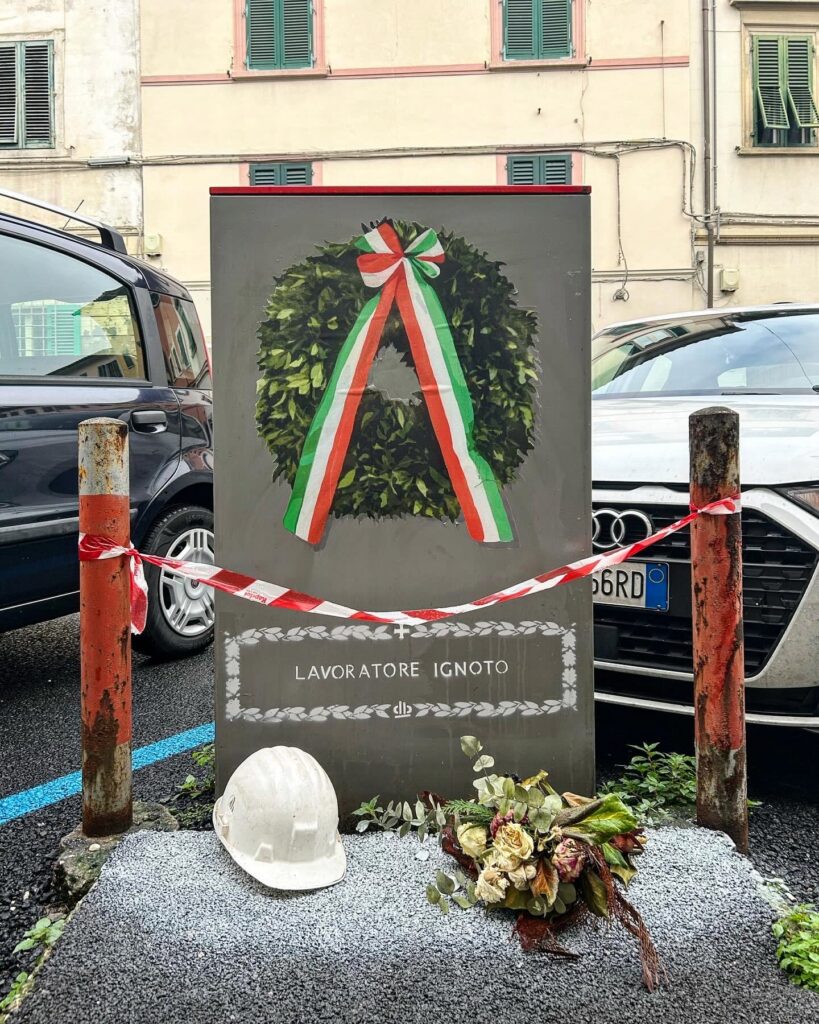
It’s hard to narrow it to just one, but the one I’ve run into most often is the theme of work, both personally — because I’m at a point where I’m reflecting on my own working situation — and in everything around it: how genuine the offer is, the conditions, the safety… Ideas often come to me after I’ve talked, argued or dug into certain subjects. I’m in love with people in general, so I like it when a lot of things come from other people’s words too, and not necessarily from my own reading of them.
We’d like to ask you something, then: could you dedicate one of your next projects to respect for animals? To conditions inside factory farms, circuses, laboratories, for instance…
I find that really inspiring — I’ll think it over! It’s a subject I care about a great deal too, and one I’ll be turning to soon!