Was Coca-Cola Invented in Florence?
And since the news stories that sound like they’ve leaked in from a parallel universe are often the most fun, this morning we opened Google and started digging. Spoiler: no, we can’t claim Coca-Cola was invented in Florence.
If you were already picturing John Stith Pemberton queuing in front of the Duomo with a lampredotto sandwich in one hand and a secret formula in the other, we’re sorry to deflate your enthusiasm so quickly.
What we can tell you, though, is a far more interesting story. Because long before Coca-Cola was officially invented in Atlanta, a pharmacy in the historic center of Florence was preparing an elixir made from coca leaves and kola nut — the very two ingredients that, a few decades later, would go down in history as the base of the most famous soft drink on the planet. The story was reported recently by Toscana Oggi, which gathered the account of the Dominican friars of the Convent of San Marco.
While reorganizing the archive of the old Farmacia di San Marco, on via Cavour, Father Manuel Russo, rector of the convent, came across an old advertising leaflet for a “restorative wine elixir” — a tonic described as a remedy “against physical and mental fatigue, headaches, and the weaknesses brought on by age or extraordinary exertion.” Put that way, it sounds like the description of any given Sunday morning. The truly curious part, however, is the recipe itself.
According to the document published by the outlet, the elixir contained 30 grams of kola nut and 10 grams of Bolivian coca leaves, all infused in a liter of alcoholic base. A combination that today immediately brings Coca-Cola to mind, but that in the 19th century belonged to a completely different world. Back then, coca and kola were anything but exotic ingredients for pharmacists and apothecaries.
Coca leaves were considered a powerful restorative and appeared in dozens of preparations meant to fight fatigue, exhaustion, and weakness. Kola nut, rich in caffeine, was used for its stimulant properties. In other words, the energy drinks of the day came with far less catchy packaging and a decidedly more serious alcohol content.

The most famous case came in 1863, when the Corsican pharmacist Angelo Mariani invented Vin Mariani, made by macerating coca leaves in Bordeaux wine. It was a runaway success. Popes, writers, artists, and crowned heads drank it, and even figures like Jules Verne and Thomas Edison spoke of it with enthusiasm.
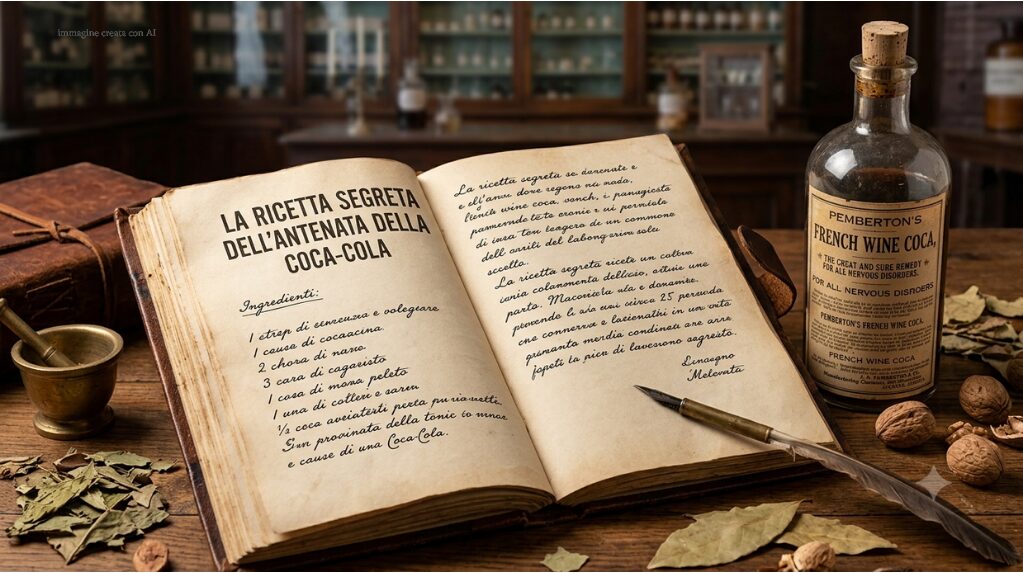
Today it would probably land straight in the category of “drinks whose ad campaign no one would approve anymore.” It was Vin Mariani itself that inspired John Stith Pemberton, an Atlanta pharmacist, who in 1885 launched Pemberton’s French Wine Coca, a wine flavored with coca and kola nut. Then came the first prohibition laws on alcohol; Pemberton dropped the wine from the recipe, added carbonated water and sugar, and in 1886 what would become modern Coca-Cola was born.
And this is where our beloved Florence steps in. The find at the old Farmacia di San Marco in no way proves that Pemberton knew the Dominicans’ recipe, nor that any direct link exists between the Florentine elixir and the birth of Coca-Cola. No serious historian would go that far.
It does, however, leave one intriguing question open: if the advertising leaflet found by the friars really did predate Vin Mariani in 1863, it would mean that someone in a Florentine pharmacy had already thought to combine coca leaves and kola nut before that pairing became famous around the world. Not the genesis of the real Coca-Cola, of course, but a small, forgotten piece in the history of the great 19th-century tonics from which the American soft drink would eventually emerge.
So no, Coca-Cola was not born in Florence. But the next time some wise guy asks you for “a warm Coke with a really short straw,” instead of rolling your eyes you can answer with a tale of Dominican friars, Bolivian coca leaves, and kola nut. He’ll probably laugh anyway. You, on the other hand, will get to show off a dose of culture — possibly unrequested — wildly out of proportion to the subject. You’re welcome.