Maurizio Seracini: Reading Art Beyond the Surface
Maurizio Seracini is one of the best-known — and at the same time most controversial — figures on the international cultural-heritage scene. Trained between Italy and the United States, his work has been decisive in the development of so-called “art diagnostics,” an approach that treats an artwork as a complex organism to be investigated with scientific instruments, integrating material data with traditional historical and critical analysis.
After his early, celebrated research in the 1970s into the possible location of Leonardo da Vinci’s Battle of Anghiari in Palazzo Vecchio, Seracini founded Editech, one of Europe’s first companies dedicated to the scientific analysis of works of art.
In parallel, he carried out research and teaching in the United States, helping to establish interdisciplinary programs such as CISA3, the Center of Interdisciplinary Science for Art, Architecture and Archaeology, founded in 2007 at the University of California, San Diego, with the goal of training professionals able to combine humanistic and scientific expertise.
Over the course of his career, Maurizio Seracini has paired his research with extensive international teaching, developing an ongoing reflection on the relationship between science and cultural heritage. One of the best-known expressions of this outreach is his 2012 TEDGlobal talk, The Secret Lives of Paintings, in which Seracini explains to a broad audience the possibility of “reading” works of art beyond their visible surface.
In the talk — now one of the most cited moments of his public career — he foregrounds the idea that every artwork holds layers of information invisible to the naked eye, accessible only through diagnostic tools and an integrated scientific approach.
In this interview for FUL, Seracini retraces his path, reflects on the resistance that still hampers his work today, and takes a critical look at the training of new generations and the future of the professions tied to conserving cultural heritage.
Your work is often associated with a pioneering role in applying scientific technologies to the study of works of art. How did that intuition come about, and what were the first chances to put it into practice?
I think it was 1968 when I tried to enroll in Architecture in Venice. Those were the years when the faculty included extraordinary figures, architects who would go on to shape the history of modern architecture in Europe and the United States. Well, I went to the department and found it occupied. It was the time of the first student mobilizations and solidarity strikes: in that case they were protesting in support of Venice’s street cleaners, the ones who back then went around the city with their little carts. The upshot was that I left the city and moved to Florence. Here I tried to enroll in Engineering, but before long that too was occupied and shut down. So I fell back on Statistics, which I cared about only so much.
During my studies, I started working and putting money aside. I had decided to go abroad to study. After about a year, having passed the various admission exams, I left for the University of California, San Diego, to study biomedical engineering — which at the time didn’t exist in Italy. I wanted to become an engineer specialized in medicine and then become a doctor, to gain a deeper understanding of the limits and possibilities of ever more sophisticated medical technologies. And that’s what I did: I earned my degree and enrolled in a rather unusual program that combined both a PhD in biomedical engineering and a medical degree. Life in San Diego was wonderful, except for one small detail: I had forgotten about military service. Ordered back by the State, I had to return to Italy, dropping everything. Never believe you’re fully in control of your life.
I found myself back in Italy, without a passport and without a job. I had tried to get into various hospitals — in Florence, Milan, I remember Rome — but they all told me: “What exactly do you do? Are you a doctor or an engineer?”
You should know that during my years in biomedical engineering I had cultivated a second great passion: art history. Maybe because I was born in Florence, right? Twice a week I would go from San Diego to Los Angeles to study art history with Professor Carlo Pedretti, who at the time taught fifteenth- and sixteenth-century Italian art. For me those were hours of pure oxygen after days spent in the lab.
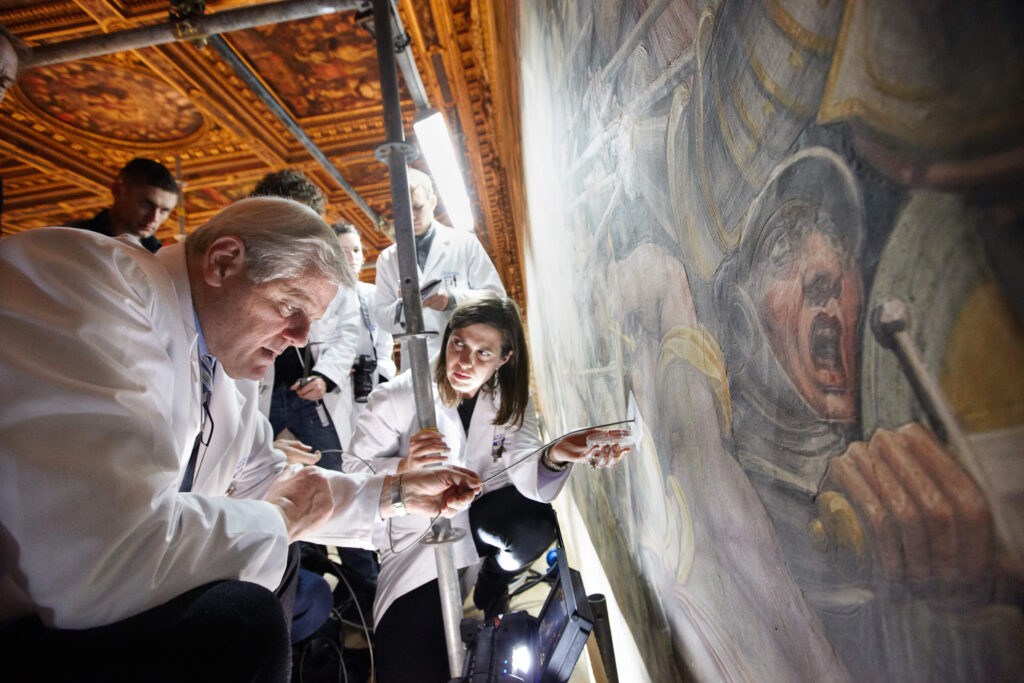
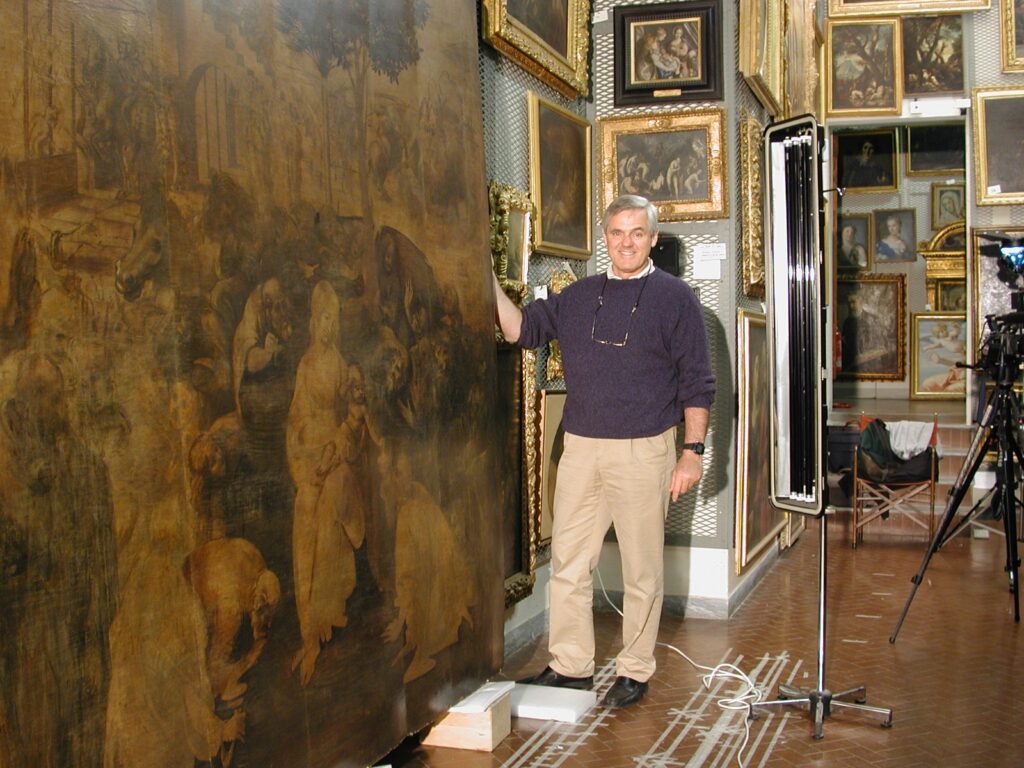
The truth is that sometimes life hands you the bill, and other times it offers you an opportunity you hadn’t even imagined. Back in Florence, in 1975, while I was working in a bar just to get by, I ran into Professor Pedretti. He had returned to Italy to do research on some documents, found a few years earlier, about the history of Leonardo’s mural painting of the Battle of Anghiari. It was there that he asked me whether it might be possible to use the instruments and techniques I had learned in biomedical engineering to search for any traces of Leonardo’s work in the Salone dei Cinquecento of Palazzo Vecchio. That’s how, within forty-eight hours, my life took a completely different direction.
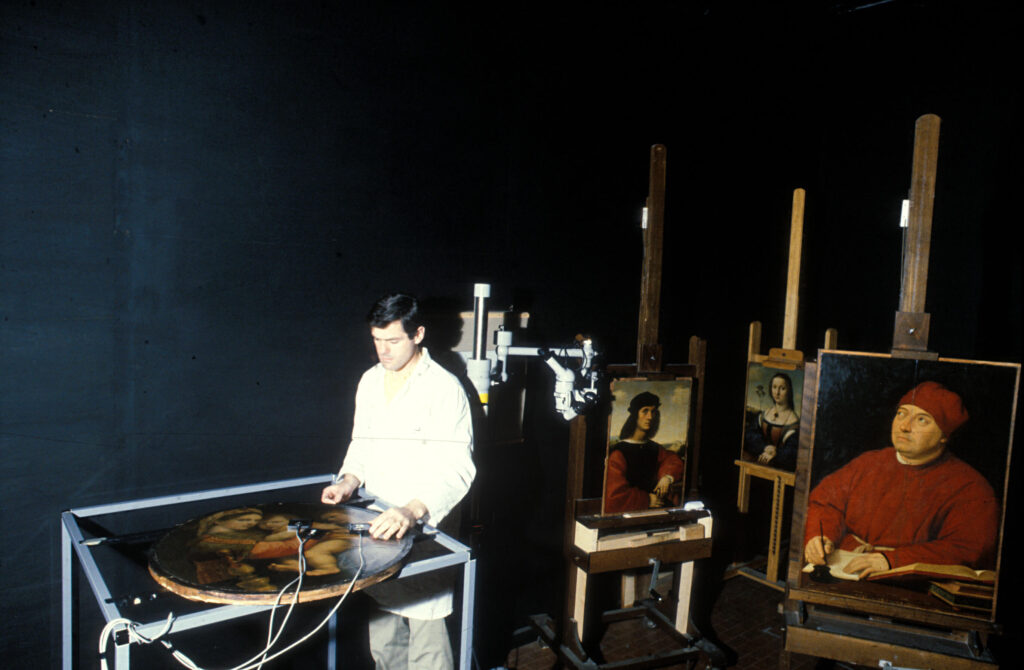
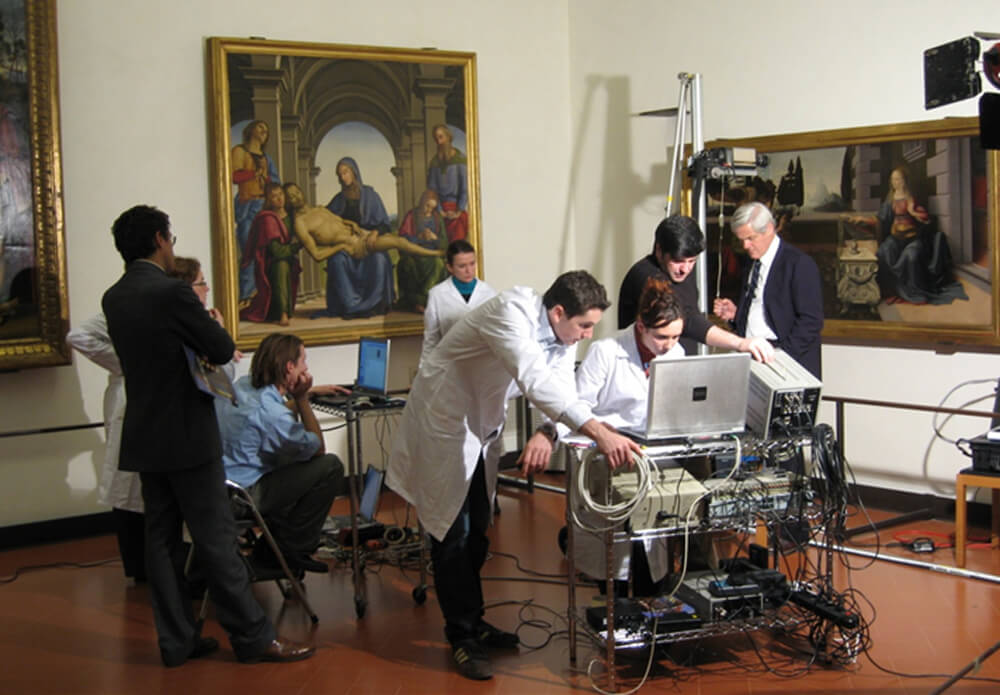
From that day on, I did little more than simply consider a work of art as a patient, a museum as a hospital — or our monumental heritage as an open-air hospital. And I applied not only this concept but also the methodological approach used in medicine to study a patient. Going beyond the mere anamnesis of the work — that is, its documented history — to come to know its anatomy. How do we find out how a painting was made hundreds of years ago? With science, because our eyes alone are not enough. As in medicine, we begin with multispectral investigations and then, reading the results, decide how to deepen the study. Chemical analyses and dating follow, allowing us to understand which period the various components of the artifact date to. So, once we know our patient’s anatomy, we can also correctly identify its pathologies and decide how to act. Just like an operation in a surgical theater, a restoration too must be supported by preliminary analyses that prove its necessity and determine its methods.
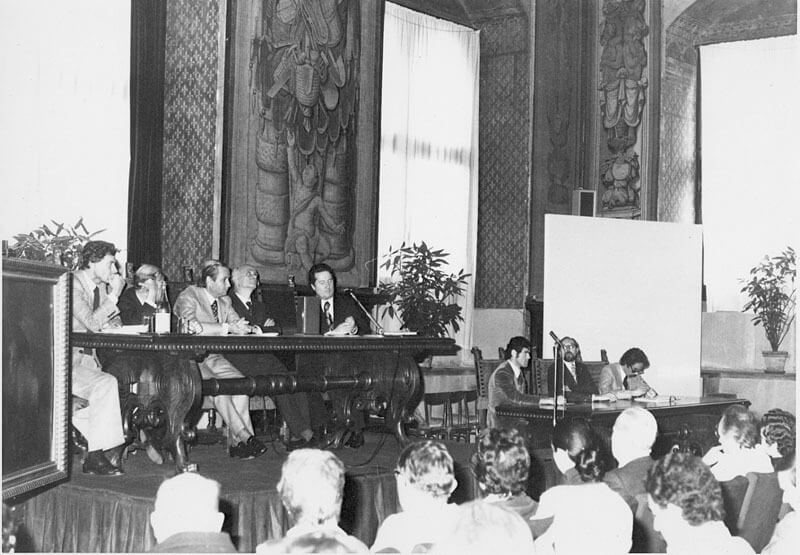
Unfortunately, even today there is no regulation making in-depth scientific analysis of works of art mandatory — not even before restoration work. It’s a significant gap, because over time it has contributed not only to sometimes irreversible errors and damage, but also to the construction and spread of historical interpretations that are not always correct.
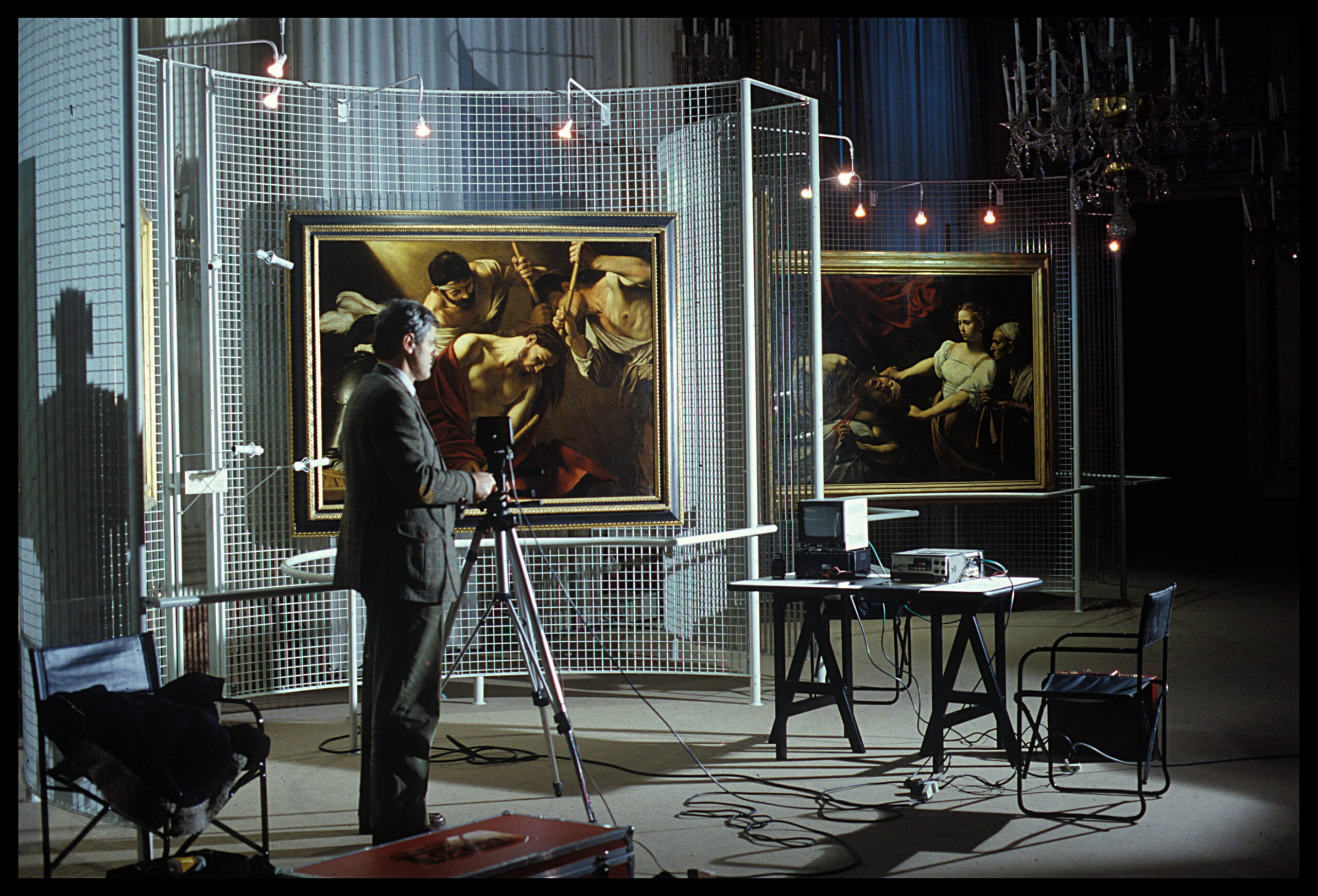
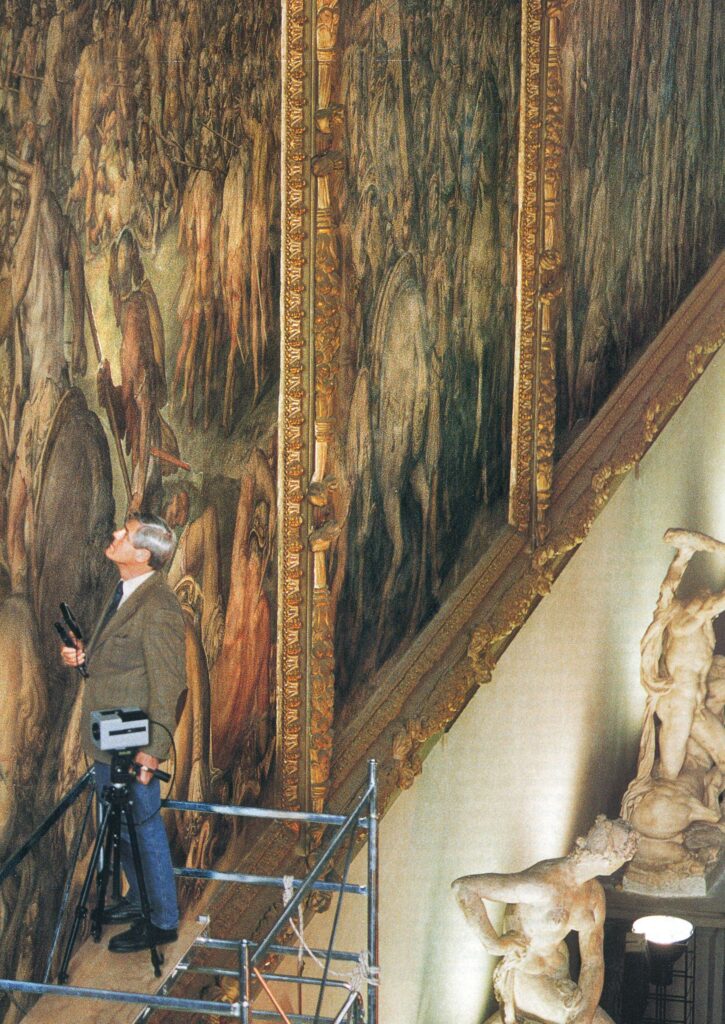
I worked on the search for the Battle of Anghiari from ’75 to ’77, using all the technologies we used in the medical field to see beneath the painted surfaces, where the eye obviously couldn’t reach. I used the whole infrared range — photographic infrared, thermal infrared — ultrasound, and I began to realize, on the one hand, that a great deal could be done, and on the other, that no one else had ever approached the study of a work with a technical-scientific lens. There were, yes, small studies dealing with chemical analysis, but they left out everything concerning the possibility of a systematic study of the artwork through multispectral imaging.
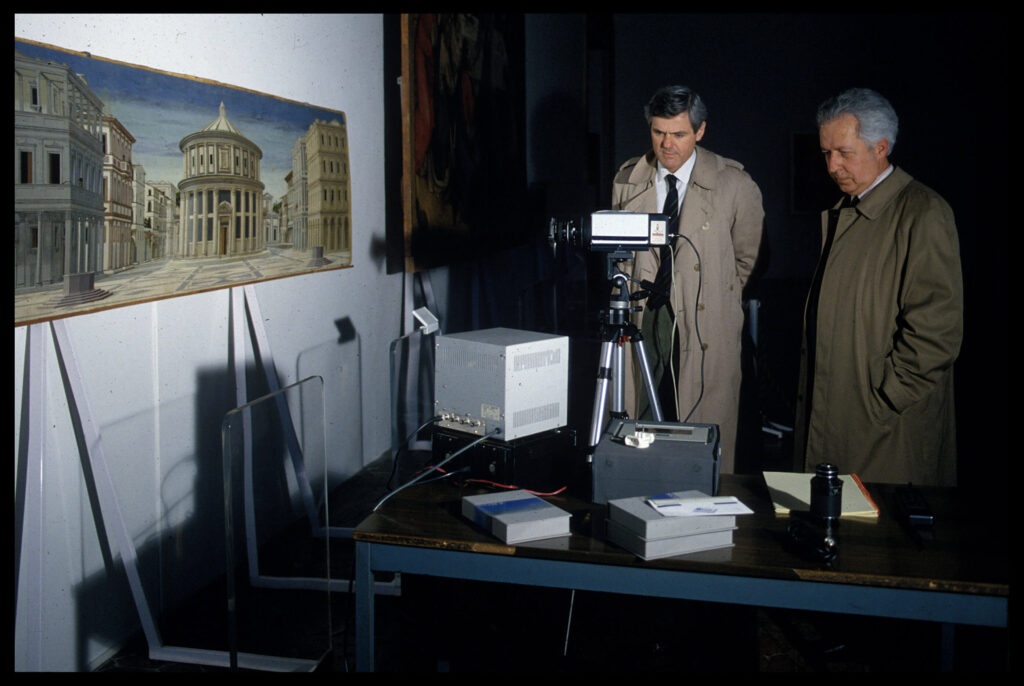
In ’77, when the research ended, I continued to offer diagnostic services in museums throughout Italy, with the aim of studying the work of art also in relation to its state of conservation. That’s how Editech was born — the first company in Europe to offer this kind of service, which next year will officially celebrate fifty years of activity.
Quite a milestone — congratulations! After your studies in America and the resistance your work had met here in Italy, why did you decide to open Editech in Florence?
Thank you. I was born in Florence, I lived in Florence, and I had started offering consultancy in the city’s museums. Over time the work expanded first to Tuscany and then to the rest of Italy. At the beginning I went from museum to museum, asking whether there were works on which diagnostic investigations could be carried out. In most cases I was entrusted with paintings destined for restoration.
It was like that, one step at a time, that I helped develop the field of diagnostics applied to cultural heritage. And it was along this path that I realized the extent of the resistance surrounding this approach — resistance that, in part, I still encounter today.
In my view, there is still a certain confusion between two distinct moments: acquiring objective knowledge about the state of conservation of a work, and the restoration itself. And this confusion can have very serious consequences. I’ve always wondered why a restoration should be based mainly on the interpretation of an art historian, when today we have instruments capable of providing measurable, verifiable, and scientifically grounded data on the state of a work.
Editech was born precisely to meet this need. And it could only have been born here, in Florence, at the heart of a country that holds an extraordinary share of the world’s artistic and cultural heritage and that, for this very reason, would need advanced tools to know and conserve it more than anyone else.
As a teacher, what kind of preparation do you think young people who want to become art historians need now?
Today an art historian should first of all be aware of what science can offer for understanding works of art. It’s about acknowledging the objective information that scientific analysis can reveal. That’s why I believe training should include at least the basics of reading and interpreting data. An art historian should be able to integrate documentary sources, art-historical knowledge, and the results of scientific investigations. We would need a figure we might call a “technical art historian.” Naturally, this would require the willingness to rethink the professions of the sector, both in the humanities and in the sciences. If the goal is to reach a more complete understanding of works, to practice prevention, and to ensure truly effective conservation, then teamwork is needed: professionals with different skills who can engage with one another and understand each other’s language.
The same difficulty we’re talking about is also faced by the thousands of students who graduate in Conservation Science. To this day, I’m not aware of a single one of them having been hired by the Ministry of Culture to do the work they studied for. Where I come from, that means having strung along thousands of young women and men for twenty years. The responsibility lies both with the Ministry and, perhaps even more, with the universities.
I say this from direct experience too: I have taught in some of these faculties and lived these dynamics from the inside. That’s why I believe degree programs in Conservation Science must be profoundly rethought — or refounded together with the Ministry — to finally offer concrete prospects.
I find it absurd that, in a country like Italy, we give up the skills of thousands of young people who chose this path with passion, enthusiasm, and great expectations. Instead, many of them end up doing completely different jobs, from call-center operator to tour guide. It’s a situation I consider truly shameful.
Here at Editech I try to host interested students and researchers and to involve them directly in research and analysis. This way, they can work daily in contact with the data, the diagnostic instruments, and the real problems of conservation. In parallel, with the Center of Interdisciplinary Science for Art, Architecture and Archaeology program, we try to shape a new professional figure, overcoming the traditional barriers between disciplines.
How do you explain this somewhat anachronistic resistance? Would you say it’s an entirely Italian scenario, or the art establishment in general?
Because it would mean that art historians would go back to being art historians, without handling things for which they don’t have the skills. Look, it’s a general scenario. I’ve worked in museums with truly first-rate laboratories — the Metropolitan (New York), the National Gallery in Washington, the National Gallery in London, and so on. Even in these, scientific consultations are usually requested only if problems arise during restoration. What’s missing worldwide, as we were saying, are written methodological rules. Just as there are no laws — in any of the countries where I’ve worked — that codify how a work of art is sold or bought.
Coming back to Editech, when did the first private commissions arrive?
The private commissions arrived when the scandals began. When a painting sells for 30 million, a debate over its authenticity can become awkward. On the other hand, though, a growing demand was emerging from the market — particularly from collectors and buyers who, before purchasing, wanted greater certainty about a work: to make sure it wasn’t a recent copy, or an old one, and above all not a forgery. Only science can prove this. Legally, in fact, an art historian’s opinion on the authenticity of a work is just that — an opinion. Requests for authentication often come indirectly from sellers as well: public or private entities that, before finalizing a sale, request tests on the work.
You could say my work has a discontinuous character, because it is neither necessarily well known nor codified. On top of that, it has earned me a great many “enemies.” Let’s say that when a seller comes to my laboratory to authenticate a work, at the buyer’s request, and discovers it’s a forgery, they rarely come back. Conflictual relationships always arise. To this day, however, no one has come here to say “you got it wrong,” and that’s enough for me. It’s a difficult job, with great responsibility, but above all it demands a very clear code of ethics. It would be easier to tell my clients that the analyses turned up nothing significant, but that’s not how I operate. Honesty is the most important thing.
In your TED Talk you argued that cultural tourism must move from passive consumption to an experience of discovery and participation. How can we encourage a more active public engagement with art history today?
For the world of cultural heritage to truly produce and transmit culture, each of us must become the protagonist of our own learning. Today, instead, in museums we are often passive visitors: we look at a work and move on. Sometimes I wonder how many would notice the difference if copies were displayed in place of the originals. And that’s a shame and a waste, because behind every work of art there is a moment of creativity and genius, a journey of insights and second thoughts that goes untold.
Imagine a visitor in front of Botticelli’s Primavera: with their phone they could see the preparatory drawing, discover how the work came to be, observe what lies beneath the layers of restoration, or learn about the various phases the painting has gone through over time. I’m convinced that tourist would leave the museum with a much richer experience and with something concrete to take away.
Learning is born of curiosity, and curiosity is fed through new experiences — especially visual ones, in a world like today’s. That was precisely the goal of Wipe Off, an app I created as Director of CISA3 at UCSD (University of California, San Diego) using engineering technologies, to allow anyone to retrace the history of a painting and discover its various transformations over the centuries.
All this body of knowledge should be shared and made accessible, especially to the new generations, who will be tasked with safeguarding and championing our cultural heritage in the future. Instead, we remain stuck behind an aura of distance and exclusivity built and defended over time. We should all commit to “giving a future to our past”!
Interview by Giorgia Migliorini / Photos courtesy of Dr. Maurizio Seracini