Palazzo Vecchio Reclaims Its Fonti dei Leoni: The Scuola del Cuoio Restoration in Memory of Tommaso Melani
There are places in Florence we pass through without lingering much on the details. Familiar places, part of the city’s everyday landscape, that hold stories often unknown even to people who have lived in Florence all their lives.
The Cortile della Dogana, inside Palazzo Vecchio, is one of them.
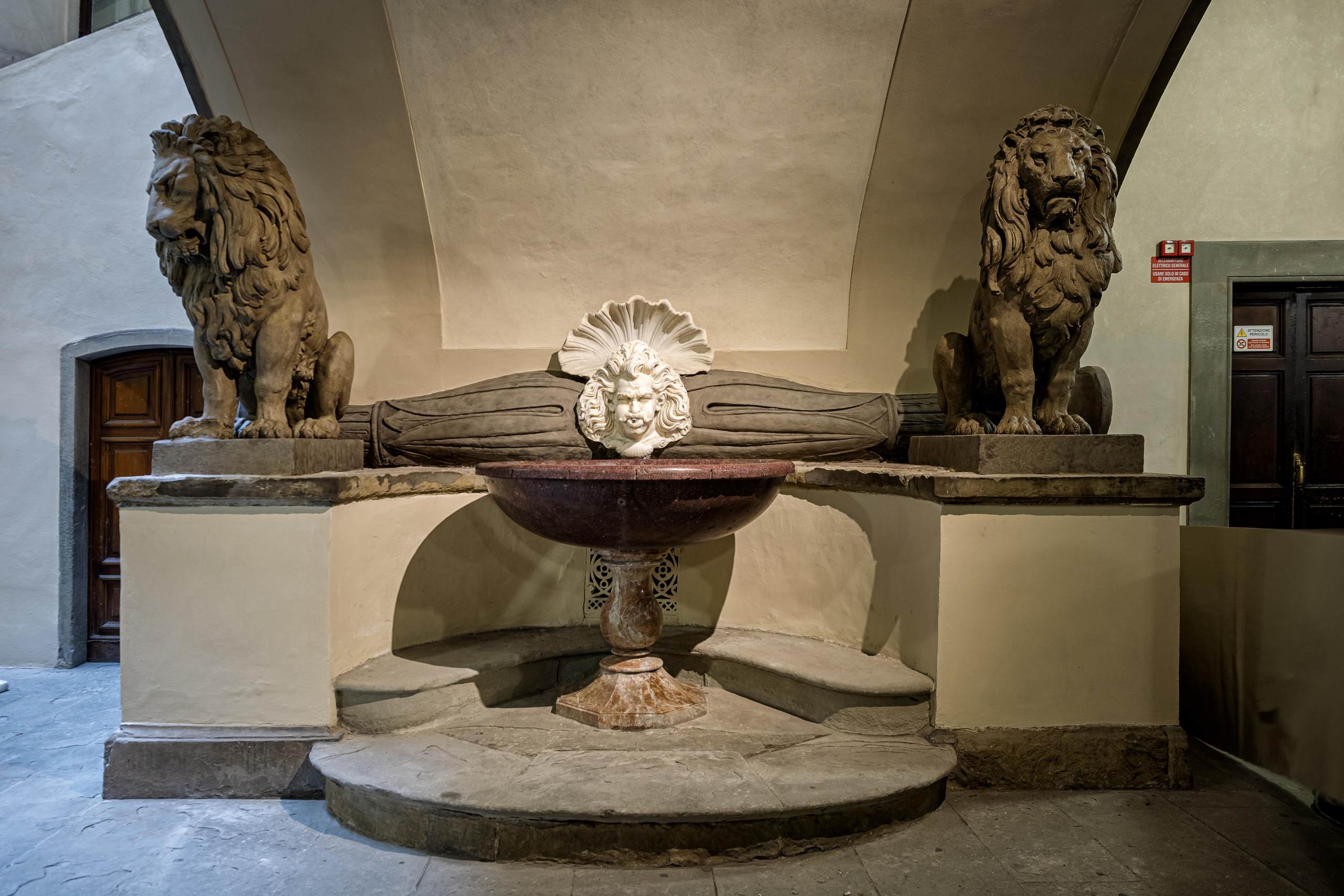
This is where the restoration of the Fonti dei Leoni and the courtyard’s decorative elements has just been completed: a project that has made one of the palace’s historic spaces legible again and deepened what we know about its works.
The project was made possible by the Scuola del Cuoio di Firenze, Florence’s historic leather school, which backed the work with an in-kind sponsorship worth €50,000 as part of FLIC – Florence I Care, the city’s program for protecting its cultural heritage through public-private partnerships.
But behind this restoration there is also a deeply personal story: that of the Gori family and their wish to keep alive the memory of Tommaso Melani, who died suddenly in New York on May 5, 2026.
A restoration that brings color and beauty back to Palazzo Vecchio
The work, which took 60 days, covered the fountains, the basins, the sculpted lion groups, the mascarons and the architectural surfaces of the Cortile della Dogana.
It also included the statue of the Electress Palatine, Anna Maria Luisa de’ Medici, placed in the courtyard in 2023.
Led by architect Rita Balzano, the restoration was preceded by analyses and tests to identify the best techniques for preserving each of the different materials.
The work included removing surface deposits, cleaning the pieces, consolidating the most fragile parts and recovering the decorative finishes.
Of particular interest was the use of laser technology to clean the mascarons and the fountains, which allowed the restorers to work on the surfaces with precision.
Stratigraphic tests also uncovered traces of the original colors of the decorative elements, hidden beneath the alterations built up over time.
The restoration thus recovered the chromatic continuity of the whole, giving a truer reading of the architectural and ornamental elements.
The discovery about the four lions: they are not stone sculptures
One of the most curious findings to emerge during the work concerns the very protagonists of the fountains.
Before the restoration, two of the four lions were believed to be carved in stone. The analyses showed instead that all four sculptures are period plaster casts, with an internal metal frame.
A discovery that shed new light on the nature of the pieces and helped identify the most appropriate conservation techniques.
The Fonti dei Leoni, the Lion Fountains, sit beneath the flights of stairs leading up to the monumental apartments of Palazzo Vecchio and probably date to the second half of the 19th century, the years when Florence was capital of the Kingdom of Italy.
The two compositions are symmetrical and feature basins, mascarons, decorative shells and lion figures.
The lions also recall one of the most important symbols of Florence’s civic tradition: the Marzocco, the lion holding the shield with the lily, the historic emblem of the city.
The Cortile della Dogana, a place that tells five centuries of Florence
The history of the Cortile della Dogana goes back to 1494, when it was built to a design by the architect and sculptor Simone del Pollaiolo, known as il Cronaca.
It is one of Palazzo Vecchio’s three courtyards and plays a key structural role: it supports the Salone dei Cinquecento, the Hall of the Five Hundred, above it.
Its name, “customs courtyard,” comes from the customs offices it housed under the Grand Dukes.
Over the centuries, this space has lived through the city’s political and institutional changes, holding on to traces of different eras.
Among them is the marble statue of the Electress Palatine, by Raffaello Arcangelo Salimbeni, installed in 2023.
The sculpture honors Anna Maria Luisa de’ Medici, to whom Florence owes one of the turning points in the preservation of its artistic heritage: the 1737 Patto di Famiglia, or Family Pact, which helped keep the Medici collections in the city.
The recent restoration adds a new chapter to the story of this place, bringing out elements that time had gradually altered.
Remembering Tommaso Melani, and the Gori family’s gesture
The project carries special meaning for the Gori family, who run the Scuola del Cuoio.
The work is in fact dedicated to the memory of Tommaso Melani, Laura Gori’s son, born in Florence in 1972 and who died in New York in May 2026.
Tommaso had built a career in high-end craftsmanship, between Florence and the United States. He had served on the board of the Scuola del Cuoio and owned the shoemaking brand Stefano Bemer and the tailoring house Sartoria Vestrucci.
The origin of the project was recounted by Barbara Gori, CEO of the Scuola del Cuoio, who recalled a conversation with Tommaso during their last meeting, this past April.
“Tommaso used to remind me that in the United States it’s the citizens themselves who actively contribute to preserving cultural heritage,” Barbara Gori explained.
An idea that had struck the family: seeing the care of historic places as a concrete way of taking part in the life of one’s community.
From that memory came the decision to support the restoration of the Fonti dei Leoni and the Cortile della Dogana.
A way of turning a shared thought into work made to last, for the benefit of the city.
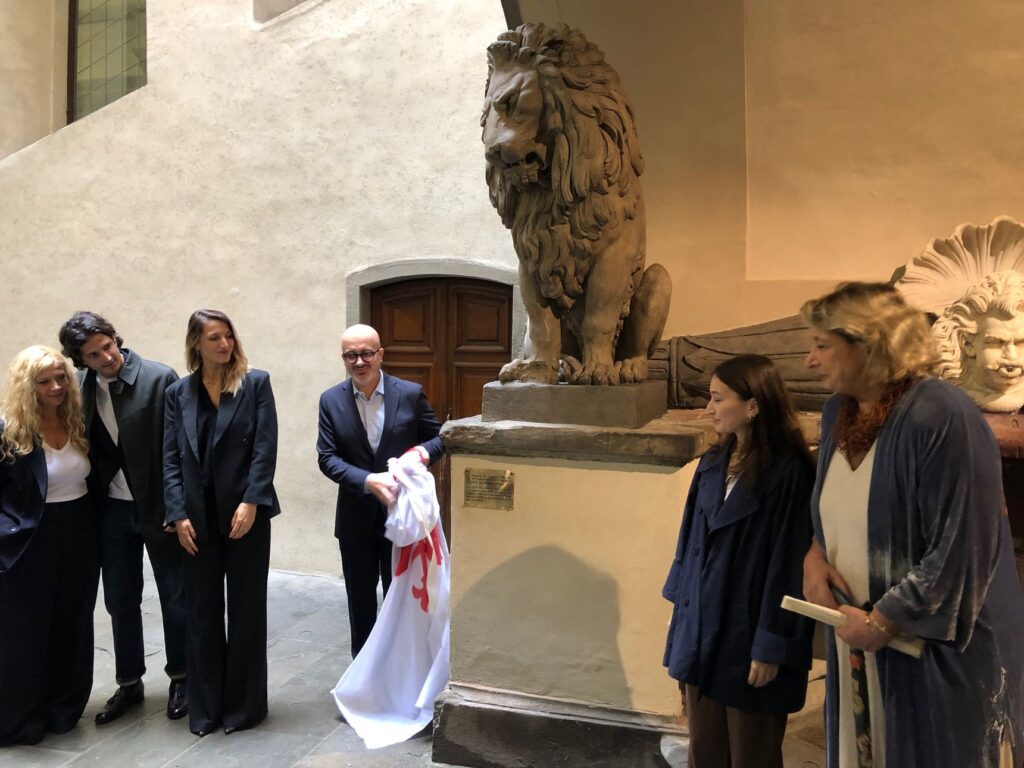
During the presentation of the work, Isabella Melani, Tommaso’s daughter, unveiled the memorial plaque dedicated to her father, placed beside the Fonti dei Leoni.
“This plaque is a sign of the affection and esteem so many people have for my father,” Isabella said, thanking everyone who took part in remembering him.
The Scuola del Cuoio and its bond with Florence
Supporting this project is part of a long history linking the Scuola del Cuoio to Florence’s cultural and artisan heritage.
Founded after World War II through a collaboration between the Franciscan friars of the convent of Santa Croce and the Gori and Casini families, the school first had a social mission: teaching a trade to war orphans, giving them a real chance at a profession.
The first lessons were held inside the Santa Croce monumental complex, where the young students learned leatherworking, hand cutting and how to make accessories.
Over the years, the Scuola del Cuoio has become a landmark of Florentine craftsmanship, keeping alive the bond between training, handwork and tradition.
Today it is run by Laura, Francesca and Barbara Gori, together with Filippo and Beatrice Parri Gori.
The Palazzo Vecchio restoration also continues the family’s commitment to preserving the city’s heritage, following its earlier project at the Noviziato di Santa Croce, the convent’s former novitiate.
Florence I Care: when businesses help protect the city
The project is part of the FLIC – Florence I Care program, through which the City of Florence encourages private partners to get involved in preserving and enhancing its cultural assets.
These partnerships can take the form of in-kind, financial or mixed sponsorships, making it possible to carry out maintenance and restoration work on the city’s heritage.
In the case of the Fonti dei Leoni, the Scuola del Cuoio’s contribution made it possible to complete a project that brings together conservation, historical research and aesthetic recovery.
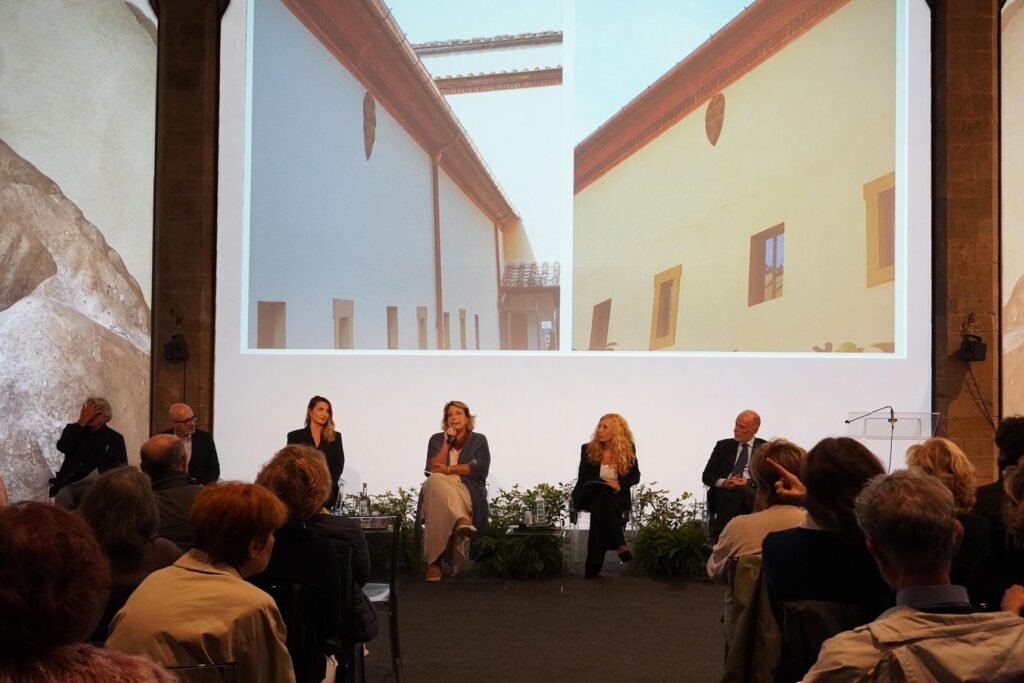
The result can be seen in the restored surfaces, in the recovered colors and in details that can now be observed more clearly.
But the value of the initiative goes beyond this single project.
Florence holds an extraordinary heritage, and preserving it demands constant attention, expertise and resources. The involvement of businesses rooted in the area can make an important contribution to this shared effort.
The story of the Scuola del Cuoio and the Gori family shows how a gesture born of a personal memory can become something shared.
A restoration that gives beauty back to Palazzo Vecchio and leaves the city a tangible sign of the bond between a family, its history and Florence.