I write about her as a woman, centuries after the life of Artemisia Gentileschi, starting from one conviction: the personal is always political. That is why the story of Artemisia Gentileschi deserves to be remembered and told again, perhaps now more than ever. Painterly skill, like the use of words, is an aesthetic matter, a question of style. And style is character. And character, understood as the willingness to accept responsibility for one’s own life, is the source of one of the fundamental ethical virtues: self-respect. Artemisia still teaches us that, in an age of decline, where the flattery is still plentiful and the victories few.
A workshop, a revolution.
Artemisia Gentileschi was born in Rome in 1593, the daughter of Orazio, a painter whose family came from Pisa. She was twelve when her mother died, leaving her the only girl in a house of men. Orazio painted in the wake of Caravaggio, at the turn of the seventeenth century. Around Merisi no real school took shape, but rather a network of friendships, rivalries and patrons; the novelty was painting “al naturale,” from life. Artemisia learned from her father, by watching and imitating him. Then she surpassed him. In 1612 Orazio himself wrote to the Grand Duchess of Tuscany that in three years his daughter had become so practiced that she had no equal. For a woman of the time, the word was pittora: a feminine form for a trade that, until then, had only ever been spoken of in the masculine.
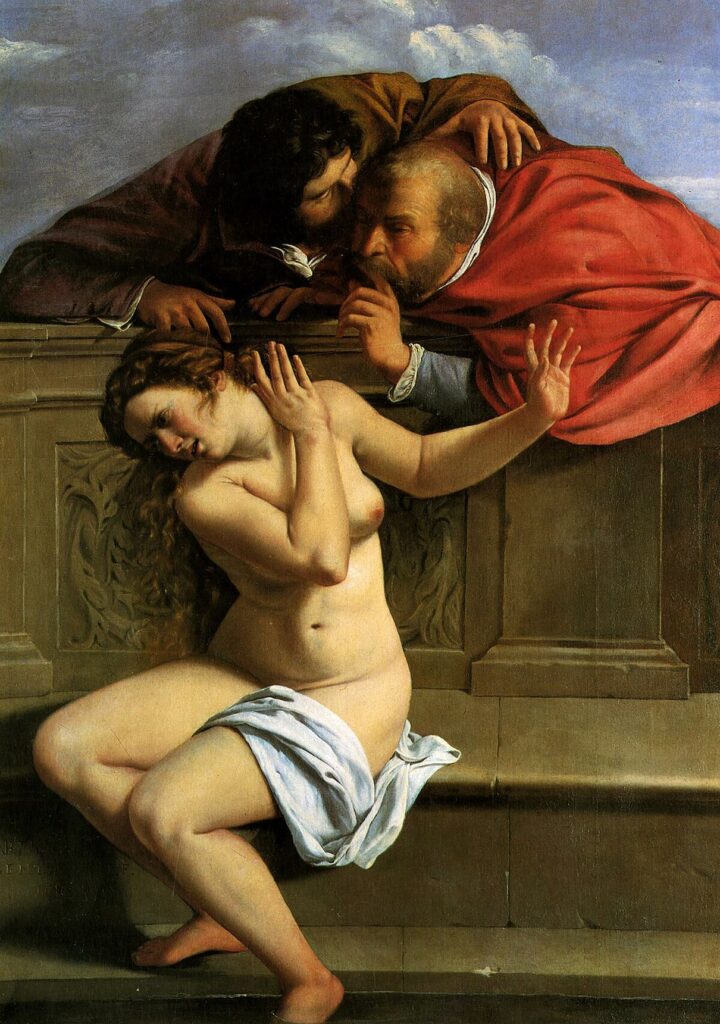
To round out her training, her father placed her with a master of perspective, Agostino Tassi, whose reputation preceded him: a criminal record in several cities, a hot temper, prison, trials and a life spent running from one sentence only to serve another. He remained a virtuoso of perspective and of quadratura, the painted illusionistic architecture that opens walls and ceilings onto loggias and skies. Orazio kept watch, because she was young and she was a woman. And yet it happened: it was Tassi himself who raped her, when Artemisia was seventeen.
Telling it, twice.
Most people know the story. The 1612 trial is one of the very few from the seventeenth century whose records have survived. The writer who gave it back to us in a novel, in every detail, was Anna Banti: another assumed name, because Banti is the pseudonym of a woman, Lucia Lopresti, who began writing in hiding and whom the world knew above all as “the wife of,” not as a woman in her own right. She was married to Roberto Longhi, the art historian who as early as 1916 had called Artemisia “the only woman in Italy who ever knew what painting is, and color, and impasto, and such essentials…”. Banti had to write the novel twice: the manuscript was lost in the Florence of 1944, under the rubble of the war, and she rewrote it from scratch, with unspeakable effort.
Artemisia in Florence.
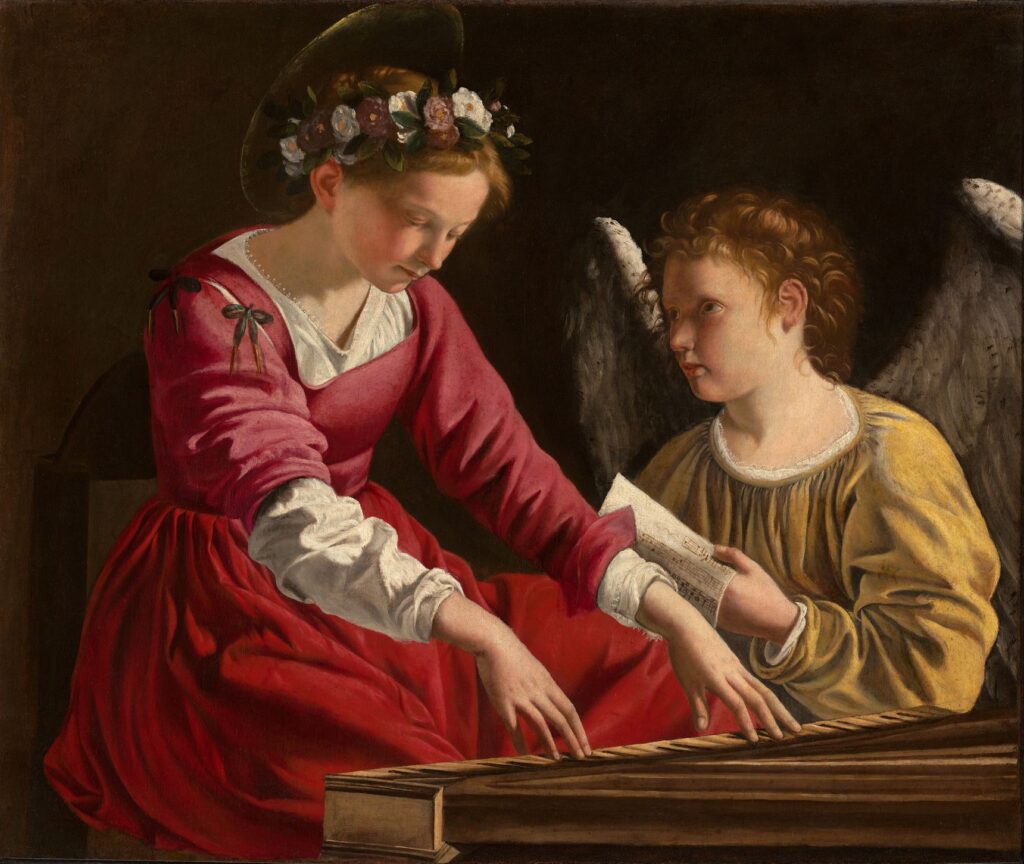
After the trial and a marriage of reparation to the Florentine Pierantonio Stiattesi, Artemisia left Rome for Florence. She was barely over twenty, and the city was cultured and competitive: there was the court of Cosimo II, of Christina of Lorraine and of Maria Maddalena of Austria. Here she received commissions from the Medici, moved among artists and intellectuals, and struck up a relationship with Galileo. She worked at home, which became her workshop, and learned to read and write with more confidence, tools she needed to deal with clients and middlemen. Success came at a price: debts, moves, lawsuits. In 1616 she was among the first women admitted to the Accademia delle Arti del Disegno.
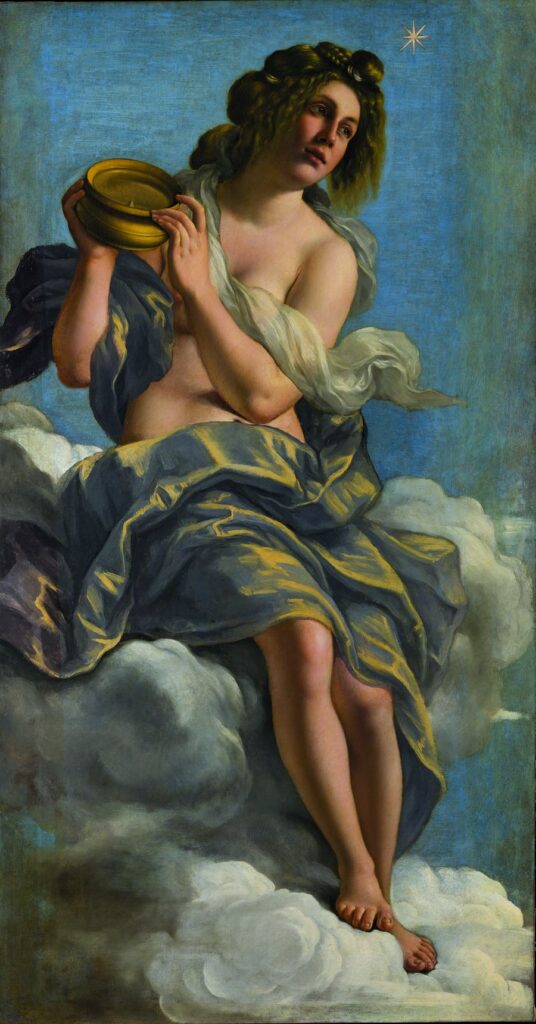
Michelangelo Buonarroti the Younger called her to Casa Buonarroti, the only woman on a project staffed by leading Florentine painters. For him she painted the Allegoria dell’Inclinazione (Allegory of Inclination), the force that steers a person toward what they were born for. She worked on that canvas for a year while pregnant: on November 18, 1615, Cristofano was born; he would die at five. She was paid thirty-four gold florins, more than three times what the other painters of the Virtues received.
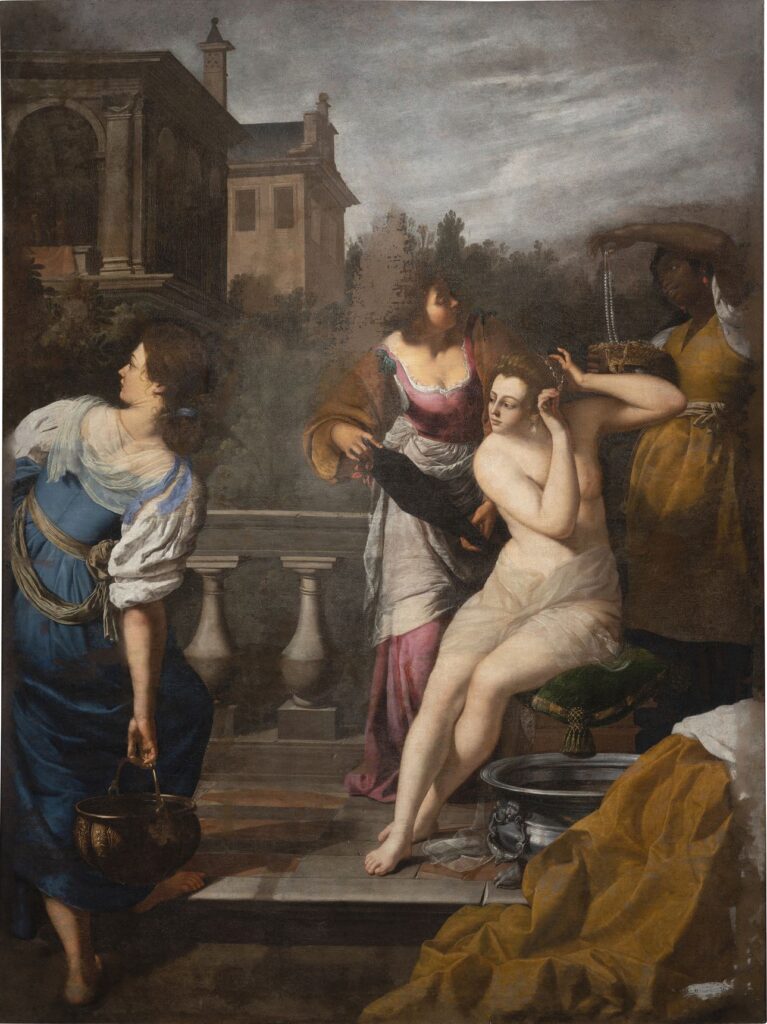
In 1620 she left Florence, which had given her prestige, connections and commissions, but also unresolved troubles. She returned to Rome, by then an established artist sought after by collectors and patrons, with her daughter Prudenzia, the only one of her children to reach adulthood. In 1630 she chose Naples, one of the liveliest capitals in Europe and one of the most vital art centers in the Mediterranean: she opened a successful workshop, where Prudenzia also trained, worked for aristocrats, religious orders and circles close to the Spanish court, and signed major public works such as the canvases for the cathedral of Pozzuoli. In 1638 she accepted the invitation of Charles I and left for London, where she joined her father Orazio, court painter, busy decorating the Queen’s House at Greenwich. Father and daughter were working in the same setting again after a long separation. Orazio died in 1639; Artemisia went back to Naples, where she carried on her work.
She is no longer the exception asking to be let in: she competes as an equal with her male colleagues, runs a workshop, collaborates with other artists, takes on the altarpiece, a ground reserved for the most established painters. She managed to make self-respect her trade.
The exhibition.
All of this is told at the Museo degli Innocenti, a place that has been caring for children for more than six hundred years. It feels like more than a coincidence that today it hosts the story of a woman who built her own freedom. And it happens in Florence, where an anti-violence center, long known for its work, also bears Artemisia’s name. The exhibition, curated by Cristina Acidini, Sandro Bellesi and Costantino D’Orazio and produced by Arthemisia (not the painter but the plant, no less “divine”), brings together more than fifty works from over forty lenders, and for the occasion also opens the unmissable rooms of the Pinacoteca.
The route starts in Rome, with a Caravaggio that opens the show: the Mondafrutto (Boy Peeling Fruit) in the Dickinson version, which resurfaced in 1996 at a London auction as a workshop piece and has been at the center of a critical debate ever since. Next comes the Florentine section, with the tragic heroines, biblical stories and myth, the sacred, the Magdalenes, the portraits, Casa Buonarroti. Upstairs, in the Pinacoteca, the last years between Naples and London. Alongside Artemisia are Orazio and the Florentine painters of the seventeenth century, from Cristofano Allori to Francesco Furini, from Cesare Dandini to Volterrano. It is a dialogue that brings back to light a Florence long left in the shadow of the Roman Baroque.
The installation winks at immersive exhibitions, with lights and projections: a style I personally don’t favor, as I prefer a less “televisual” way of showing art. The wall texts are direct and intuitive, with small “fun facts.”
But the works are extraordinary, and you can take them in directly: they hang at the height at which Artemisia painted them, not sky-high and hard to see, as so often happens with canvases of this size.
Women at the center.
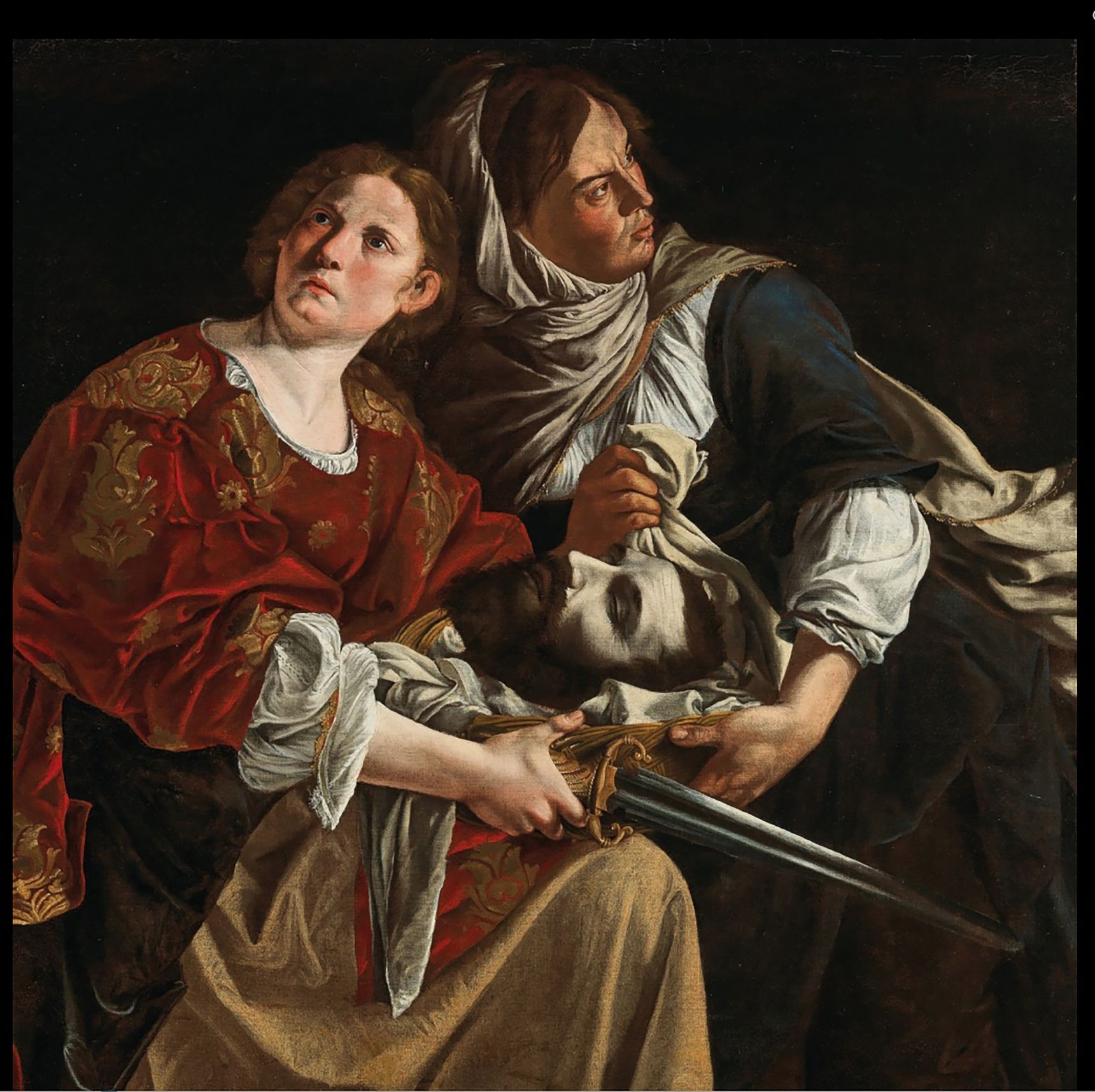
What strikes me is how central the women are. The painted stories are told with vivid definition, and a female complicity often emerges, even amid the most savage atrocities of the mythological and biblical tales that were circulating at the time. The severed heads of the men withdraw to the margins; what stays at the center are the gazes, the flushed cheeks of women who have finally done the deed. It brings to mind a little gem by the artist Erik Kessels, MAN (2005): a man, flanked by an equal number of women on either side, always stands exactly in the middle. Instinct, intent or pure coincidence? And so the binding of the book, which falls right there, makes him disappear on every page.
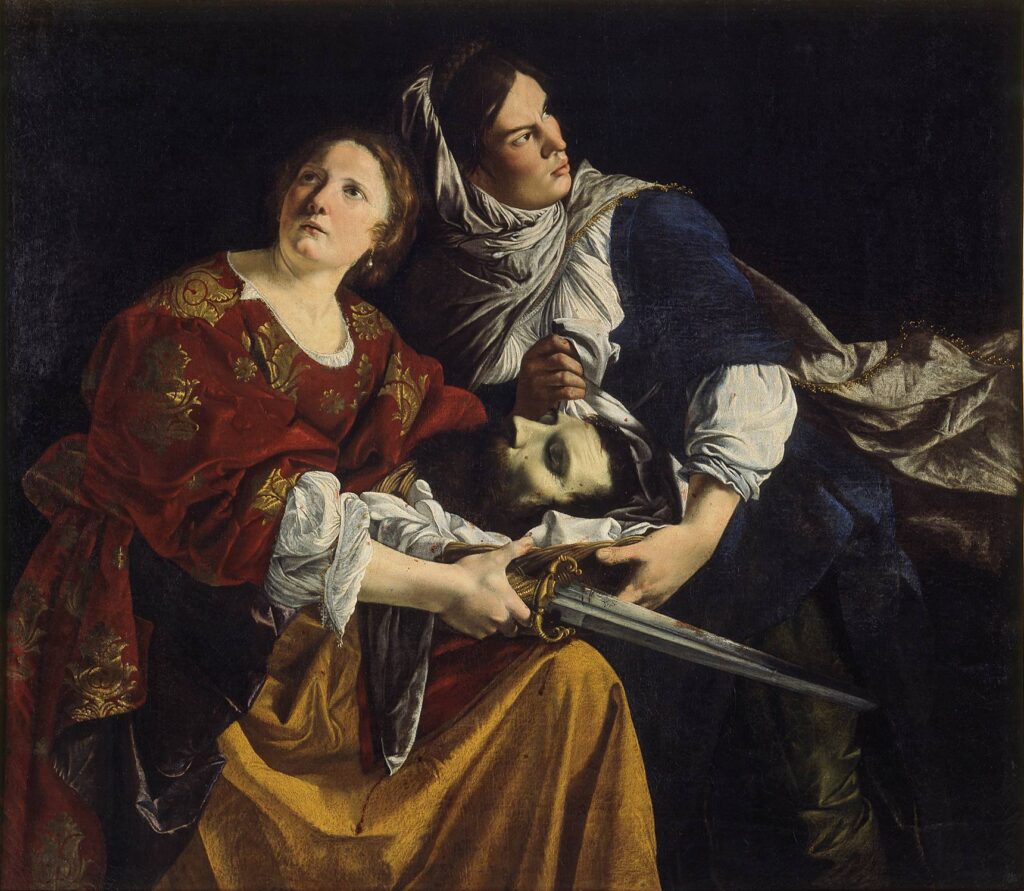
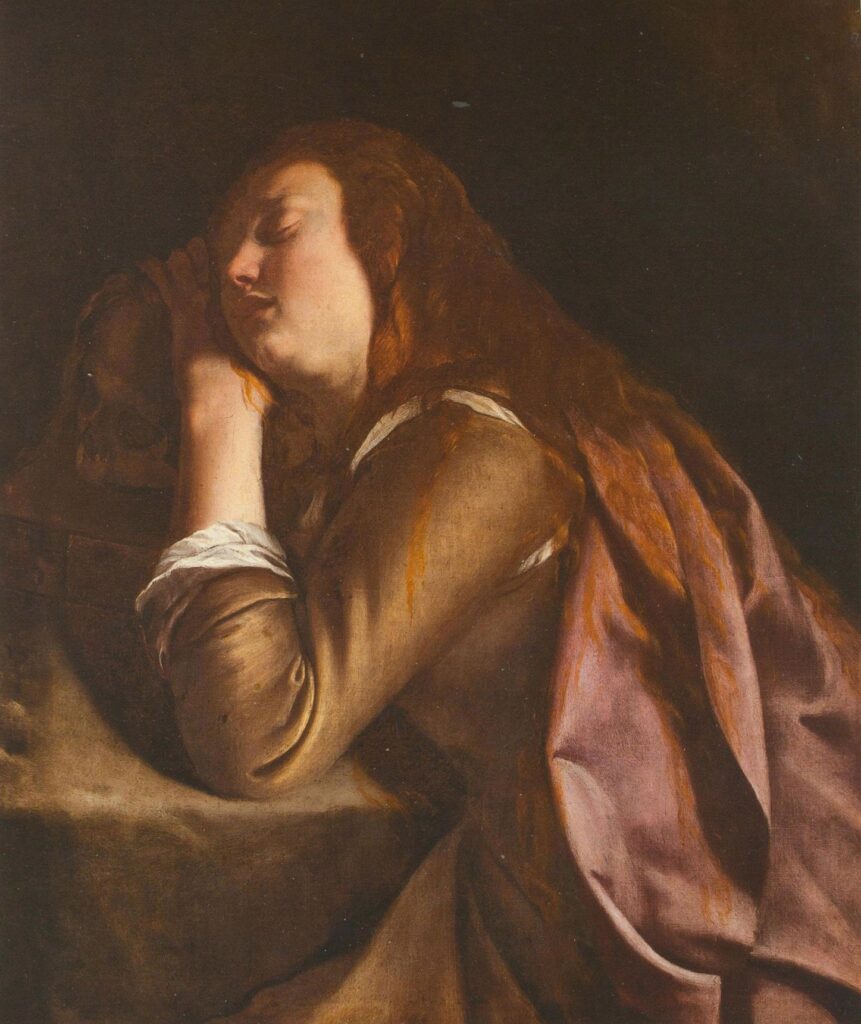
Artemisia’s women, by contrast, emerge from the black. The Allegoria della scultura (Allegory of Sculpture) is beautiful: Artemisia, who probably never had the chance to learn the rudiments of sculpture, shows she knows the craft perfectly well. It may be a self-portrait, because the woman wears a ring, a rather awkward accessory for someone who works stone. Moving is the comparison between Orazio’s Giuditta e l’ancella con la testa di Oloferne (Judith and Her Maidservant with the Head of Holofernes) and Artemisia’s, almost identical, but with women who are more excited, more animated, more flushed. Extraordinary is the Maddalena in meditazione (Mary Magdalene in Meditation), slumped over a skull, a memento mori: so human, her face lit on its tilted side, her hair loose, the colors golden and rosy, an expression of fullness, surrendered, her brows barely knit, in tension from self to self.
Artemisia did not need to be forgiven, or explained, or reduced to her wound: she painted with talent, she worked, she demanded. The question is how much it still costs, today, to do the same. “What served her was having no fear at all,” her husband, Pierantonio Stiattesi, wrote of her, in a line quoted on one of the exhibition panels.
The exhibition is worth the visit for the richness of the display and the exceptional value of the works, and to get to know Artemisia Gentileschi and never forget her.