From the Arno to the Oceans: The Florentine Navigators of the 1500s
Who was it that called Florentines “the fifth element of the world”? The odd phrase was coined by Pope Boniface VIII to praise the enterprise and reach of the men born in Florence. During the Jubilee of 1300, the pope had noticed that most of the ambassadors sent by Europe’s lords to pay him homage were Florentines. Boniface could hardly have guessed how apt the words would prove two centuries later, when Florentines, driven by that same spirit of initiative, began to fan out across the globe. The age of geographical exploration did not belong to the maritime republics alone; it swept up the people of Florence too, unrivaled masters of the art of commerce.
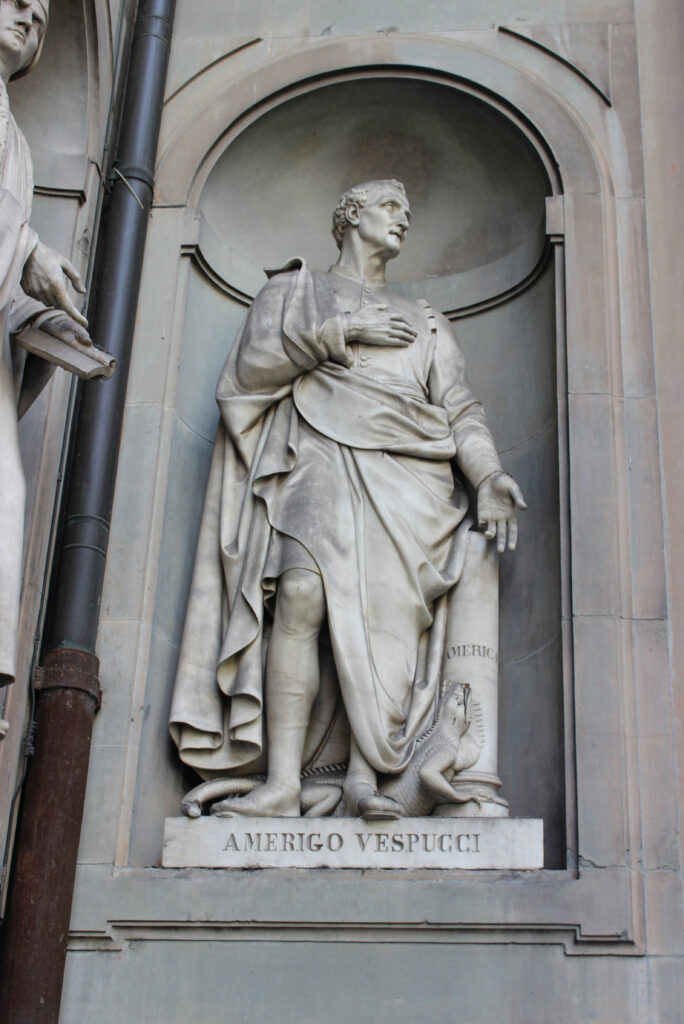
Amerigo Vespucci: undeserved fame?
The sharpest traveler among them was Amerigo Vespucci (1454–1512), the first to grasp that the shores he had reached across the Atlantic were not the coast of Asia but those of a Mundus Novus, a “New World,” as he christened it in one of his letters. Using a method he devised himself for calculating longitude, Vespucci realized that the search for a western route to the East had in fact landed him on an unknown continent. His legendary crossing is usually dated to around 1501, nearly a decade after Christopher Columbus’s. So why does the continent bear his name, and not that of the Genoese navigator?
Columbus never once doubted that the coasts he had reached were the far edge of eastern Asia. Vespucci, by contrast, understood otherwise from the start, and his accounts were quickly printed in Florence and circulated across Europe. They reached as far as Germany, where the cartographer Martin Waldseemüller, drawing an updated map of the world for his Cosmographiae Introductio (1507), chose to name the new continent “America,” a feminine Latinization of Amerigo (the pronunciation later shifted under the influence of “Africa”). For this, Bartolomé de Las Casas accused Vespucci of usurping the credit for the discovery: in the Spanish bishop’s view, the new continent should have been called “Columba.” The idea was revived three centuries later, in 1819, when the Venezuelan revolutionary Simón Bolívar chose the name “Gran Colombia” for the South American state he had wrested from the Spanish Crown.
De Las Casas was not Vespucci’s only detractor. Over the years, more and more came to see the navigator as a boaster and his reports as forgeries dressed up to win him an undeserved place in posterity. The long-running “Vespucci question” is captured perfectly in a dilemma posed by the historian Marina Montesano: “So who are we dealing with? An intelligent member of Florence’s leading class in the early Medici age who, drawing on the standing and influence of certain relatives, tried his hand at politics and diplomacy and then at trade, before finding his truest calling as a sailor-astronomer, perhaps a cartographer, and backing it with a real gift for self-promotion? Or a shrewd, unscrupulous publicist of feats he claimed as his own and merits that belonged to others, favored by the spread of that formidable new instrument, the printing press?”
Giovanni da Empoli: the voyages of a Life
The exploits of the Florentine merchant Giovanni da Empoli (1483–1518) are far harder to doubt. His travels can be reconstructed from a varied trail of documents: travel reports, account books kept in Portugal and across Asia, and letters sent to members of the Medici family. Our fullest source is the Vita (“Life,” 1544), a biography written by his uncle Girolamo da Empoli at the age of eighty-nine. In it, the biographer recounts the three voyages the merchant managed to make in his short life, and the considerable fortune he amassed through them. The Vita teems with episodes worthy of the best adventure novels: Girolamo tells of sudden dead calms, of mutinies sparked by a shortage of fresh water (which, in one desperate attempt, was stretched with seawater), and of encounters with hostile peoples, including an astonishing battle against the war elephants of the natives of Malacca, and the mysterious fire aboard one of the cargo ships. So relentless were the hardships that the merchant drew up a will in Singapore before his third voyage, bound for the fabled empire of China. Giovanni died in Canton at just thirty-five, killed by a cholera epidemic that broke out aboard his ship. He was the first Tuscan traveler ever to reach the Far East.
Filippo Sassetti, the merchant-scholar
The Florentine merchant Filippo Sassetti (1540–1588) had far less luck in business. His lack of timing and commercial instinct went hand in hand with a total indifference to goods, trade, and shipments. Sassetti took up the trade only on his father’s orders, setting aside his humanist calling, which is why his letters from India brim with sharp observations on the most unexpected subjects. In them, the merchant-scholar holds forth on the bioluminescence of plankton, magnetic declination, the armored shell of the armadillo, and the customs of the cannibal peoples he met along the way. It is no accident that his pen name at the Florentine Academy was “Assetato,” the Thirsty One, thirsty for knowledge, that is. And yet Sassetti would have dropped the transoceanic routes in a heartbeat to return to the leisure of letters in his distant Florence.
Had he stayed home, though, he would never have arrived at the surprising insight that saved him from oblivion: Sassetti was the first to notice the resemblance between Sanskrit, an ancient Indian language, and several European tongues, both ancient and modern. Those offhand observations would become the prelude to studies that, over the following centuries, led scholars to posit an ancient common ancestor, the so-called “Indo-European” language. In pursuit of Dante’s virtute e canoscenza, “virtue and knowledge,” these Florentines traced the lineage of a tongue that linked West to East and redrew the boundaries of the known world, even if from a Eurocentric point of view, as Roberto Benigni notes in the film Non ci resta che piangere (“Nothing Left to Do but Cry”). The Renaissance had taught them that the quintessence of the universe was humankind and its noblest aspirations: to understand where we come from, to press on where no one has yet gone. The answers waited beyond the horizon.