Piazza della Repubblica: The Contested Heart of Florence
In every great city there is at least one square, street, or even neighborhood that, as you stroll past, seems entirely detached from its surroundings — a world apart, a reality within a reality. Florence, of course, is no exception, and here that role belongs, without a doubt, to one of the busiest squares in the historic center — and perhaps one of those with the most to say about history: Piazza della Repubblica. What captivates us is not only its peculiar difference, which seems to have nothing to do with the “Florentine atmosphere,” but also the gentle, melancholy, agreeable strains of music played by the many street performers who gather here — especially at sunset, when a warm, inviting orange light wraps around everything.
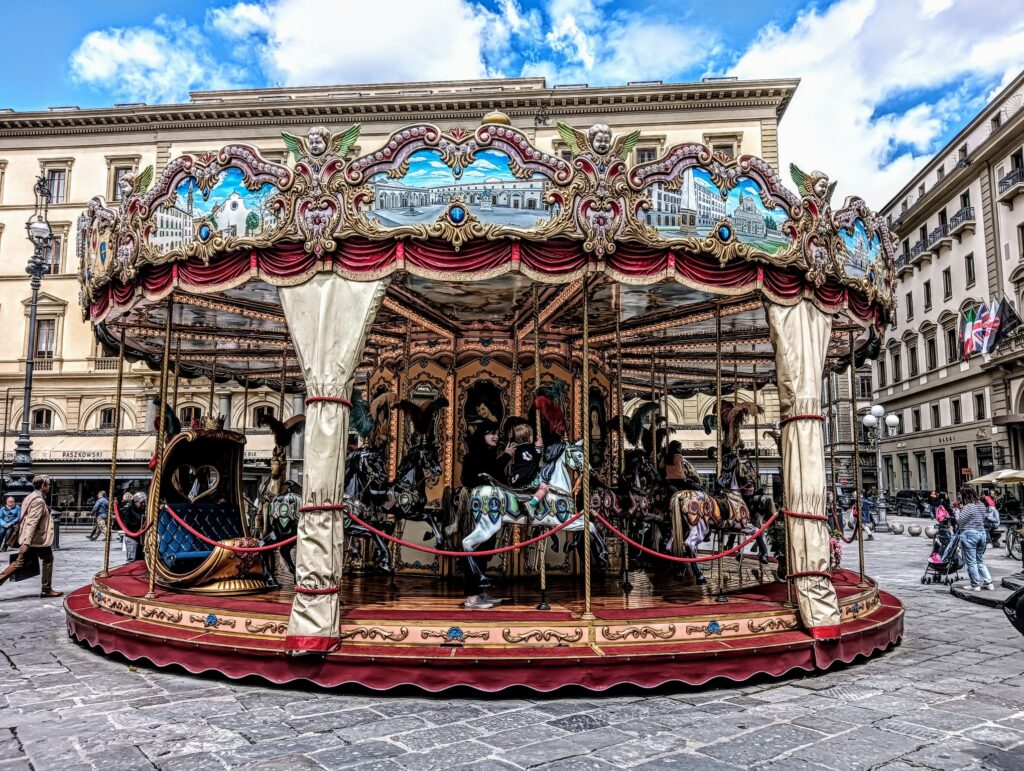
One of the first things to catch your eye in Piazza della Repubblica is the carousel for children (and adults, too). Few people know, though, that once upon a time — when Piazza della Repubblica was still called Piazza del Mercato Vecchio (Old Market Square) — the carousel’s spot was occupied by the Loggia del Pesce (Fish Market Loggia), which today can be admired in Piazza dei Ciompi, where it was moved during the great urban renewal. But let’s put things in “historical order,” so to speak, the better to understand how this square was born and transformed.
Piazza della Repubblica stands where the ancient Roman Forum once lay, at the crossing of the Cardo (today Via Roma, Via Calimala, Via Por Santa Maria) and the Decumanus (Via del Corso, Via degli Speziali, Via Strozzi). Sadly, nothing of it survives today, apart from certain 19th-century archaeological finds pointing to places of worship and a bath complex to the south — where, not by chance, the aptly named Via delle Terme (Street of the Baths) still branches off.
During the early Middle Ages, the area ringing the square was densely built up, so much so that vegetable gardens and green spaces all but vanished to make room for tower-houses — the only structures that, being vertical, could fit into Florence’s cramped and crowded core. And so the square, hemmed in and perhaps suffocated by palaces, alleys and tabernacles heaped one atop another, came after the year 1000 to be called Piazza del Mercato (Market Square): just as Piazza del Duomo embodied religious power and Piazza della Signoria political power, this square was assigned commercial power, becoming one of the city’s most important crossroads. If little trace of all this remains today, the 15th-century Colonna dell’Abbondanza (Column of Abundance), also called della Dovizia, can fortunately still be admired, having been spared by the urban overhaul carried out during the renewal in the era of Florence-as-Capital (1865–1871).
The column, marking “the navel of the city” — its exact center — is topped by a resin replica of a pietra serena statue representing Abundance (Dovizia), made by Mario Foschi in 1956; that statue is itself a copy of a work by Giovan Battista Foggini, which had in turn replaced a sculpture by Donatello, sadly lost.
More intriguing still is the reason for the two iron rings that encircle the column. One (the higher of the two) held the bell that rang to signal the opening and closing of the market; the other (lower down) served a more peculiar purpose — to chain up swindlers and dishonest merchants so that passersby could jeer, scorn and mock them. This was a rather fashionable way in the Florence of the time to punish minor offenders; for graver crimes, there was the executioner.

Later, in 1571, a Jewish Ghetto was established in the square by Cosimo I, to separate, exclude and confine the Jews living in the city, restricting them to trade alone — as was happening in every other major Italian city of the age. Nothing of the Ghetto survives today either, because of that same “renewal” promoted under King Vittorio Emanuele II for the city of Florence, which in this case meant leveling the square, demolishing its buildings and raising new ones better suited to the taste of the rising bourgeoisie — all under the pretext of improving the by-then wretched sanitary conditions, a pretext that in fact concealed an ambitious real-estate speculation.
Among those pushing for the project were several prominent figures of the day, such as the journalist Jarro (Giulio Piccini), who in his book Firenze Sotterranea (Underground Florence) denounced the sanitation problem at length. The square was renamed Piazza Vittorio Emanuele II, and an equestrian bronze of the king was even placed there — though today it can be admired in the square of the same name that fronts the entrance to the Cascine park. The market, meanwhile, was moved to the San Lorenzo area.

The square became Florence’s true “grand parlor,” ringed by sumptuous 19th-century palaces that the Macchiaioli painter Telemaco Signorini bluntly dismissed as “monstrosities,” making plain his contempt for bourgeois taste. On the square’s southern side, a triumphal arch was built, marking the lavish passage from the square to Via Strozzi and on to the refined Via de’ Tornabuoni, along with majestic arcades flanking the arch — all the work of the architect Vincenzo Micheli.
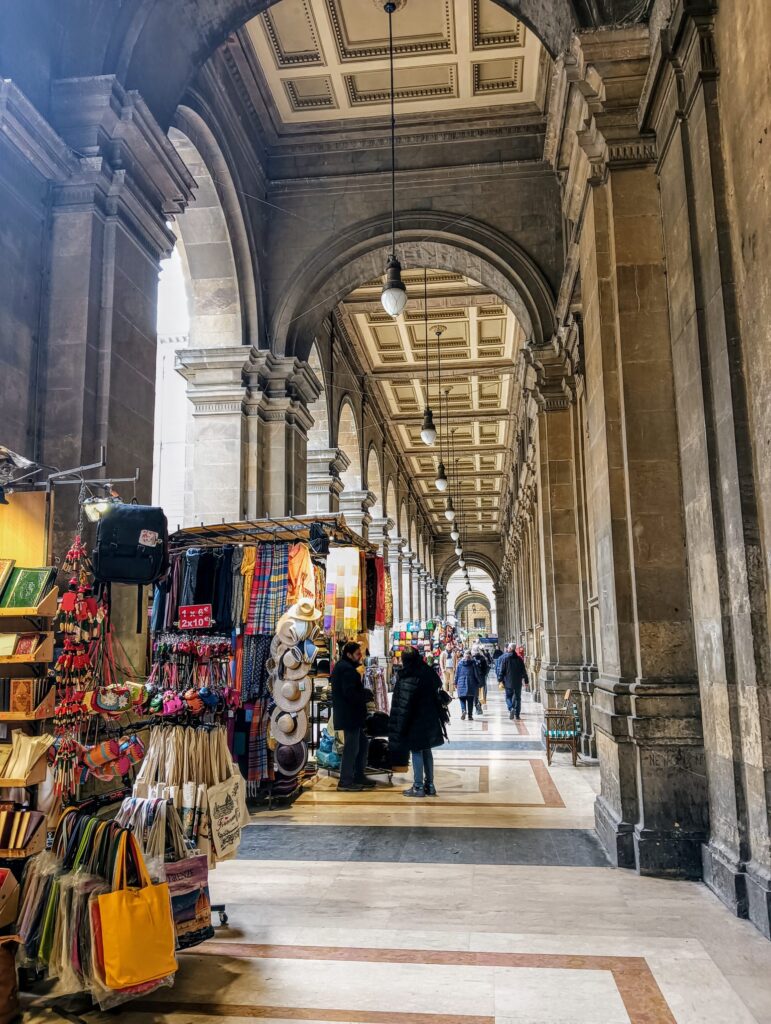
The arcades, beneath which hordes of tourists walk today, house shops, tobacconists, newsstands, the Central Post Office and the international Hard Rock Cafe, as well as a colorful flower and plant market held every Thursday (except public holidays), from 8 a.m. to 2 p.m.
Beyond the pompous palaces and the triumphal arch — which conjured up more than a little of the splendor of ancient Rome — other buildings rose as well, among them the still-standing Pensione Pendini, set within the arch building, founded in 1879 by a member of the Pendini family and designed to host travelers in an age when the famous “Grand Tour” was in vogue among wealthy intellectuals of the European aristocracy. Then there is the Palazzo del Trianon, inaugurated in 1891 and today home to the La Rinascente department store; the Savoy, erected in 1898 and still a hotel today; and the neo-Renaissance Palazzo Levi, dating to 1893.

But of undoubted historical and cultural importance are the historic cafés that still surround the square — all except the Caffè Gambrinus, sadly gone, in whose place we now find the Hard Rock. Among those we can still admire and enjoy is the celebrated Le Giubbe Rosse café (1897), so named because its waiters wore the “red jackets” then fashionable in Vienna. It became a lively literary salon, hosting the Futurists and serving as the stage for the famous brawl between Marinetti’s Milanese Futurists and the Florentine artists gathered around the magazine La Voce.
Over the years it became the literary café par excellence, its rooms frequented by well-known and active figures of Florence’s exuberant cultural life, such as Eugenio Montale, the painter Ottone Rosai, Aldo Palazzeschi, Elio Vittorini and others. The café’s fortunes were not without controversy and setbacks, which led to the bankruptcy of the company running it.
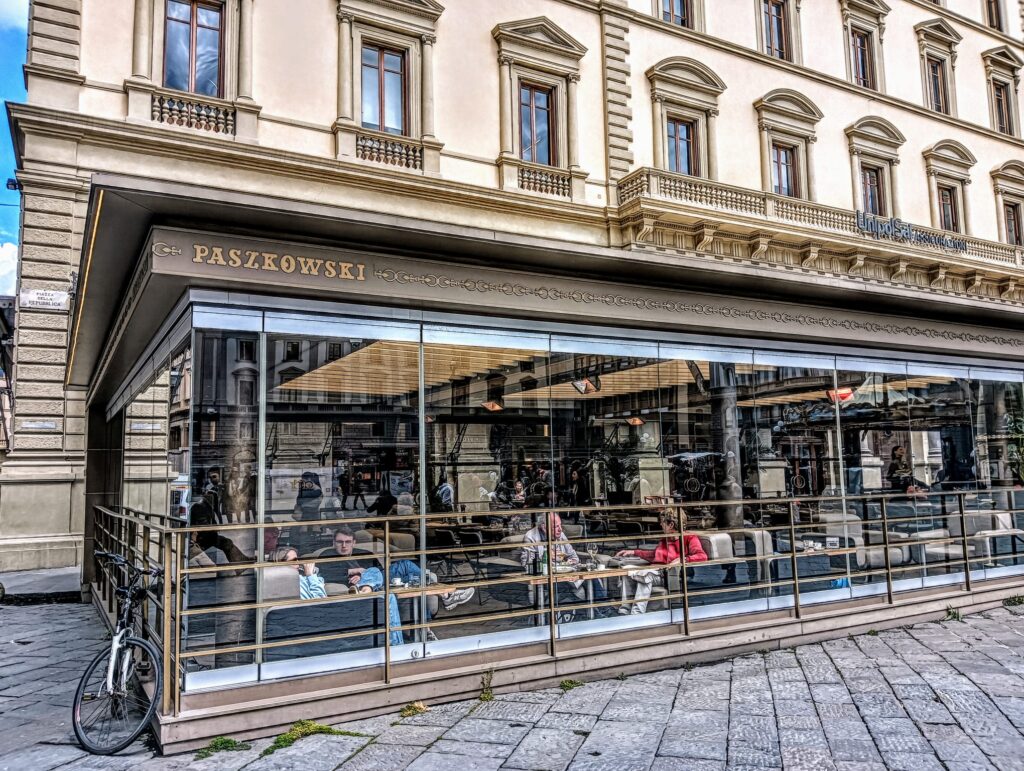
On the other side of the square, inside the Palazzo Levi mentioned above, stands the Caffè Paskowski, founded in 1903 by the Polish family of the same name. It became a café-concert, a character it still preserves today. Needless to say, enjoying an aperitivo here — whether indoors, amid its early-20th-century furnishings, or outside, perhaps to the strains of a skilled pianist at work — is an experience well worth having.

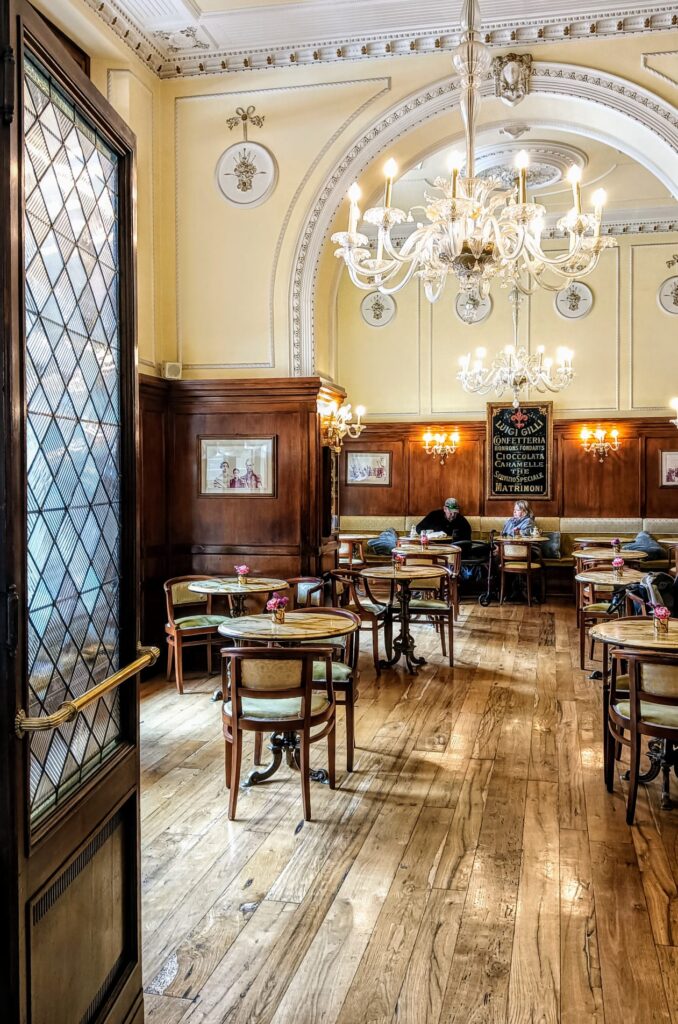
Next to Paskowski, at the corner with Via Roma, stands the Caffè Gilli, declared a national monument in 1991. Founded by the Swiss family of the same name in the second decade of the 20th century, it is today the only surviving example in Florence of a “Belle Époque” café, still with its original furnishings, frescoed ceilings and Murano-glass chandeliers. Stepping inside, sitting at one of those little tables and savoring a delicate pastry over a steaming cup of tea, is a plunge into a fascinating era — perhaps one of the most mannered and indulgent in history — an atmosphere that a place like Caffè Gilli still evokes with extraordinary power.

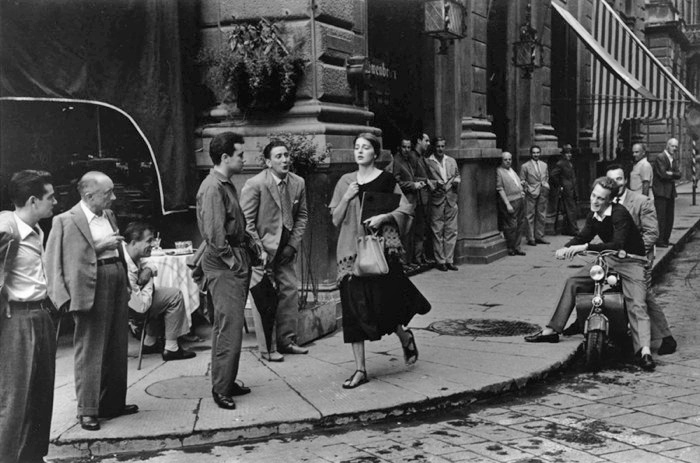
But this café is famous not only for its literary clientele: it is also known for another detail — a photograph, American Girl in Italy (1951), taken by the celebrated American photographer and filmmaker Ruth Orkin (1921–1985) right in front of Gilli’s windows. It shows a 23-year-old woman walking alone with a shy yet resolute, self-assured stride, passing through a group of fifteen men who watch and study her with curiosity.
In short, Piazza della Repubblica — renamed as it is today after the birth of the Italian Republic — is one of those squares that has watched history pass by, but has also endured it, not always for the better, and that in any case has much to tell us. Not everyone, then or now, has admired the aesthetic evolution that made this square what it is today: almost a scale model dropped at random among the ancient, medieval-looking buildings of Florence’s historic center, disrupting the general view of the city like a flaw amid so much beauty. And yet it would be worth looking past that first impression to learn the history behind it — the history that took Piazza della Repubblica from a place oppressed by a tangle of towers, buildings and alleys to a bold rationalization that gave it a graceful, harmonious aspect, however foreign to the overall picture our eyes hold of the city.
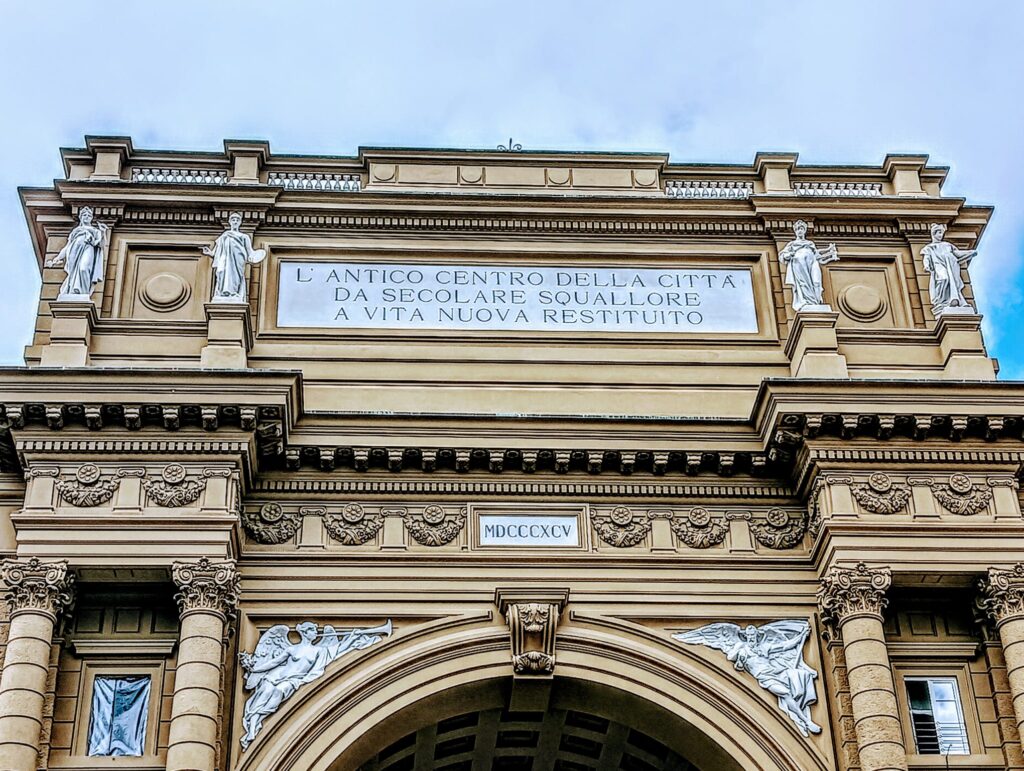
And if the hurried visitor’s gaze does not stop at mere appearances but lifts a little higher — both figuratively and literally — it will surely not miss the solemn inscription, attributed to the literary critic and politician Isidoro del Lungo (1841–1927), set atop the triumphal arch: “L’ANTICO CENTRO DELLA CITTÀ / DA SECOLARE SQUALLORE / A VITA NUOVA RESTITUITO” (“The ancient center of the city, restored from centuries of squalor to new life”). Only then can one leave this square, beneath the caressing notes that captivated us a moment ago, and continue the visit of Florence, secure in not having overlooked its history — the kind that makes a city truly matter.