Hitler in Florence, 1938 — and the Poem That Answered Him
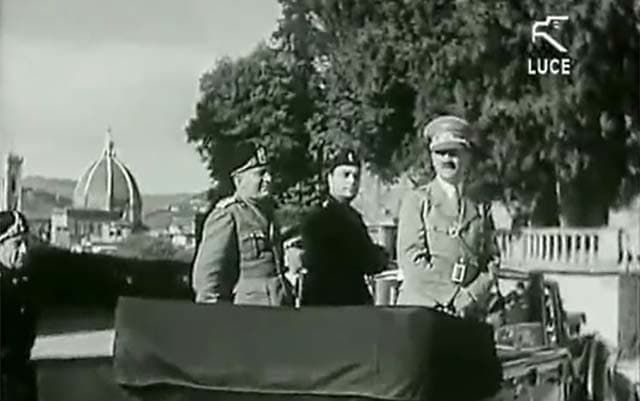
Hitler steps off the train from Rome at platform 16, like any ordinary tourist. Santa Maria Novella station is a riot of lily-emblazoned banners, swastikas, House of Savoy coats of arms and fascist symbols. The crowd presses in for a glimpse of the guest in all his luciferian splendor. Among them is the poet Eugenio Montale — or so it seems, to judge by his poem La primavera hitleriana (“The Hitler Spring”), published in 1946 and later gathered into the collection La bufera e altro (“The Storm and Other Things,” 1956). The dictator sweeps down Corso Regina Elena — today Corso Italia — while the militiamen bawl their exultant alalà war-cries. Montale watches the grotesque parade, brooding. It is as if the city of the lily had been turned into Pandemonium itself.
Hitler had never been to Florence, but he had often daydreamed over its painterly treasures in his manuals of medieval and Renaissance art. Throughout the day, Benito Mussolini escorts him — to the Boboli Gardens, to the Pitti Palace, to the Uffizi, to the Palazzo Vecchio — like a tour guide. Before the most sublime works, the Austrian lets out a guttural gurgle of pure satisfaction. He crosses the Vasari Corridor murmuring with excitement, “Michelangelo, Michelangelo…”
Mussolini, by contrast, makes no secret of his utter indifference to painting, gazing at the canvases as though facing a blank white wall. In their honor an opera is staged at the Teatro Comunale: Giuseppe Verdi’s Simon Boccanegra. A singular choice, given that the story ends with the killing of a tyrant. Even so, the melodrama is much appreciated by the Nazi official Joseph Goebbels, who writes in his diary that it was “an excellent performance.”
The shop windows of the center pay homage to the Führer, too. They are half empty, drained by the recent sanctions over the invasion of Ethiopia (1935–36), but what little remains is steeped in the militarist spirit befitting the pre-war mood: cannons and toy weapons appear in them. The door of the Beccaio’s butcher shop is bolted shut — he, too, has decided to close in celebration of the visit. Ordinarily his windows displayed slaughtered kid goats, their muzzles adorned with berries. Ferocity creeps into the harmlessness of the toy, into the macabre display of flower-decked carcasses. The shopkeepers, in their unwitting cult of the slaughter, foreshadow the coming spilling of innocent blood.
Nazi-fascist ideology perpetuates itself through acquiescence; every single act carries its share of responsibility and complicity. Aware of this, Cardinal Elia Dalla Costa has barred all the entrances of Florence’s churches, the cathedral of Santa Maria del Fiore and the basilica of Santa Croce included. Hitler and Mussolini will not set foot in a single place of worship. He boldly declares that he will venerate “no crosses but that of Christ” — an obvious jab at the blasphemous swastika. Montale, too, upholds anti-fascism, and pays for it: a few months after the chancellor’s visit, he will be stripped of his post as director of the Gabinetto Vieusseux for refusing to join the party.
Once the Nazi’s car has sped away, the poet begins to question himself. “All for nothing, then?” Centuries of civilization and culture have failed to prevent world war. Suddenly the figure of Irma Brandeis resurfaces in his memory — his beloved, with her steel-gray eyes. Of Jewish descent, she had been forced to return to the United States to escape racial persecution. He relives their final farewell, which had taken place in this very city. The sky was lighting up with fireworks for the feast of Saint John, patron of Florence. To the memory of that pyrotechnic display he joins the evocative vision of a comet in the icy skies of North America — an omen of possible salvation in the darkness of the future.
He thinks back to the secret promises they made, and to how Irma’s hands seemed to transform, marvelously, into sunflowers ready to turn toward their source of life. He had chosen to rename her Clizia in his verse, borrowing the name from a mythological fabula in Ovid’s Metamorphoses. In the Ovidian poem, the nymph Clytie, abandoned by the Sun god, resolves to eat nothing for nine days but tears and dew, and to await her beloved’s return on the bare earth. Her limbs finally fuse with the ground. She becomes a heliotrope — a plant — preserving her tormented love though changed in form (“mutataque servat amorem,” “and, transformed, she keeps her love”).
Night falls. Shaken and heartbroken, the poet studies the unsettling phenomena the Führer‘s arrival seems to have caused. A swarming cloud of white moths thickens over the banks of the Arno. Many of them plummet to the ground, struck down by the glare of the spotlights. On the earth they form a layer that crunches underfoot like sugar crystals when trodden. And here, faced with the prophecy of extermination in the form of a deadly snowfall of moths, Montale’s poetry reaches its lyric zenith. Sunlike Clizia — she who loves with the same intensity despite the turns of personal and historical fate (“changed, she keeps her love unchanged,” as Dante perhaps wrote in a sonnet of doubtful attribution) — must become the guarantor of the salvation of all humankind, an otherworldly allegory of undying hope. Her light must join with the absolute light of the Divine, just as Beatrice’s does in the Paradiso. In her dazzling sublimation, in her cathartic, Christ-like sacrifice, she will regenerate herself, blazing like the phoenix. Through her, poetry can take on a mediumistic message, standing against the diabolical delirium of the looming apocalypse of war.
The Duce escorts the Führer to the station. They part with a promise as solemn as it is vainglorious: “Now no force can separate us.” A tear runs down the chancellor’s face. The train heads for Berlin; Mussolini’s car sets off for Rome. Montale listens to the pealing of bells that bids the Nazi-fascists farewell — midnight has just struck. Perhaps the tolling of the Martinella bell is already blurring with a celestial sound foretelling victory over absolute evil. Then he turns his gaze to the gravelly banks of the Arno. In the darkness of the night he imagines the coming of a fresh, luminous dawn, free of the sinister fluttering. In his mind he begins to shape the lines of a poem, in the dream that literature might annihilate horror through its radiant foresight.
La primavera hitleriana (“The Hitler Spring”), Eugenio Montale
Folta la nuvola bianca delle falene impazzite
Dense, the white cloud of crazed moths
turbina intorno agli scialbi fanali e sulle spallette,
whirls around the pallid streetlamps and over the parapets,
stende a terra una coltre su cui scricchia
spreading on the ground a blanket that crunches
come su zucchero il piede; l’estate imminente sprigiona
underfoot as if on sugar; the coming summer sets loose
ora il gelo notturno che capiva
the night frost that had lain hidden
nelle cave segrete della stagione morta,
in the secret hollows of the dead season,
negli orti che da Maiano scavalcano a questi renai.
in the gardens that spill down from Maiano to these sandy banks.
Da poco sul corso è passato a volo un messo infernale
A moment ago an infernal messenger swept in flight down the avenue
tra un alalà di scherani, un golfo mistico acceso
amid the war-cries of his thugs; a mystic gulf, lit up
e pavesato di croci a uncino l’ha preso e inghiottito,
and decked with hooked crosses, seized and swallowed him,
si sono chiuse le vetrine, povere
the shop windows have closed, poor
e inoffensive benché armate anch’esse
and harmless though they too are armed
di cannoni e giocattoli di guerra,
with cannon and toys of war,
ha sprangato il beccaio che infiorava
the butcher has barred his door — he who wreathed
di bacche il muso dei capretti uccisi,
with berries the muzzles of the slaughtered kids,
la sagra dei miti carnefici che ancora ignorano il sangue
the feast of the mild executioners who still know nothing of blood
s’è tramutata in un sozzo trescone d’ali schiantate,
has turned into a foul jig of shattered wings,
di larve sulle golene, e l’acqua séguita a rodere
of grubs upon the flood-plains, and the water goes on gnawing
le sponde e più nessuno è incolpevole.
at the banks, and now no one is blameless.
Tutto per nulla, dunque? – e le candele
All for nothing, then? — and the Roman
romane, a San Giovanni, che sbiancavano lente
candles, on St. John’s night, that slowly whitened
l’orizzonte, ed i pegni e i lunghi addii
the horizon, and the pledges and the long farewells
forti come un battesimo nella lugubre attesa
strong as a baptism in the grim waiting
dell’orda (ma una gemma rigò l’aria stillando
for the horde (but a jewel scored the air, raining down
sui ghiacci e le riviere dei tuoi lidi
on the ice and shores of your far coasts
gli angeli di Tobia, i sette, la semina
the angels of Tobit, the seven, the seed
dell’avvenire) e gli eliotropi nati
of the future) and the heliotropes born
dalle tue mani – tutto arso e succhiato
of your hands — all scorched and drained
da un polline che stride come il fuoco
by a pollen that shrieks like fire
e ha punte di sinibbio…
and stings like a driving blizzard…
Oh la piagata
Oh, the wounded
primavera è pur festa se raggela
spring is still a feast if it freezes
in morte questa morte! Guarda ancora
this death into death! Look up
in alto, Clizia, è la tua sorte, tu
again, Clizia: it is your fate, you
che il non mutato amor mutata serbi,
who, changed, keep your love unchanged,
fino a che il cieco sole che in te porti
until the blind sun you carry within you
si abbàcini nell’Altro e si distrugga
is dazzled in the Other and destroyed
in Lui, per tutti. Forse le sirene, i rintocchi
in Him, for all. Perhaps the sirens, the tolling bells
che salutano i mostri nella sera
that greet the monsters on the evening
della loro tregenda, si confondono già
of their witches’ sabbath, are already blurring
col suono che slegato dal cielo, scende, vince –
with the sound that, loosed from heaven, descends and conquers —
col respiro di un’alba che domani per tutti
with the breath of a dawn that tomorrow, for all,
si riaffacci, bianca ma senz’ali
may rise again, white but without the wings
di raccapriccio, ai greti arsi del sud…
of horror, over the scorched riverbeds of the south…