Lost and Rediscovered Theaters of Florence
Let’s begin with a detour into Piazza dell’Unità. Here, a few steps from the Santa Maria Novella station, Florence keeps a small secret. Because it sits at the level of the second floor of an otherwise unremarkable building, it risks going forever unnoticed. With your back to the obelisk and your eyes on the Hotel Baglioni, follow the facade and turn right into via del Melarancio. The first building you reach, today a holiday rental, is an ochre-yellow townhouse with brown shutters.
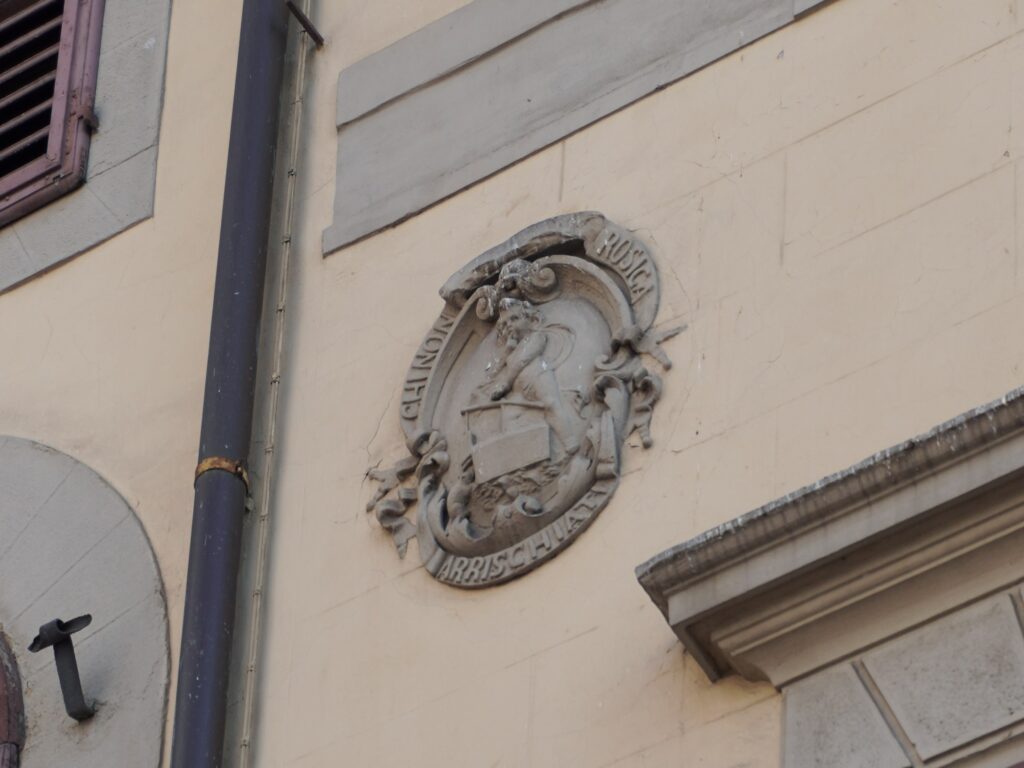
Look up and you’ll surely spot a strange coat of arms, showing what looks at first glance like a mouse in a trap, framed by the motto “Chi non risica non rosica” — nothing ventured, nothing gained. We are at the old seat of the Accademia degli Arrischianti, a company founded in the eighteenth century and so nicknamed — or so the story goes — precisely because of the hazardous state of the theater in which its members performed.
Of that old wooden structure — “a puppeteer’s shack” — nothing survives. This little theater lasted barely a century before being demolished in 1871 and converted into apartments. Dig into the relationship between Florence and the stage, and certain recurring patterns leap out.
If the venues active today number somewhere between twenty and thirty, just as many — if not more — have shut their doors over the years, turning into cinemas, private homes, or hotels, or else being torn down amid the urban upheavals that reshaped the city across the nineteenth, twentieth, and twenty-first centuries. The current picture, map of Florence in hand, is the sign of a series of shifts that are steering the city’s cultural offering toward a genuine metamorphosis.
Old beacons of stage drama in the northern part of the city are slowly fading, while fresh signs of vitality are appearing to the south and along the Isolotto–Cascine–Novoli axis. The story is different in the center and in the Oltrarno, where venerable cultural strongholds are dying out and old historic institutions are being patched up or updated, though with disappointing results.
The hardest-hit neighborhood, in any case, is Rifredi. Beyond the painful loss of the Flog and the conversion of the Palazzetto ITI at the Ponte di Mezzo into a sports center, much of the area’s energy has clearly been sapped by the end of the “Il Buh!” project and, above all, by the crisis of the historic Teatro di Rifredi — recently taken under the wing of the Pergola and in need of a rescue plan worth more than a million euros.
Music and stage drama now cluster in the ARCI social clubs, such as the Casa del Popolo Lippi and the Nuovo Sentiero. Moving into the center, we find old friends and very old protagonists reinvented as something new: on one side the grandees (the Verdi, La Pergola) and the more intimate venues (the Teatro del Sale), on the other the beguiling legacies of a theatrical tradition rooted in the seventeenth and eighteenth centuries (the Niccolini).
The Gada Playhouse, set inside a deconsecrated church near Sant’Ambrogio, is meanwhile making a name for itself with an ever richer program of workshops and performances that draw a young crowd. Over in the Oltrarno, the historic triangle of Sala Vanni, Cango, and Cestello stands out, alongside the old Teatro Goldoni — home to Pierfrancesco Favino’s acting school and, more recently, to Il Teatro delle Donne.
The small but dynamic scenes of the Conventino and the bookshop l’Ornitorinco — both a short walk from Piazza Tasso — still can’t replace the foot traffic that, just twenty years ago, flowed through the now-defunct Stud in San Frediano. The Firenze Sud area, by contrast, is fairly fertile and active, if almost only on weekends. On one hand, the historic Glue (next to the Franchi stadium) now leans more toward music than theater, while the Instabile and the Teatro dell’Unione Italiana dei Ciechi manage to sustain a fairly lively schedule.
A special mention goes to the admirable work of the company Chille de la balanza, which has turned the former San Salvi asylum into a very active cultural garrison. Another, still younger venture is that of the Lavoratorio on via Lanza — hugely busy, with a program that ranges across music, theater, and dance.
Between Campo di Marte and Gavinana, as we already saw in Rifredi, well-attended ARCI Case del Popolo endure, like the historic Ex-Fila and the Vie Nuove club. The municipally run Teatro 13 keeps a limited but effective program, while crucial historic venues hold on — the Teatro Reims, the Affratellamento, and the Lumière in Badia a Ripoli.
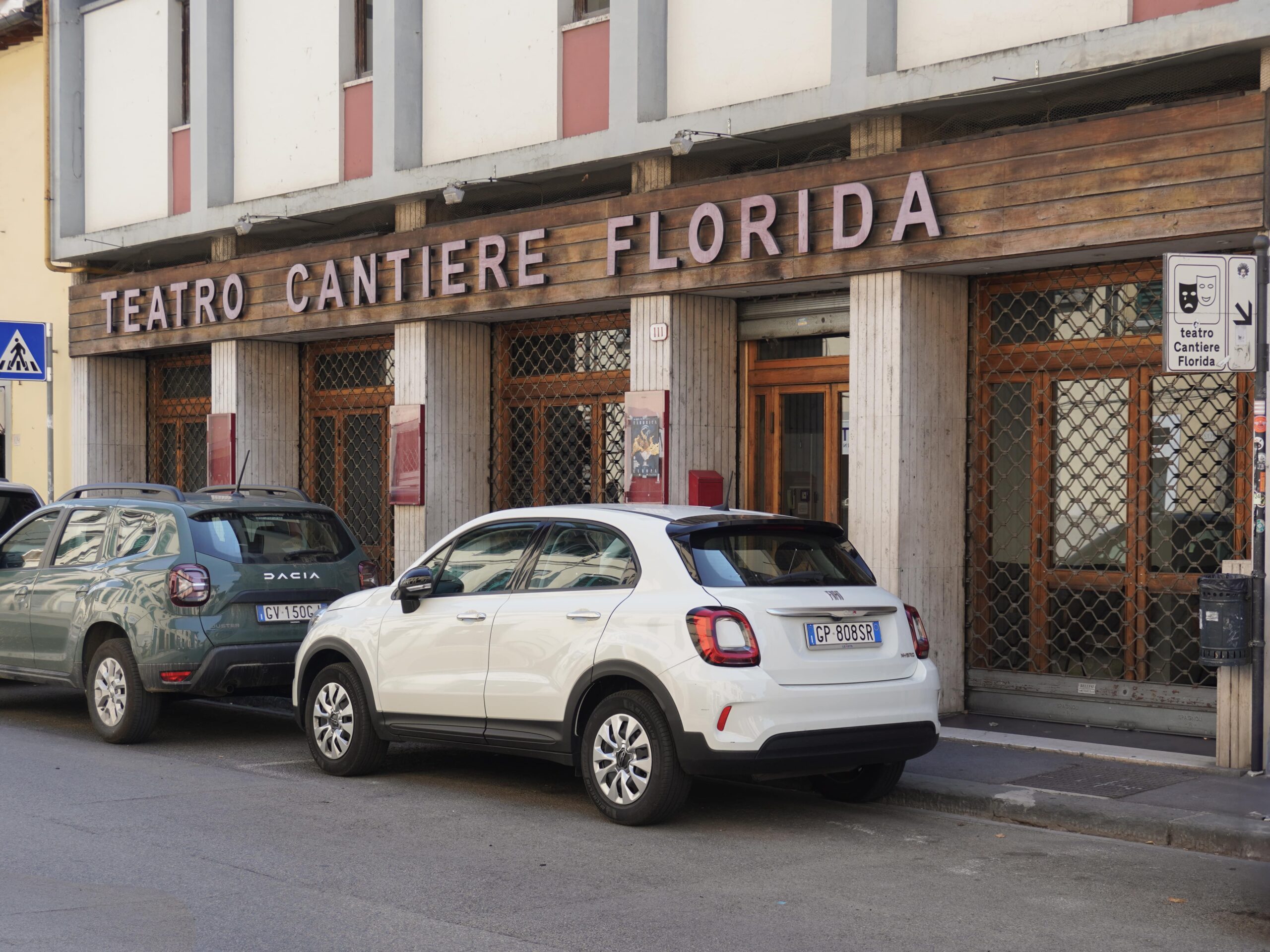
Finally, between the Cascine park and the Isolotto, there are good reasons to rejoice, but also to shed a few nostalgic tears. It’s a real shame, to begin with, that the “25 Aprile” cultural center on via Bronzino has ended its theatrical activities — once so lively thanks to the Epicentro project. The Cantiere Florida stays afloat, as does the Casa del Popolo dell’Isolotto, while the summer programming of Villa Strozzi and Villa Vogel manages to stir the waters a little, in an area that still finds important anchors in the Teatro delle Spiagge, the Teatro del Borgo, and the Teatro della Fiaba.
The Cascine district, in any case, thanks to a coexistence of young and lively scenes, presents itself as an appealing cultural hub — starting with the Teatro del Maggio that replaced the old Teatro Comunale, and running through anchors such as the Teatro Puccini, the Parc at Fabbrica Europa, Palazzina Indiano Arte, and Manifattura Tabacchi.
The history of Florence and its theaters is a work in perpetual progress, but for the sake of a telling account it’s worth recovering at least three or four historic cases that can bring certain phenomena into focus. We’ll dwell briefly on the Teatro Comunale on Corso Italia, the Amicizia (via Il Prato), the Teatro Nazionale (via dei Cimatori), and the recently revived Teatro dell’Oriuolo, on the very central street of the same name.
Florence’s Comunale was long the largest theater in the city, seating more than two thousand between the stalls, the boxes, the gallery, the gods, and the Ridotto. Born as the open-air Arena Fiorentina in 1861, it was roofed over and renamed the Politeama after a devastating fire damaged it a year later. Having changed hands several times, once bought by the city it became the backdrop for the birth of the Maggio Fiorentino in 1933, before falling victim to a bombing in 1944. Heavily shored up in the 1950s, it was then partly rebuilt after yet another disaster — the flood of November 1966.
From the early 2000s the old Politeama was at the center of a public auction meant to fund the new Teatro del Maggio Musicale Fiorentino, which finally came into service in 2015. Beginning in 2021, then, the Teatro Comunale was partly demolished to convert its spaces into a series of luxury apartments. Wholly different is the story of the Teatro l’Amicizia, founded in the 1950s as a hub of popular, vernacular theater. For several decades it hosted Wanda Pasquini’s celebrated company and, in the 1970s, a television program on Canale 48 (“I’ Grillo Canterino”).
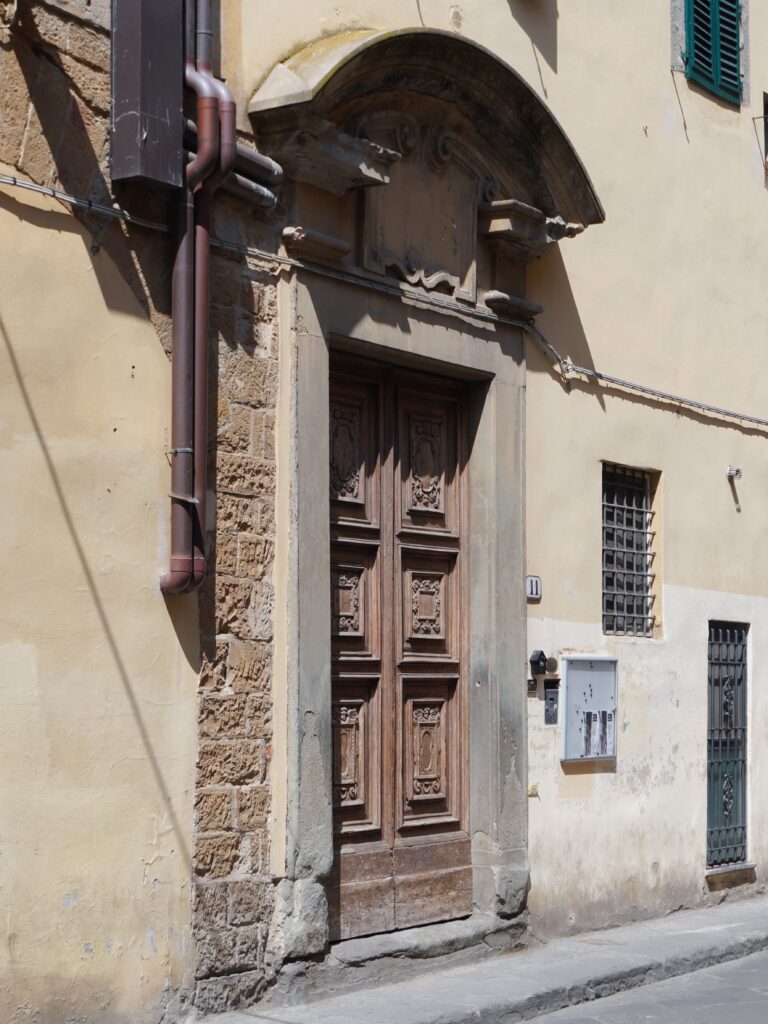
With the loss of its guiding spirit — Pasquini died in 2001 — the Amicizia was first rented to the University of Florence to house first-year courses of the Economics faculty. After that faculty moved to the new Novoli campus, the building was turned over to the Education Sciences faculty as a teaching space. The property currently belongs to the MCL club (Movimento Cristiano Lavoratori).
Far older, by contrast, is the story of the legendary Teatro Nazionale, established as early as 1789 as the Teatro della Quarquonia. That peculiar epithet, whose etymology is still debated, seems to derive from the hospice founded on the site by Ippolito Francini in 1650, meant to give a roof and an education to the many children living on the streets at the time. The neologism chosen to name that charitable institution was likely a portmanteau of two Latin words (quare and quoniam, “why” and “since”).
Refounded as a vernacular prose theater by Gioacchino Cambiagi, it was one of the many Florentine stages that contributed to the birth of Stenterello, the last mask of the old Italian Commedia dell’Arte. Heavily restored in 1840, it became the more decorous Teatro Leopoldo, then the Teatro Nazionale after the Risorgimento. Site of the first national congress of Benito Mussolini’s Fasci di Combattimento (1919), from the 1920s to the 1980s it turned into a cinema of the same name — whose seats, it seems, were chained down to prevent theft.
The Teatro dell’Oriuolo, for its part, first appeared in 1951 as a wooden structure in the courtyard of Palazzo Bastogi. A former Teatro Stabile, it was a crucial venue for stage drama until 1993, when it had to close because of inadequate systems and the presence of asbestos in the roof. A protocol signed by ETI, the city, and the university (2002) — aimed at recovering the spaces for the experimental theater of the Department of Arts and Performance — allowed the theater to be reclaimed. It has since returned to the city’s hands (2013) and, from 2019 to today, has seen the creation of the new Teatro delle Arti Visive, a hub for virtual performances of digital art as part of the Grandi Oblate project.
Beyond the positive signs registered today in some parts of the city, then, there’s no doubt that the story of Florence’s theaters often reads as a story of “former theaters”. The last four centuries of the city’s history are studded with them: from the ancient Teatro dell’Acqua (closed at the end of the eighteenth century) to the mythical little Teatrino della Baldracca — a “big room,” now inside the Uffizi complex, used for comic performances between the sixteenth and seventeenth centuries — and on through many others, like the Teatro dei Concordi (1675–1854), the Alfieri (1740–1928), the Teatro dei Solleciti (1778–1887), and the enigmatic Teatro Brendel (1850–1940).
Not least, of course, the former Accademia degli Arrischianti, where in the mid-nineteenth century you could still have caught the controversial performances of Lorenzo Cannelli, whose Stenterello earned the surname “Porcacci” for the extreme vulgarity of his cursing.
Photos by Jacopo Visani.