Prato to Romania: The Illegal Journey of Textile Waste
On September 9, 2025, in Strasbourg, the European Parliament voted on a law to reduce textile waste that unfortunately still prioritizes recycling over strategies for durability and reuse. According to an EU dossier, European citizens consume on average 26 kg of textile products a year and throw away 11 kg. With 465,000 tons, Italy is Europe’s leading producer of textile waste.
Prato is considered the European capital of textiles, where natural fibers are recovered and recycled. And yet — despite a narrative that celebrates the district as a model of circular economy — illegal textile-waste disposal persists in the province, an environmental problem of major impact: in 2024, 819 tons of illegally treated waste were confirmed, and in the first four months of 2025 the figure was already 252 tons. These numbers were reported in a statement by Dr. Luca Tescaroli, chief prosecutor at the Court of Prato.
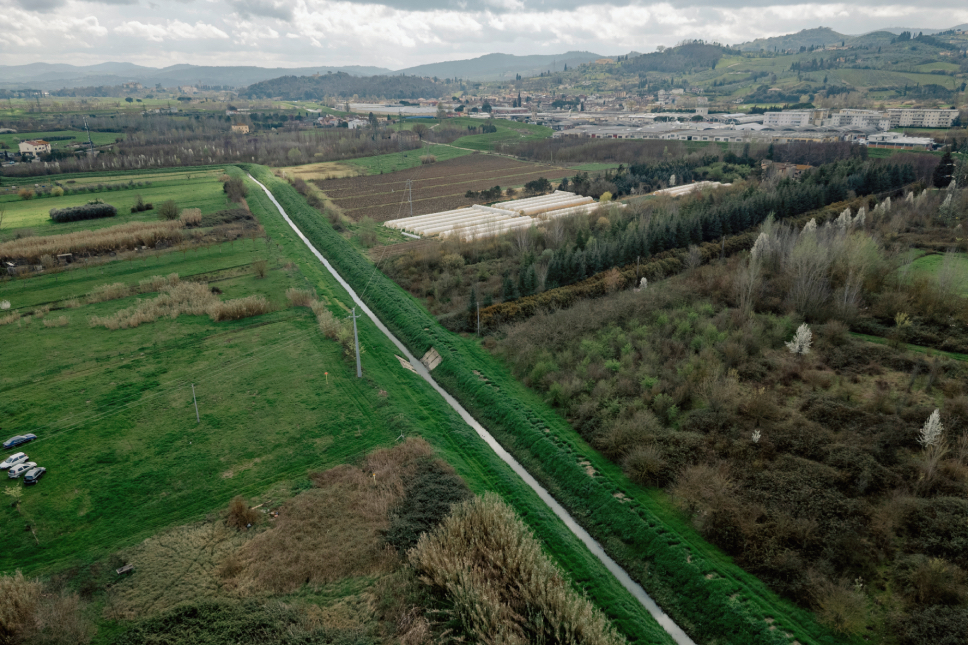
An area beside the Filimortula stream, where at least ten braziers used to incinerate textile waste were found, has been nicknamed the “Land of Fires of Prato.” In Le Monde, an article by Thomas Saintourens on the crime infiltrating the fast-fashion sector described the “Prato system” as a giant drug market — only with clothes instead of drugs.
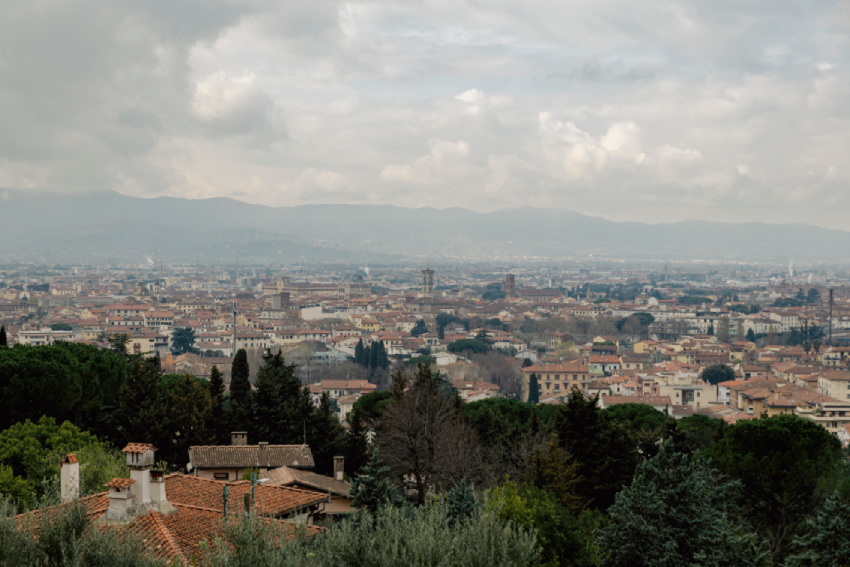
The phenomenon fits a context in which Legambiente ranks Tuscany 6th nationally for environmental crime, just below regions with a traditional mafia presence. And the illegality has crossed Italy’s borders. Prato — capital of the Tuscan province of the same name, with 198,000 inhabitants — is by population the third city of central Italy after Rome and Florence, and home to the largest textile district in Europe.
In 2024 a Romanian court gave a three-year suspended sentence to businesswoman Georgeta Trifa, now known in the country as “the mother of waste,” for the illegal disposal of textiles originally imported into Romania from Italy as second-hand clothes. The case had begun four years earlier, when the Garda Națională de Mediu, Romania’s environmental guard, together with local police, discovered two illegal warehouses holding more than 400 tons of textiles in the Bihor district, at Ineu and Vadu Crișului.
According to the investigation, most of the waste was leather and contained hexavalent chromium, which could not be burned in the former cement works converted into dumps.
Romanian journalist Andrei Ciurcanu, a member of the investigative collective Rise Project — whom we reached through Greenpeace, and who is familiar with the case files — confirmed a suspicion: that the textile scraps imported from Italy could also come from Prato, home to hundreds of businesses specializing in recycling clothes and textile scraps collected from all over the world. In particular, he flagged the name of a Prato company that appears in the Romanian judicial investigation.
We requested a company record from the Chamber of Commerce, and even a first read turned up something interesting: an online search for the name of the company’s director brings up a 2017 local news article in Il Tirreno, listing 98 entrepreneurs charged by the District Anti-Mafia Directorate with violating rules on the export of plastic waste and used clothing — all material originating in Prato’s textile district and destined for Asia. The company in question, according to its own website, provides services for the correct and eco-sustainable disposal of industrial waste; the method, evidently, is debatable.
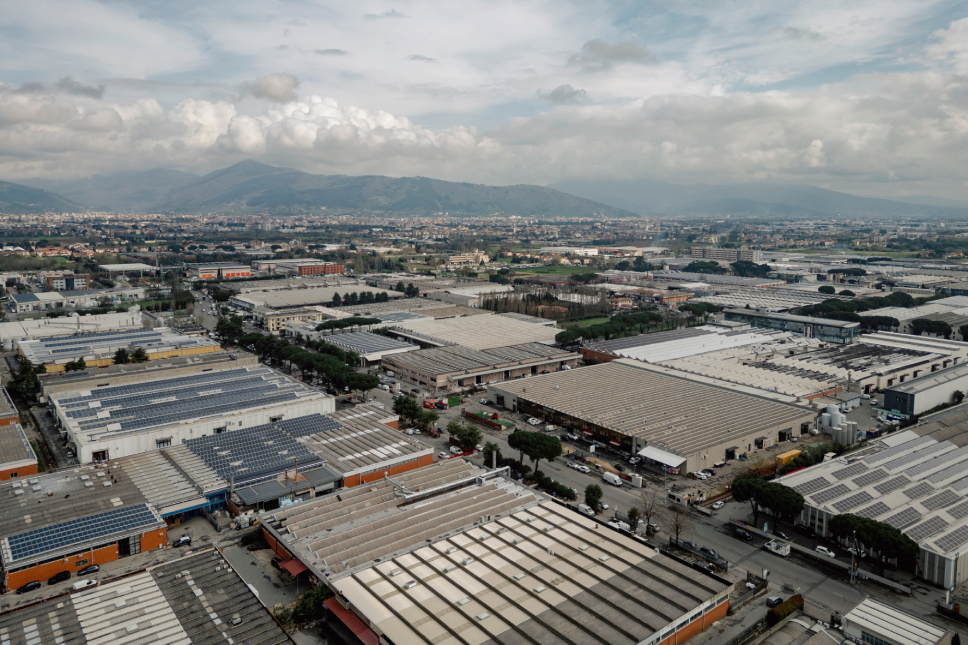
The Prato model of textile regeneration, which yields “carded wool,” produced incredible wealth for decades. Then, in the late 1990s, the “rag” district saw the arrival of Chinese fast-fashion companies. This brought a functional and structural metamorphosis of the district, marking the transition from a circular economy based on regenerated wool to a low-cost, high-speed fast-fashion chain.
Chinese firms took over much of the pre-existing textile infrastructure — sheds, machinery, the subcontracting network — originally meant for processing carded wool, seizing control of an entire supply chain and replacing the previous model. And textile scraps became a problem with major negative externalities, no longer only local but international, as this case shows, with Romania at risk of becoming Europe’s dump given storage costs ten times lower than in Western Europe.
Macrolotto Zero has been known as the heart of Prato’s textile district since the 1950s, and is today marked by a high density of Chinese residents and fast-fashion businesses. Because the textile-waste trade, disguised as the transport of second-hand clothes, was unknown to many magistrates in Romania (and even to some customs inspectors), who had yet to grasp the full environmental danger, the shipments allowed these goods to end up, in large part, in the hands of unscrupulous importers who burned them or dumped them in illegal landfills already identified in the northern districts, on the border with Hungary.
Because the illegally treated textile waste has been confiscated, the Romanian state is now forced to pay for its correct disposal and for reclaiming the areas used as illegal dumps, as Ciurcanu explained. In his reportage published in English on November 19, 2024, titled “A textile danger: when magistrates wear other capes”, he describes how Romania is a target for those who want to get rid of waste quickly, pretending to export second-hand goods.
In short, Romania has become the destination for anyone looking to quickly offload loads of textile waste — a business that enriches a few at the expense of communities, the environment and the state’s coffers. The alarm comes from the prosecutors investigating the phenomenon, who point to other districts with an illegal presence of textile scraps beyond Bihor. Burning shoes and clothes — largely made of synthetic materials — releases toxic substances, and yet the judicial response has been timid beyond the high-profile cases.
Romania has an import register for waste that has produced good results; however, the lack of a register of companies importing used goods — a legal gap Bucharest is now working on — has made it hard to know where the textile waste ends up. On March 20, 2026, Environment Minister Diana Buzoianu declared: “Waste must not enter the country under the false label of second-hand products,” effectively confirming that for years the system lacked a rigorous legal framework. According to the Rise Project investigation, in 2023 alone around 40% of the material imported into Romania as used goods turned out to be non-recyclable textile waste, feeding an illegal market that saw more than 3,000 tons of shipments rejected at the border.
Intrigued by all this, we wanted to dig deeper and interview Enrico Fontana, head of Legambiente’s National Observatory on the Environment and Legality and, since 1994, editor of the “Ecomafia Report.” Fontana laid out for us, in no uncertain terms, a scenario in which dangerous criminal activity slips into the seams of Prato’s virtuous textile-recycling chains.
Prato is one of the most important textile districts in the world — but at what price for the environment? What are the real consequences of textile activity on the area today?
“Prato is a district where virtuous chains for recycling textile waste — especially the recovery of wool and cashmere — coexist with genuine criminal activity, at the center of major investigations developed particularly over the last two years by the Prato Prosecutor’s Office, led by prosecutor Luca Tescaroli, as he recounted at the Ecoforum on the circular economy organized by Legambiente Toscana in Montemurlo, one of the municipalities most affected by waste dumping.
At the root of these trafficking operations, as prosecutor Tescaroli explained, is a genuine parallel system: the illegal import of huge quantities of textile products from China, businesses that systematically evade taxes, labor exploitation, illegal waste disposal. But illegal flows also depart from Prato — above all used clothes, which without any treatment are exported to Africa, in particular Tunisia, and to East Asia, Thailand first among them.”
Illegal textile-waste disposal is growing at an alarming rate: from 154 tons in 2023 to 819 tons in 2024, with 252 tons already in the first four months of 2025. These figures clash with Symbola’s claim (the foundation promoting Italian quality, Ed.) placing Italy first in Europe for recycling rate over total special waste: 91.6%. Where does the truth lie? Who profits from this illegal business, and how does the system really work? Will the trend continue, or are there signs of a reversal?
“The exponential growth of textile waste dumped across the province of Prato, together with the phenomenon of the so-called ‘braziers’ where it’s set on fire, is the result of the monitoring carried out by law enforcement, in particular the Environmental and Forestry Police unit of the Carabinieri. It’s the other face of a district that also has stories of excellence, precisely in the recycling chains — even if the textile one, compared with other waste chains, is still well behind. The latest ISPRA report estimates that against a production of 15 kg per inhabitant, only 3.1 kg per person is collected in Italy.
Those who profit are the companies that, instead of paying for the correct management of the textile scraps they produce, rely on operators with no authorization who dump them directly into the environment. Pseudo-entrepreneurs who run facilities and fake the treatment of post-collection clothing, to ship it illegally abroad or onto the Italian market. But also genuine criminal organizations, both of Chinese origin and, above all, camorra-linked. If attention isn’t raised immediately — strengthening the work of law enforcement and the judiciary, especially the Prato Prosecutor’s Office, with staff, technology and resources — the phenomenon is inevitably destined to grow.
But a more incisive role by the municipalities involved and by the Region of Tuscany is also indispensable. There are important signals, as prosecutor Tescaroli himself told us, but they’re not enough.”
During the eco-mafia commission’s inspection at Carmignano, the link between waste dumping and organized crime emerged. How do eco-mafias and illegal disposal intertwine in the textile district?
“The direct interests of the camorra in managing textile waste in the Prato district are, in fact, a story known for at least fifteen years, with roots going back even further. The first investigations were carried out by the Florence District Anti-Mafia Prosecutor’s Office between 2009 and 2010. But the National Anti-Mafia Directorate has also dealt with it, reporting in 2019 — in a document sent to the parliamentary commission on illegality in the waste cycle — further investigations into the illegal trafficking of used clothes in Lazio, Basilicata and Lombardy.
The most important axis of criminal interests runs between Prato and the hub of Ercolano, in Campania, with a direct role played by camorra clans, who guarantee logistics — starting with transport — front companies for the ‘treatment,’ and access to outlet markets.”

The area around the Filimortula stream, where at least ten braziers used to incinerate textile waste were found, has been renamed the “Land of Fires of Prato.” Investigations and courts point to textile firms run by Chinese citizens from Fujian and Zhejiang. How did they build such a structured system to dispose of waste illegally, and what economic or social levers did they exploit? What does this tell us about the social and economic fabric of the district?
“When you analyze these phenomena, you must never let yourself be conditioned by explanations of a purely ‘ethnic’ nature. The Chinese community in Prato is strong, rooted for years, and it must be helped to counter the illegality — generated in part by collusion with other, thoroughly Italian, criminal actors. We need to fight more decisively the illegal flows of raw materials, imported from China, triangulated through Eastern European countries — above all Hungary — and brought to Prato while dodging VAT, with evasion estimated by magistrates at over one billion euros a year.
Just as we need to expose the ‘throwaway’ firms that open, pay nothing in taxes or contributions to their workers, and close abruptly. And efforts must be multiplied to protect people’s rights — increasingly people of other nationalities, brutally exploited and forced to work in unsafe environments.”
The Prato Prosecutor’s Office complains of a shortage of staff and technological tools. If institutions had adequate resources, what would change in the fight against illegal disposal? What measures could make the difference on the ground, and what obstacles remain insurmountable?
“The first responses have arrived: the use of drones, the possibility — guaranteed by new rules that came into force last year — of charging crimes for the dumping and burning of waste, including special waste, and of making deferred arrests thanks to surveillance cameras. We supported prosecutor Tescaroli’s request to set up in Prato a detached section of the Florence District Anti-Mafia Directorate, and the monitoring, through the regional Observatory on legality, of what happens in the textile district.
After all, the Region of Tuscany had already flagged the seriousness of the situation in a broad document sent to the parliamentary eco-mafia commission, used in the report approved in 2022 on textile waste. A team effort — involving trade associations, unions, and the consortia operating in the recycling chains — can really make the difference. The biggest obstacle concerns the effectiveness of national controls on imports of raw textile materials and on the management of post-collection waste. We can only hope that, in our country, the Environment Ministry’s decree on extended producer responsibility comes into force as soon as possible.”
Article by Francesco Sani and Sacha Tellini. Photos by Gianmarco Caroti.