The Story and Map of Florence’s Street Tabernacles
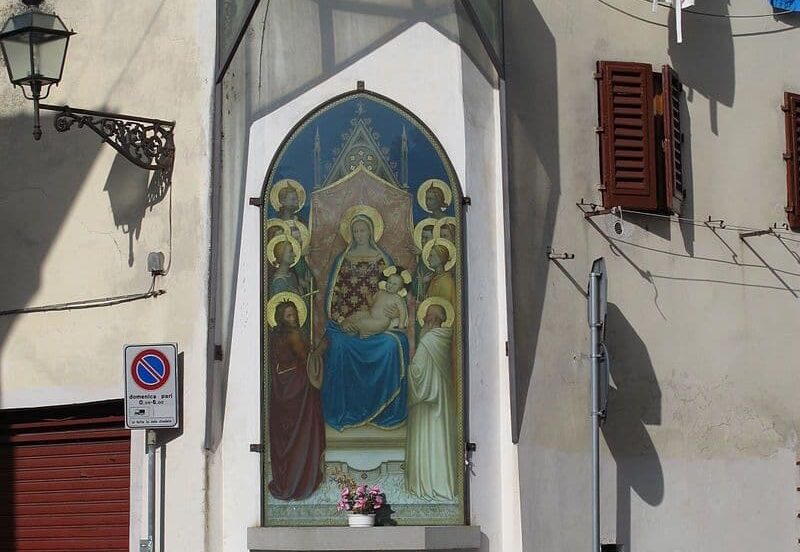
Framed in stone or housed in little shrines all over Florence, tabernacles (tabernacoli) are a genuine piece of street furniture. Ancient in origin — already present in Roman times and again in the Middle Ages — they multiplied in Florence in the thirteenth century, when heretical currents spread among the people and began to threaten the Christian faith. To counter them, this form of religious architecture took hold along the city’s public streets. Later, during the plague, these structures took on a practical function as well: fitted with an altar, they allowed the liturgy to be celebrated in the open air.
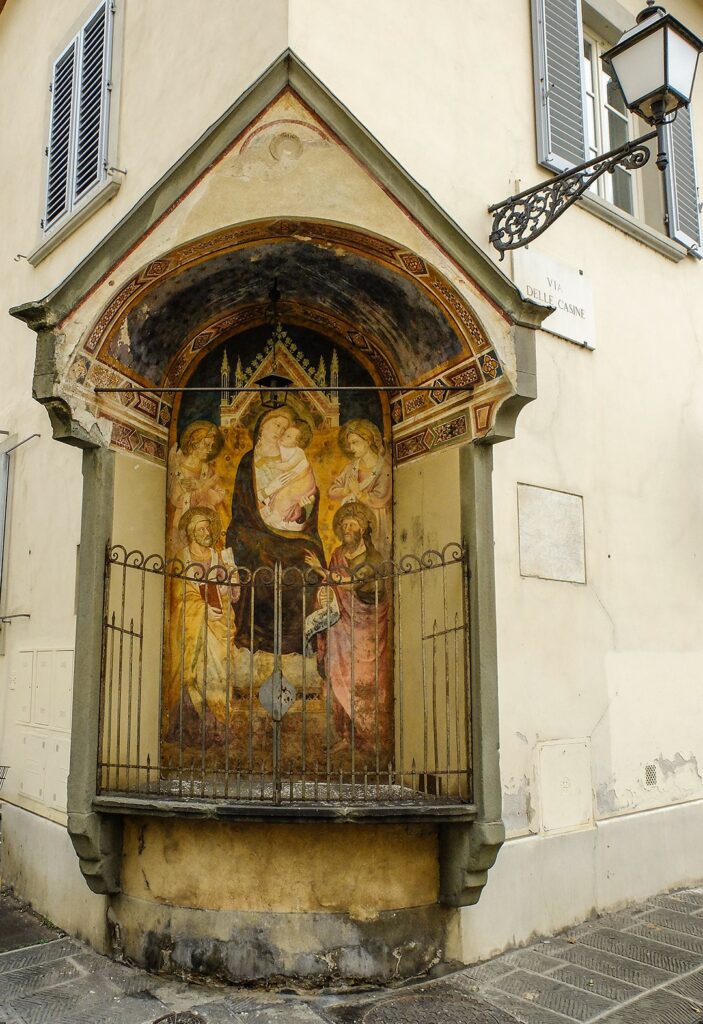
Tabernacles in terracotta and ceramic, but also framed prints and frescoes, began to fill the Florentine streets as acts of devotion, displays of faith, and appeals for protection — and also to advertise the power of the religious orders, convents, families, and houses that commissioned them. During the Renaissance, nobles competed for the finest tabernacle. Because that, in the end, is what these are: open-air masterpieces that hold within them the events of Florentine history. Each tabernacle lets us in on anecdotes and legends about the city, and even on the former function of certain districts. The tabernacle on via dei Malcontenti — one of the first fitted with an altar, and so suited to celebrating Mass — or the one on via delle Stinche — by Giovanni da San Giovanni, showing the senator Girolamo Novelli paying a prisoner’s ransom — remind us that this area once held the jail from which the condemned set out for the place of execution. The tabernacles accompanied them along the way.
The tabernacles of the Oltrarno
These works were made with the common people themselves as their audience, and so they also became gathering points and landmarks, images in which whole communities recognized themselves. It is no surprise that one of the districts most densely populated with them is the Oltrarno, the artisan quarter of Florence par excellence. Here are a few worth seeking out in this part of town.
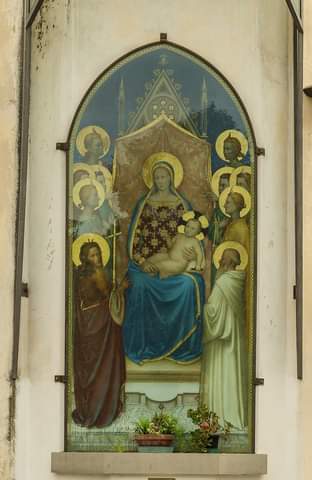
On the corner of via del Leone and via della Chiesa stands one of the most famous: the Madonna del Morbo (the “Madonna of the Plague”). Attributed to Giottino, it was made to celebrate the end of the plague in 1348. The one you see today is a copy of the original, now in the Uffizi, and it marks a happy moment in Florentine history.
Between via dei Serragli and via Santa Monica, a fifteenth-century work by Bicci di Lorenzo stands out: a Madonna and Child — the child holding a cuckoo in his hands — flanked by Saints Jerome and Paul. The area was once known as Canto alla Cuculia (“Cuckoo’s Corner”), because the bird’s call was heard most here, in a district full of gardens.
In piazza San Felice, by contrast, the scene is the Annunciation: Mary, reading a book, is startled by the Archangel. The subject was likely chosen because the church of San Felice staged an annual theatrical performance of the Annunciation, complete with stage machinery — a tribute, then, to that lovely tradition. Just walk and look around and you will notice how rich this area is in other tabernacles too: the one on via delle Caldaie honoring Saints Roch and Sebastian — patrons of plague victims and the sick — for the end of the pestilence, or the one on via San Giovanni — a nursing Madonna — made in thanks for the help the Hospital of Santa Lucia gave to pilgrims.
The tabernacles of Sant’Ambrogio
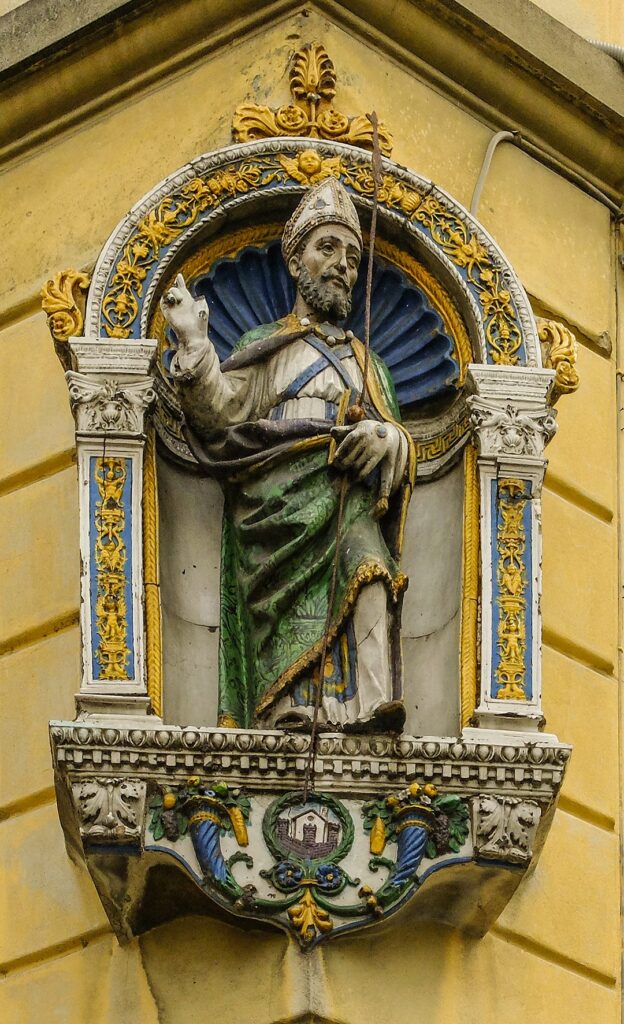
The tabernacles near the church of Sant’Ambrogio also tell us a great deal about the history of their surroundings. On the right-hand side of the church, the saint is shown with a red fortress at his feet, in praise of the neighborhood community that made bricks. It was the local rione (district) guild that commissioned the work, made in terracotta by Giovanni della Robbia. Finally, still in this quarter, the last stop on the condemned prisoners’ route — and the last place enclosed by the walls — was Borgo La Croce. There, Christ steps down from the Cross in answer to the Madonna’s prayers, in a work made by Giuseppe Moriani in 1714.
Four tabernacles not to miss
One of the loveliest and most distinctive is surely the one between via Orsanmichele and via dell’Arte della Lana, which formerly stood on via degli Speziali. It is grand thanks to its very structure: an aedicule decorated with reliefs and complete with a niche, showing the Madonna and Child enthroned between Saints John the Baptist and John the Evangelist, with the coats of arms of noble Florentine families on the side walls. This work by Jacopo del Casentino is known as the Tabernacolo di Santa Maria della Tromba (the Tabernacle of Santa Maria della Tromba), after its earlier location in what was called the Vicolo della Tromba, home to the trumpeters of the Florentine Republic. On this street, it is said, San Pietro Martire (Saint Peter Martyr) once worked a miracle, making a rearing black horse — a symbol of the devil — vanish with a religious gesture.
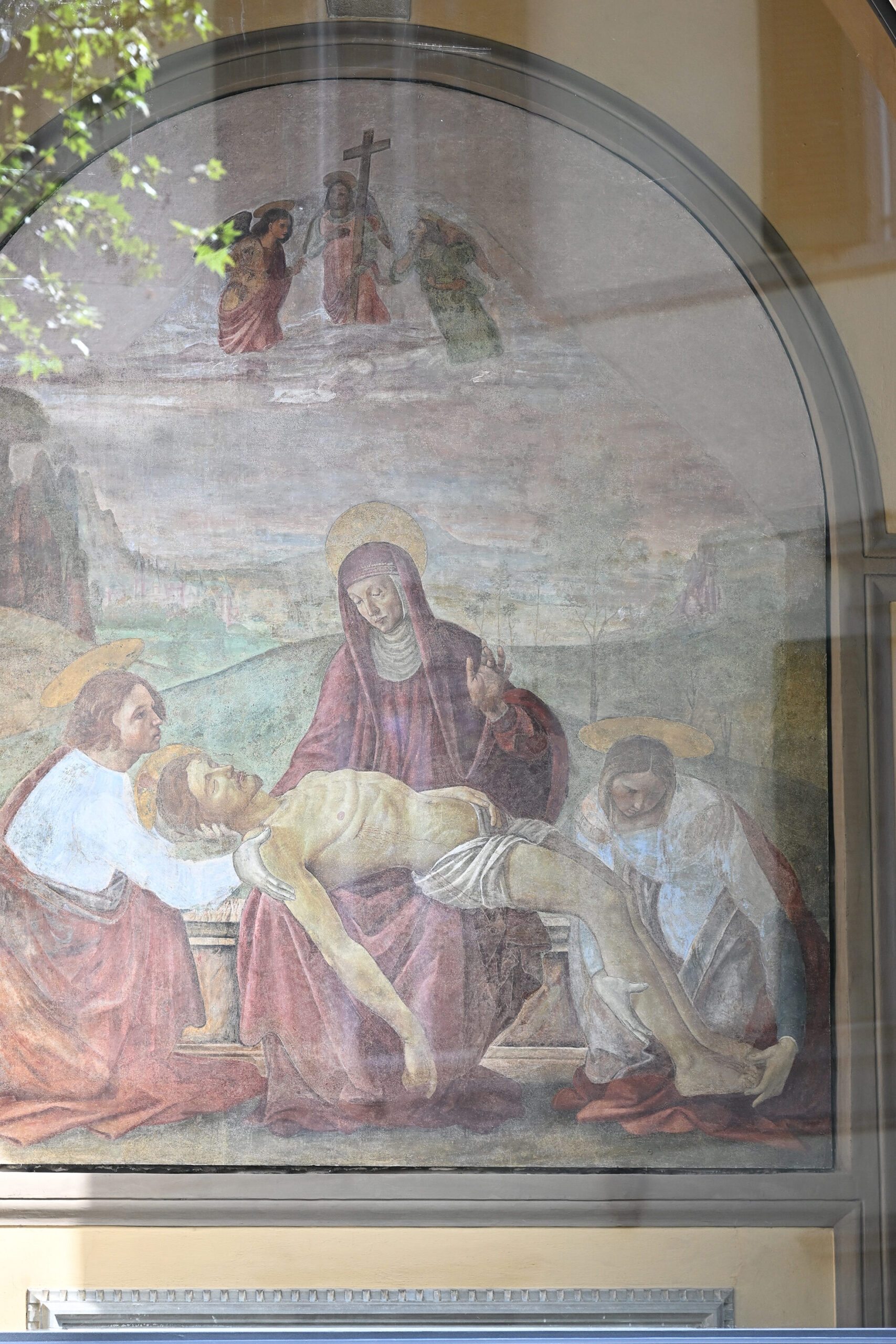
Another tabernacle housed in a marvelous setting is the one commissioned by the lay confraternity for the façade of the Oratorio di Santa Rosa. To this day, on the little tower of Santa Rosa, you can admire a Pietà with the Madonna and Saints John the Evangelist and Mary Magdalene.
On via Ricasoli, at the corner of via dei Pucci, there is a tabernacle unlike any other in shape: within a single arch sit two niches, with two frescoes of the Madonna enthroned with the Child and Saints John the Baptist and Zanobi. It is known as the tabernacolo delle cinque lampade (the tabernacle of the five lamps), because five oil lamps burn before the two niches, once kept alight by the offerings of the faithful. It is the work of Cosimo Rosselli.
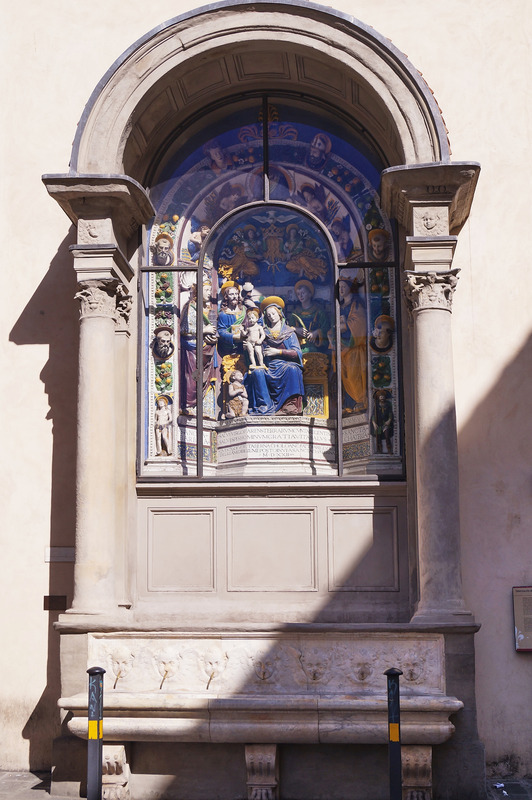
Splendid for its colors is the tabernacolo delle Fonticine (the tabernacle of the little fountains), on via Nazionale at the corner of via dell’Ariento, made in terracotta by Giovanni della Robbia in 1522. It takes its name from the marble base beneath it, animated with jets of water, and shows the Madonna enthroned with the Child, the young Saint John, and four saints, crowned by God the Father, the Holy Spirit, and angels.
Finally, two streets are the real stars of this itinerary. They lie at opposite ends of the city and are sure to surprise you with a wealth of masterpieces. Via della Scala — right in the historic center, near Santa Maria Novella — and its tabernacles will tell you about the families who lived in the quarter, such as the Latini and the Rucellai, and about the many religious institutions once found here. Then Via Faenza, near the Mercato Centrale, where a monastery once stood. Two evocative corners of Florence well worth a stroll.
Discovering the city through this unusual itinerary is genuinely rewarding: just wander with your nose in the air and let yourself be surprised. We challenge you to track down the many other tabernacles along the city’s streets — and to point them out to us. And for anyone who still hasn’t had enough: when Florence became the capital of Italy and many buildings were pulled down in the name of urban renewal, a great number of tabernacles were saved by Stefano Bardini, the Florentine antiquarian who turned his business into a museum — the Museo Bardini. There you can admire some of the oldest tabernacles of all: a form of art that fills the city of Florence, and one well worth getting to know, because it tells us so much about her history.