The Macchiaioli: A Tuscan Revolution in Painting
Standing before “La Libecciata” (1880–1885) by Giovanni Fattori, held in the enchanting Gallery of Modern Art in the Palazzo Pitti, Florence, the first thing that strikes you is the overwhelming, destabilizing, almost subversive force of the wind that whips the Livorno sea, sending the tree and the bushes flying as if swept away. And this is exactly what the Macchiaioli (1855–1867) did: in tune with the Risorgimento currents sweeping the nation in that period, they blew away the old theories and practices of painting with a gust of the new, becoming the pioneers of modern Italian painting and foreshadowing French Impressionism.
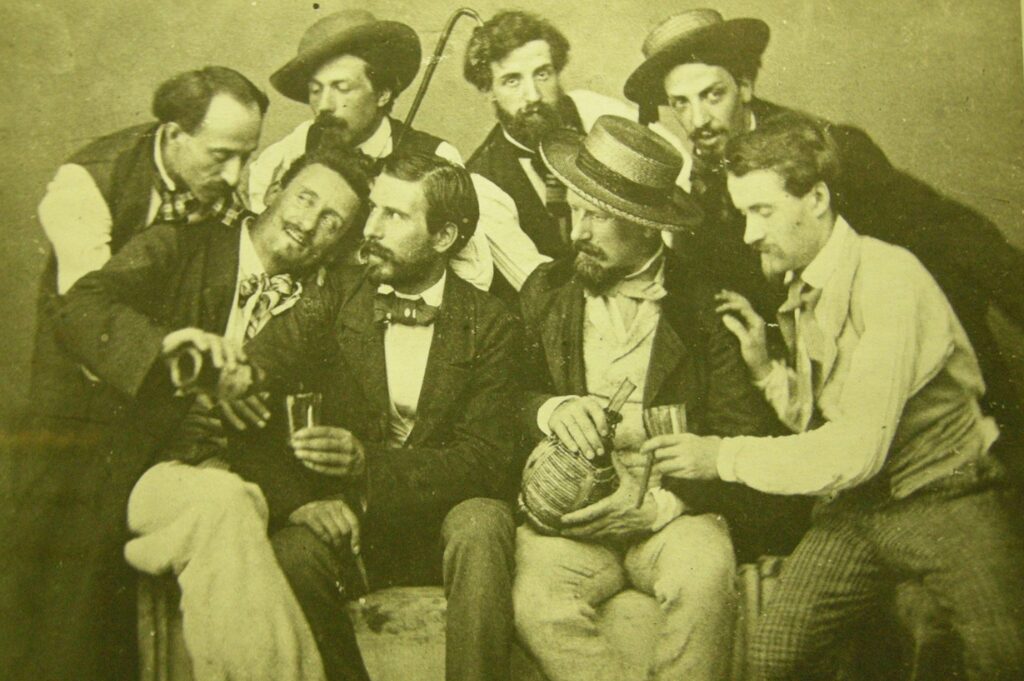
Gathering at the Caffè Michelangiolo (once located at Via Cavour 21), they broke with the old schemes imposed by academic Classicism, abandoning its conventions entirely to bring about a new way of painting that took shape in two main elements: the theory of the macchia (the “patch,” or blot of color) and the ton gris (the gray tone).

The Macchiaioli and the “theory of the macchia”
The “theory of the macchia” consisted of laying patches of color directly onto the support (canvas or panel) to give an overall impression, free of the outlines that would define the figures depicted — a device used to bring the scene in the painting closer to what our eyes actually see, or rather to the visual impressions stirred by the reality around us. To this end they also relied on another trick learned from French painting, the ton gris (gray tone), which meant painting the scene by observing its reflection in a black mirror. The mirror brought out the contrasts of light and shadow more sharply, and these were then reproduced directly in the painting, giving it enormous expressiveness.
In doing so, the Macchiaioli freed themselves completely from the dictates of the academies — which, on the contrary, called for subdued colors and uniform tones — while at the same time setting themselves apart from the Impressionists, who focused more on the fleetingness of light and rendered their subjects and scenes through small brushstrokes or dashes.
The Macchiaioli and painting en plein air
It should also be said that the Macchiaioli loved to paint outdoors, and were among the first to do so, since until then painting had been done inside buildings, away from the open air. It was surely a more delightful practice for the painter, too — to paint “under the sun,” out in nature, surrounded by real, everyday life. It is no coincidence, then, that in most Macchiaioli paintings the scenes depicted are bucolic landscapes and their inhabitants: the Tuscan countryside and its humble people, busy with their daily tasks — as we see, for instance, in “L’Alzaia” (The Towrope, 1864) by Telemaco Signorini, which shows laborers along the bank of the Arno near the Cascine, hauling a barge upstream by rope.
Seascapes, too — especially those frequented by holidaymakers in the warmer months — were undisputed protagonists of Macchiaioli painting, which captured in particular the most telling scenes of vacation life, as in Fattori’s “La rotonda dei bagni Palmieri” (1866). It is worth stressing that in their landscape painting the Macchiaioli had no interest in portraying the grandeur of nature in a Neoclassical sense; what drew them, rather, were the most anonymous, least “interesting” glimpses and moments — which nonetheless held the marvelous power to stir feeling.

The Macchiaioli and scenes of war
This should not lead us to think that only beautiful landscapes interested the Macchiaioli, for other aspects of reality drew them too — the bleaker, more sorrowful ones, such as war. Fattori was certainly the one who most often depicted scenes tied to the military episodes of the Risorgimento, which he went to observe firsthand on the battlefields, as he did for “The Italian Camp at the Battle of Magenta” (1862), portraying a fragment of the Second War of Italian Independence between the Austrians and the Franco-Piedmontese forces. The most striking, and surely most original, aspect was that in the Macchiaioli’s battle paintings there was nothing heroic or glorious, but rather something truthful and faithful to the sad, painful reality of war — as if the painters wished to capture the states of mind of those who fought, certainly with courage, but also with enormous hardship and grief. Exemplary in this respect is Silvestro Lega’s “An Ambush of Italian Bersaglieri in Lombardy” (1861), also held in the Palazzo Pitti, in which the anguish and bitterness of war are utterly visible. From this point of view, the Macchiaioli were inspired by the French painter Paul Delaroche, who did not celebrate historical subjects in a rhetorical, conventional way but rendered their seemingly insignificant details with feeling. And so what had been a slight inattention to purely pictorial particulars and to the outlines of figures became a meticulous attention to the small things no one else noticed, rather than to the scene as a whole — thereby escaping a superficial rendering of reality in favor of emotion.
The Macchiaioli and their schools
And to think that at first the Macchiaioli were disparaged and criticized — especially in the early days of their activity when, exhibiting some of their works at the “Promotrice Fiorentina” art show of 1862, they caught the attention of a reviewer for the newspaper La Gazzetta del Popolo, who asked in his article: “But what are these macchiaioli, who claim to make out a little head, a little man, a little horse in the veins and scattered blotches of the wood?” The painters targeted by the criticism — and Telemaco Signorini in particular — wittily set aside the pejorative sense of the term “Macchiaioli” and seized instead on the added value it expressed, using the word as a nickname to define and, above all, to distinguish the group. Unlike the Gazzetta’s critic, another Florentine critic and art patron, Diego Martelli, came forward to share his view of the emerging group of painters, embracing the novelty they proposed and becoming the movement’s principal point of reference. He even founded a school in the small seaside village of Castiglioncello, near Livorno, with the aim of giving the Macchiaioli the theoretical framework they still lacked.
The “Castiglioncello School” thus became the movement’s meeting place — a place that coincided with Martelli’s own holiday home, where he hosted the artists to discuss innovative concepts and ideas. Martelli also founded the Gazzettino delle arti e del disegno (1867) and Il giornale artistico (1873) to spread the Macchiaioli’s positions more widely. Fortunately, the face of Diego Martelli — a crucial support for the Macchiaioli movement — is not unknown to us, thanks to a portrait (“Portrait of Diego Martelli,” 1879) painted by Federico Zandomeneghi and held in the Palazzo Pitti, which depicts the patron during one of his frequent stays in Paris — occasions on which he brought French Impressionist art into contact with that of the Macchiaioli.
The “Piagentina School” in Florence, like the one at Castiglioncello, was hugely important for these artists. It arose around 1861, when the celebrated painter Silvestro Lega moved to the country residence of the Batelli family in the district beyond Porta alla Croce — today a busy area, but once a holiday destination thanks to the beauty of its countryside just outside the city walls. There, drawing on the surrounding nature, Lega found the right inspiration for his artistic research, and he was not alone: he was joined by Odoardo Borrani, Signorini and the Neapolitan Giuseppe Abbati, among the leading figures of the Macchiaioli movement.
Where to see the Macchiaioli’s works
To admire the Macchiaioli masterpieces, the Gallery of Modern Art in the Palazzo Pitti is undoubtedly the leading museum, home to many rich collections of paintings as well as a substantial bequest from Diego Martelli. But of fundamental importance too are the Fattori Museum in Livorno, the civic museums of Udine, the Pinacoteca di Brera in Milan (where, among others, we find Lega’s “The Pergola”), the CR foundation in Florence, and the Matteucci Institute in Viareggio — the last of which holds Borrani’s wonderful “April 26, 1859 in Florence” (1861), in which, through a play of light and shadow, the figure of a woman emerges — extraordinary and evocative — seated by an open window, intent on her sewing.
Recently, moreover — unlike what was the case until the early 2000s — Macchiaioli paintings have aroused great public interest; two exhibitions held in 2022, at Palazzo Blu in Pisa and at the Revoltella Civic Museum in Trieste, were a considerable success.

It is undeniable that this success, though it came a little late, is more than deserved, for the Macchiaioli represented a true revolution in Italian and world painting, bringing innovation but, above all, feeling — far from set formulas and from arid, impassive pictorial rendering. And there are no better words to express what the Macchiaioli meant for painting than those engraved on the plaque placed where the Caffè Michelangiolo once stood, which read:
“In this building stood the Caffè Michelangiolo, the inspired gathering place of a group of free artists whom Florentine wit nicknamed the Macchiaioli, and whose works — born amid the political struggles and the martial heroism of the national Risorgimento — carried on the light of the Italian painting tradition while renewing its spirit.”
It is incredible, then, how the reforming force of Macchiaioli painting is something great that nonetheless resides in small things: the light on the waves of the sea, the shadows on the walls, a tree shaken by the wind, or a woman gathering flowers in a meadow — all those small aspects that make up the truth of life, without frills and, above all, without illusion.