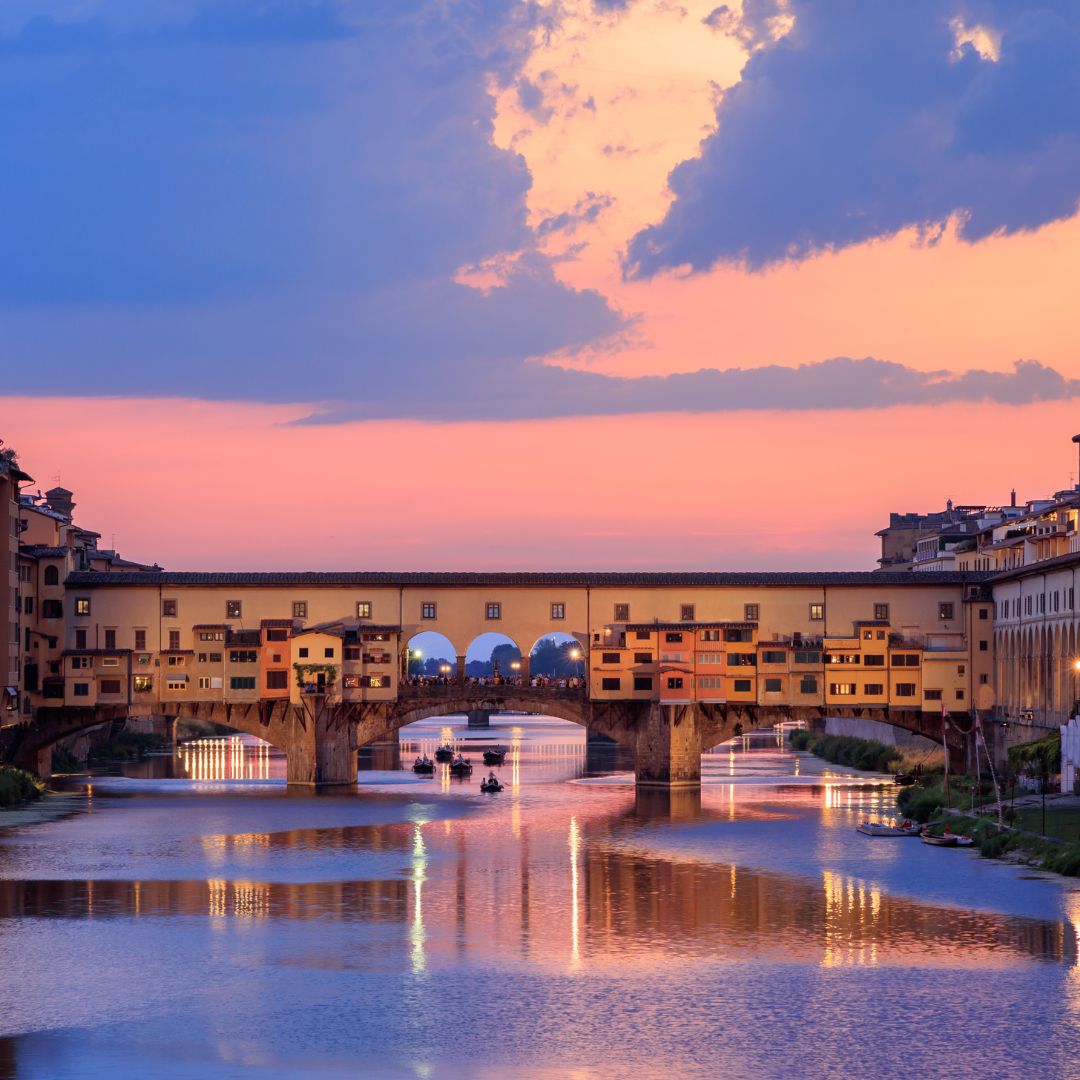
The “anglobeceri”: English-speaking travellers in nineteenth-century Florence
At first glance the term “anglobeceri” might mislead us with its seemingly derogatory ring, since “becero” in the Florentine dialect denotes an ignorant, coarse and rowdy sort. But joined to “anglo” it takes on a wholly different, positive sense: the anglobeceri are those who, despite the hurdle of the language (“anglo” pointing precisely to their English origins), strove hard to weave themselves into the social fabric around them. And so, for all the Florentines’ famous irony, this time it is less pure sarcasm than a slice of history hidden behind an amusing word.
So who, then, were the “anglobeceri”? They were the English and Americans who, between the nineteenth and twentieth centuries, had settled in Florence and tried to blend into the Florentine community, speaking a comical Tuscan with an unmistakably Anglo-Saxon accent. In truth this integration was never quite carried through, for the anglobeceri tended instead to withdraw into solitude in sumptuous villas on the slopes of the soft, winding hills around Florence — keeping their distance from the city’s political and social life, which they merely watched from afar, studying it out of pure cultural curiosity while denying themselves any real part in it.
They frequented the most celebrated literary cafés of the day, but above all they read the foreign journals at the Gabinetto Vieusseux, a subscription reading room stocking publications from across Europe, which in the nineteenth century became one of the single most important meeting points between Italian and European culture. Founded in 1819 by the Genevan banker and publisher Giovan Pietro Vieusseux, it had its first home in Palazzo Buondelmonti on the well-known Via de’ Tornabuoni, where Vieusseux himself lived, before moving in 1940 to Palazzo Strozzi. Across all those years it was the place through which every major Italian — and, above all, foreign — intellectual passed, from Giacomo Leopardi to Lawrence.
This coming and going of foreigners in Florence was no accident of those particular centuries, for they were the centuries of the famed Grand Tour, a phenomenon rooted in the seventeenth century that continues to this day, albeit in a different and far more commodified form, under the name of tourism.
The Grand Tour was a genuine journey of formation, as well as a chance to perfect one’s learning; those who undertook it were wealthy aristocratic intellectuals from every corner of the world, travelling through Continental Europe and, in particular, through our own country, where cities such as Rome, Venice, Naples and — of course — Florence drew no small share of their attention, rich as they were in history, art and culture, and so ideally suited to the aims of the Grand Tour.
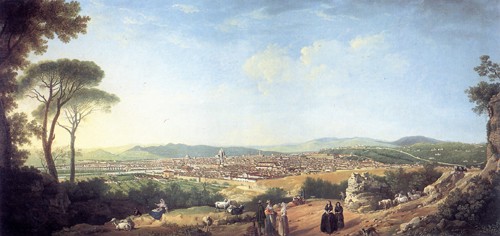
And so, in search of classical art and the splendours of ancient Rome, hordes of intellectuals poured into Italy, crossing it from north to south and at times being adopted by it, for many ended up living — and dying — here. On which note, it is no coincidence that Florence is home to the English Cemetery, set on the oval island of Piazzale Donatello, which between 1828 and 1877 was the burial place of a great many intellectuals and men of culture, most of them English (around 760 of its 1,409 graves). This lasted at least until the years when Florence was capital of Italy, when the cemetery was enclosed within the city walls and the Protestant community was consequently forbidden to bury its dead there; and since Florentines equated the English with Protestants, burials of people of Anglo-Saxon origin came to a halt as well.
Among the many graves of famous men and women you can visit on a short tour of this cemetery is surely that of the English writer Elizabeth Barrett Browning, who fled England with her husband — the poet Robert Browning, married in secret against her father’s wishes — and came to Florence, where she lived, wrote and died. She and her husband occupied the piano nobile of Casa Guidi, near Palazzo Pitti, and it was here that she gave life to the poem “Casa Guidi Windows”, in which she recounted the patriotic movements stirring the city in those years. On Via Maggio you can still find a plaque marking the house where she lived; it reads:
“Here wrote and died E. B. Browning, who in the heart of a woman reconciled the learning of a scholar with the spirit of a poet, and made of her verse a golden ring between Italy and England […]”
It is no accident at all that she had fled to Florence: one of the reasons Italy was then the most sought-after country — beyond its culture and its mild, favourable climate for treating illnesses such as tuberculosis — was also the greater freedom to be enjoyed here, above all by intellectual women, who in our country could, unexpectedly, study and work in the cultural sphere far more serenely than they could in their homelands, England in particular showing itself decidedly hostile towards them. Among the women of letters who came to Florence, one must surely cite the creator of one of the cornerstone novels of English literature: Mary Shelley, author of the celebrated “Frankenstein”, who stayed at length at Palazzo Marini together with her husband Percy Shelley, and it was here that she wrote two of her most famous works, “Prometheus Unbound” and “Ode to the West Wind”.
But England, like other parts of Europe, did not reserve its bigoted moralism for women in the arts alone; it turned it on homosexuals too, who were often condemned to hard labour in prison. Here one cannot help but think of Oscar Wilde, who stayed in Florence twice — the second time precisely after the imprisonment he suffered in England for his homosexuality. Famous are the letters in which Wilde wrote to his father, speaking with passion and intensity of the many beauties he had had the chance to admire in the capital of the Renaissance, among them the Basilica of San Lorenzo with the tomb of Giuliano de’ Medici, Michelangelo’s creation, as well as the Laurentian Medici Library, the Abbey of San Miniato al Monte and, finally, the Archaeological Museum, where he was struck by its precious testimonies of Etruscan art.
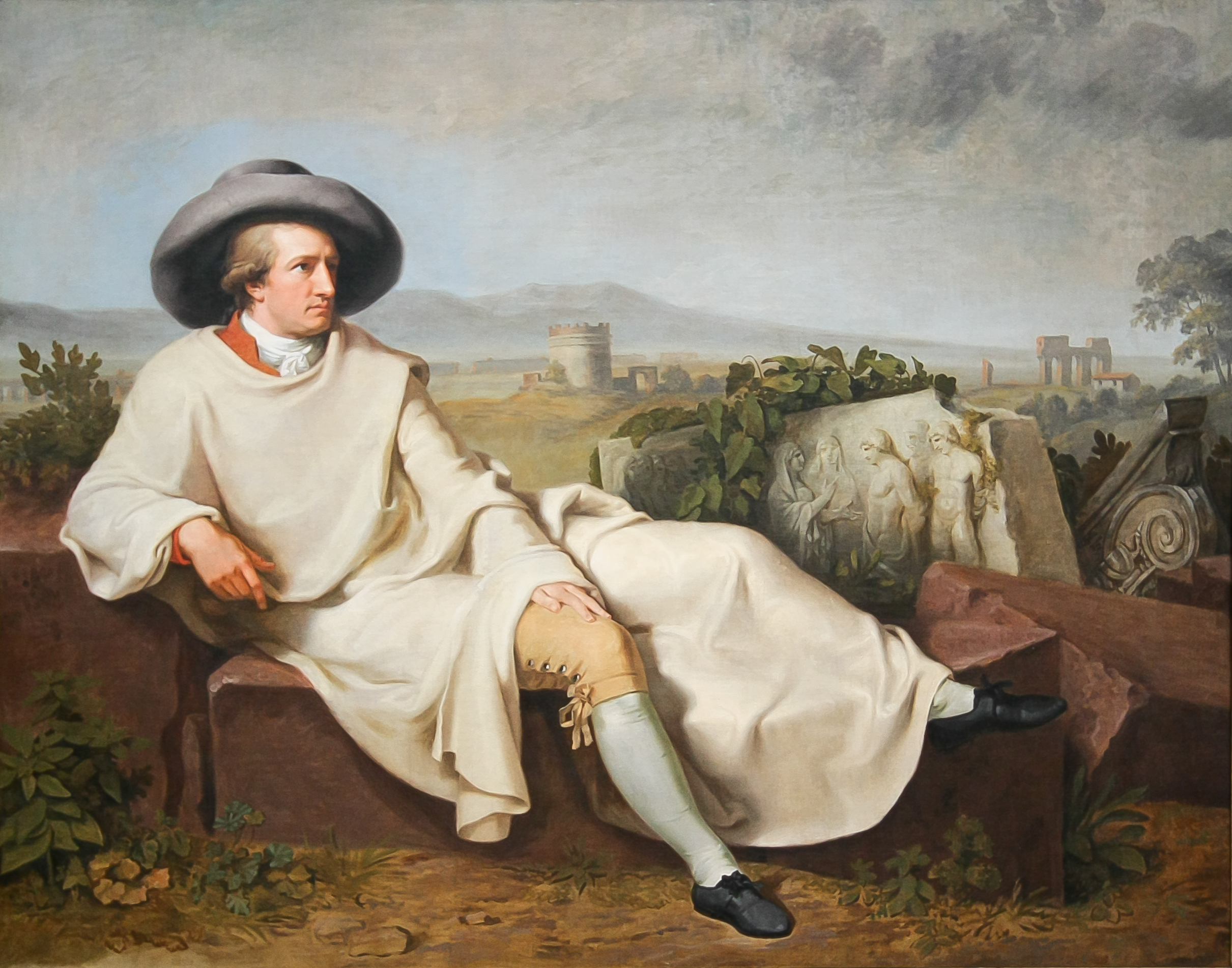
Another celebrated name in European literature to pass through Florence — though not Anglo-American but German — was, beyond any doubt, that of Goethe, who in his “Italian Journey” (1786–1788) wrote of Florence:
“In the city we see proof of the prosperity of the generations that built it, and we are suddenly seized by the conviction that they must have enjoyed a long succession of wise rulers […]”
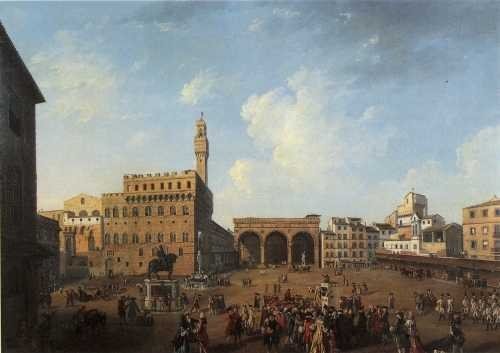
And indeed Florence, in the years of Romanticism, saw a veritable tourism boom — thanks to the city’s cultural and artistic riches, but also to the fact that here one could live in luxury for less, unlike what happens today. For a wealthy aristocrat or an intellectual it was neither hard nor too costly to find a home in a fine, sumptuous villa on the Florentine hills. Among the many we might name the New York writer Henry James, who stayed at length in Bellosguardo as a guest in the villa of the American writer Constance Fenimore Woolson, where, among other things, he wrote his “Italian Hours” and “The Portrait of a Lady”. Then there was the writer Nathaniel Hawthorne, American too, who lived and worked in Florence — at Villa Montauto, to be precise — where he wrote “The Marble Faun”. Like so many others, from Wilde to Churchill, these writers often frequented the salons of the British writer Violet Trefusis, who lived in the famous Villa dell’Ombrellino, and of the French writer Vernon Lee, who instead resided at Villa il Palmierino.
In short, on those panoramic hills, had you lived back then, it would not have been hard to meet any number of figures — from the world of culture to that of politics — who, aboard their carriages, dashed from one villa to the next to discuss culture at large or to draw inspiration for new literary works, as did, for example, D. H. Lawrence, for whom the Tuscan countryside surrounding his house in Scandicci inspired the setting of his most famous novel, “Lady Chatterley’s Lover”, first published in 1928 in Florence rather than in England — since the writer’s homeland deemed the book’s content too scandalous and licentious for the hypocritical, prudish English society of the day.
But it was not only Florence that gave art, inspiration, health and well-being to these men of culture from afar, for they too gave the city something important in return — the Anglo-Americans, for instance, who donated their art collections to Florence, collections we can admire today at the Museo Horne and the Museo Stibbert; or the writers who chose the Tuscan capital as the setting for their novels. On which note, one cannot fail to mention E. M. Forster, who set his “A Room with a View” (1908), one of the most famous novels in world literature, in Florence.
In short, the bond between Florence and the intellectuals arriving from Europe and America was an exchange of beauty between equals, one that enriched both sides and that forms an important piece of history for this city — which once again hands us, on a silver platter, the proof of how important it was, and still is, for anyone who needs to be close to the magnificence and splendour of a city with so much to offer, aesthetically and culturally alike. It is no coincidence that Oscar Wilde, in his poem “By the Arno” (1881), likely inspired by a walk he took along the banks of the Florentine river, wrote:
“ The oleander on the wall
Grows crimson in the dawning light,
Though the grey shadows of the night
Lie yet on Florence like a pall.”
These gentle lines bear witness to how Florence has always left in people’s hearts a pure sense of beauty and of the poetry of living — something the “anglobeceri” had grasped very well, so much so that they came to prefer Florence to every other Italian city.