The “Oh!” Point Above Florence and the Woman Who Named It
Who was Violet Trefusis?
Writer, cosmopolitan intellectual, patron of the arts: Violet Keppel, later Trefusis, was born in London in 1894 and became a formidable author and collector of rare books, and above all a “collector of countries,” as she liked to call herself. Though she belonged to English high society, she never shared its hypocrisy or its claustrophobic conventions. Driven by a fierce hunger for knowledge and a love of travel, she developed an openness rare for her time. Arriving in Paris for the first time in 1905, she declared: “When I grow up I shall live in Paris, and write books in French.” And indeed we find her back in the French capital from 1923, attending the Sorbonne and living at 59 Rue du Ranelagh, where she hosted a dazzling circle of young intellectuals, among them Valéry, Colette, Cocteau, Anna de Noailles, Louise de Vilmorin, Poulenc, Les Six, Misia Sert and Arthur Rubinstein, and later artists such as Dalí, Picasso, Mondrian, Balthus and Jean Hugo. In May 1927, on Marcel Proust’s suggestion, she bought the estate of Saint-Loup-de-Naud a few kilometers from Provins, designed its interiors, and turned it into a gathering place for writers and politicians such as Reynaud, de Gaulle, Palewski and Mitterrand, along with aristocrats, musicians and couturiers — Dior, Schiaparelli and Balmain among the regulars — as well as actors, painters, and philosophers like Gabriel Marcel and historians like Chastenet and Georges Lefebvre.
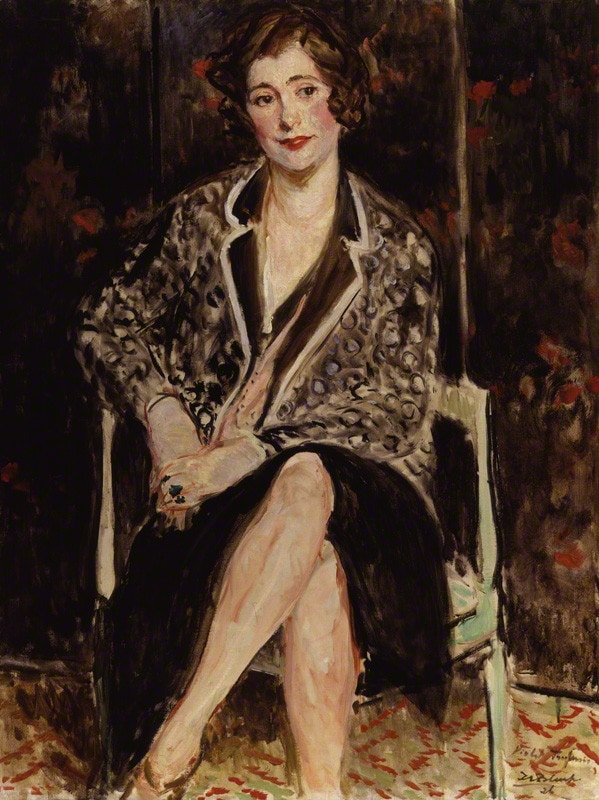
Violet Trefusis in Florence
Among the many stops in her life, Florence stood out as a revelation. As she herself put it: “In Florence I understood how much Italy, like France, would be necessary to me, even if for different reasons.” Violet loved Florence for its art and for the sense of intimacy the city gave her, and she devoted one of her novels to it, Pirates at Play (published in Italian as I Pappagalli sull’Arno). Hers was a living, reciprocal relationship with the city: she never used it as a showcase but championed its craftsmanship, its fashion, its beauty, its cultural heritage. It was thanks in part to her efforts that Pietro Francavilla’s statue of Spring could once again be admired on the Ponte Santa Trinita after its destruction by the retreating Nazis, and after the 1966 flood she mobilized international appeals and financial aid, supporting Mayor Piero Bargellini. She died in Florence, at her Villa dell’Ombrellino, in 1972, leaving her wardrobe — precious masterpieces of haute couture — to the Florentine Red Cross, a Greek statue, The Faun, to the city, and six million lire to Florence’s neediest.
The Violet Trefusis belvedere
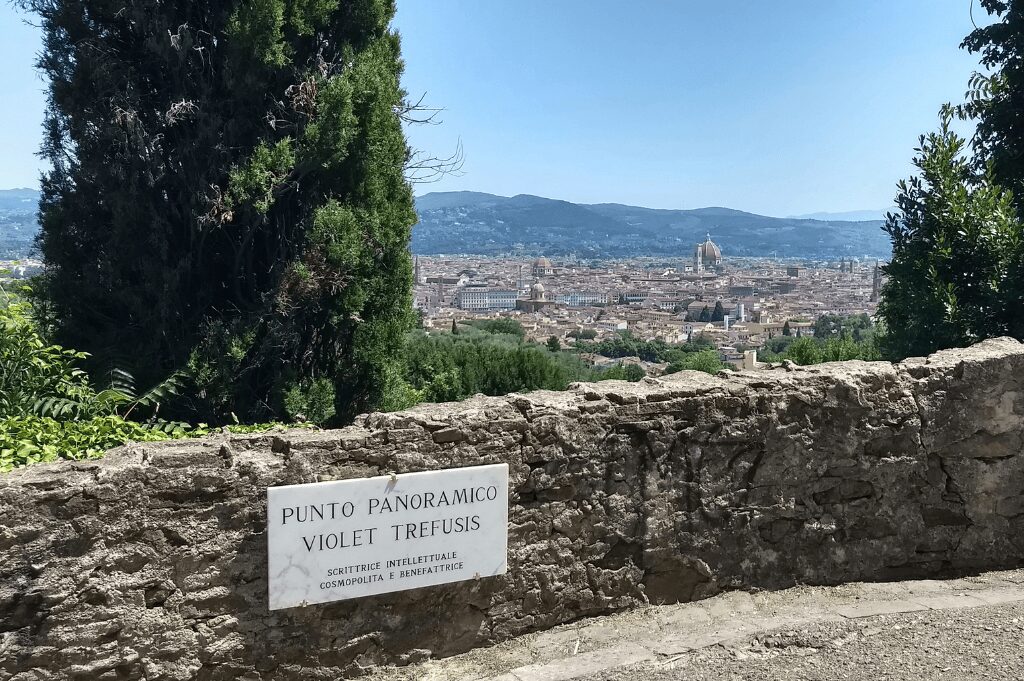
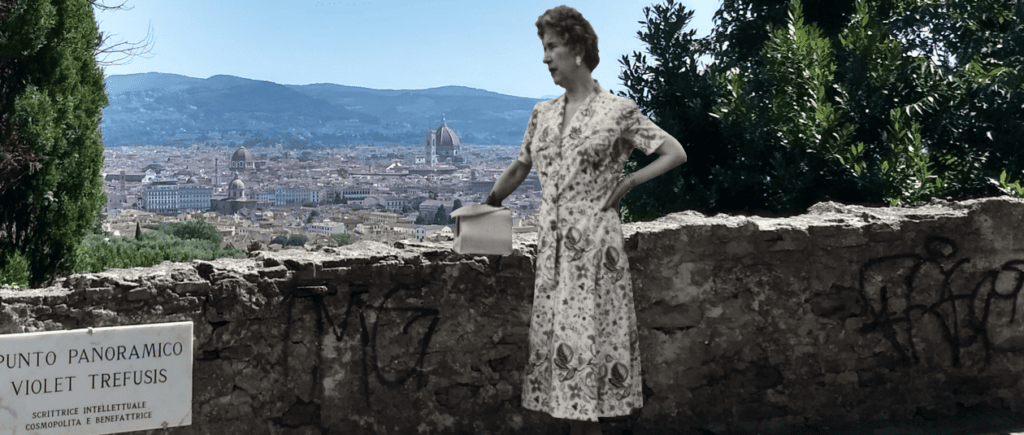
And it is here in Florence that one of the city’s most evocative viewpoints bears her name: the spot that crowns the hill of Bellosguardo, facing south, wrapped in greenery and bathed in light. From here, Florence reveals itself in its full beauty, in an atmosphere of enchanting silence. Leaving Piazza di Bellosguardo and walking along Via Roti Michelozzi toward the Villa dell’Ombrellino, you come upon the overlook on your left — officially the Belvedere Violet Trefusis, but better known as “the Bellosguardo belvedere” or “the oh! point,” because it is impossible to arrive here and not let slip a gasp of astonishment at the view over Florence.
Violet watched Florence from up here every day, from the house where, through the 1950s and 1960s, she welcomed some of the most important figures in the world, helping to promote the city’s cultural richness, its creativity, its artisan energy, its taste for elegance. As you reach the belvedere and turn toward the Villa dell’Ombrellino, you glimpse a statue: “the beautiful goddess, guardian of the tranquil arts” — Canova’s Venere Italica, which in 1925 a Violet Trefusis barely past thirty had Cecil Pinsent install to mark the very spot where Ugo Foscolo is thought to have found inspiration for Le Grazie.
In short, the view from the Belvedere Violet Trefusis symbolically mirrors her own gaze: open for Florence, not merely upon it.
A walk through Bellosguardo with Violet Trefusis
“Bellosguardo is a dimension unto itself, an atmosphere, a state of perception,” wrote Violet Trefusis, who on spring and autumn days would take this walk down to Florence and back home to the Villa dell’Ombrellino at Bellosguardo. She recommended it to her friends and houseguests, too. So it was not unusual to run into a young Mitterrand, Pierre Balmain or Francis Poulenc along Via di Bellosguardo — and sometimes Winston Churchill, though he would only manage a few steps on foot before continuing by car.
From this idea were born the Violet Trefusis “sound walks”: itineraries to be followed on-site or virtually, and above all to be listened to, that retrace the places of Violet Trefusis through a careful and original historical-biographical reconstruction. It is an eclectic route, a journey immersed in time, discovering enchanting and unexpected atmospheres, extraordinary characters, curiosities, and precious memories to reclaim.
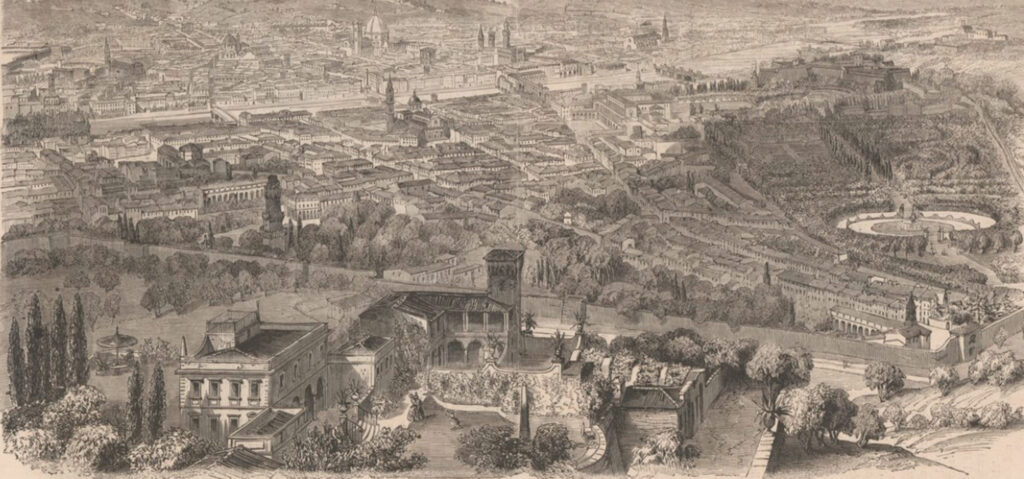
The route runs from Piazza Tasso to the Belvedere Violet Trefusis in thirteen stops, each chosen for what it has to tell, guiding you along a lively and eclectic path: from the Carnival traditions that link Lorenzo the Magnificent and the Commedia dell’Arte, to the old game of ruzzola (a rolling-disc contest); from hidden poetic corners tied to illustrious bards, to the spirituality of the Tabernacle of the Magnificat, which holds a special bond with Violet Trefusis, “the Cyrenean of joy”; from the painterly curiosities that for centuries have marked a particular vantage point over Florence, to the legend of the Saracen’s well in Piazza di Bellosguardo, and finally to the fascinating pull of the Villa dell’Ombrellino, its guests, its history, and of course the cosmopolitanism and esprit of Violet Trefusis.
It is a route that lets you hear the voice of the wind along Via Roti Michelozzi, which skirts the park of the Villa dell’Ombrellino; that lets you pause, intrigued, at the gate of the Villa Bellosguardo with its secrets, some worn away by time; and that finally plunges you into the wonder of the Belvedere Violet Trefusis, which never fails to take your breath away. And, with a virtual eye, it reveals the hidden symbolism of the statues that adorn the so-called “upper” terrace of the Villa dell’Ombrellino.
The route
Start: Piazza Tasso; 2. Piazza San Francesco di Paola / Via di Bellosguardo; 3. Via di Bellosguardo; 4. Villa Fioravanti; 5. The Ruzzola Bend; 6. The Corner of the Sigh; 7. Tabernacle of the Magnificat; 8. The Painter’s Viewpoint; 9. Piazza di Bellosguardo; 10. Villa dell’Ombrellino — main entrance; 11. Via Roti Michelozzi; 12. Villa Bellosguardo; 13. Finish: Belvedere Violet Trefusis.
The self-guided audio walks can be found at violettrefusis.com.