Brunelleschi’s Dome: The Stairway to the Firmament
“Wardens, there is no doubt that great undertakings are always hard to bring about. Not even the Ancients, those immense masters, ever managed to turn a dome so gigantic. I have thought without rest about centering, inside and out, so that the masons might work in safety — sleepless nights with no answer. What worries me is not only the height, but above all the width of the building. Had it been round, we could have used the method of the Romans, the one with which they built the Pantheon, which I studied with great care on my journeys to Rome; but here we must respect an octagonal base, a detail that pushes the project to the very limit of the possible. And yet this is a sacred temple, dedicated to God and to the Virgin, and for that reason I have great faith that it will be They who grant the strength, the knowledge and the ingenuity to whoever authors this immense work.
Can I be of help, since I conceived the project as it stands? No. Not yet. I have thought and thought again about the solution, but I believe Your Lordships will have to trust my instinct and judge my work in the moment — even though I do not think I am the one to be chosen. For this reason I propose that the greatest architects be summoned to Florence: not only Tuscans and Italians, but Germans, French, and men from the whole world over. Whoever can define the right way to build the dome shall be the one to raise it. I cannot give you better counsel than this.”
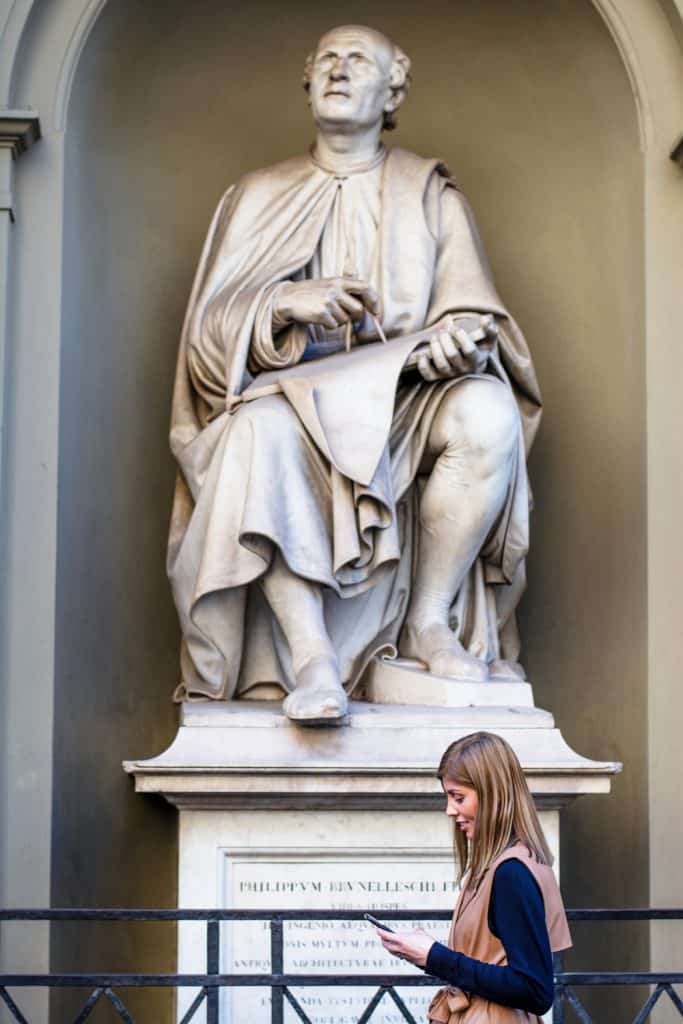
Ironic, brazen, visionary, brilliant: with this speech — reported by Giorgio Vasari and addressed to the men in charge of building the dome of Florence Cathedral — Filippo di Ser Brunellesco Lapi, known simply as Filippo Brunelleschi, opens the tale of one of the greatest feats in history, a journey between earth and sky. To understand it properly, though, we have to take a step back.
Florence, the year 1350. A deafening silence hangs over the streets and squares of the city; much of the population has been wiped out by a merciless epidemic — the Black Death. Europe is on its knees, progress has stalled, art is forgotten. Now the worst seems past, and it is time to recover, to begin again, to lay the foundations for the dawn of one of the most fertile ages in human history: the Renaissance.
The sun shines again over Florence and over all of Tuscany, which becomes the stage for a spectacle: a full-blown race to prove one’s might. Siena and Florence face off — whoever builds the largest church will hold the moral high ground. Florentine pride pushes past every limit, and an immense basilica is raised, a colossal project that, as was the custom of the age, gave no thought to the problems that would surface during construction. The way we conceive architecture and engineering today springs precisely from the revolutionary turn tied to Brunelleschi.
Construction of the Florence Cathedral — Santa Maria del Fiore — had begun many years earlier, in 1296, under Francesco Talenti. The work was all but finished; only one small detail remained: there was no roof, no dome! What was meant to be the jewel of the city, the masterpiece to show off and take pride in, was in fact an open wound in the heart of Florence. For nearly a hundred years no one could solve a problem that seemed destined to stay unsolved forever, plunging the proud, disappointed people of Florence into dismay.
It is 1418 when an official competition is announced for the building of the dome. Before the Wardens of the Works of the Cathedral of Florence steps a man of strange features. He is short, slight, decidedly ungainly, a little homely; in the city he is known for his irresistible wit and his taste for a joke — elaborate, clever, brilliant pranks, just like him. Born into a comfortable Florentine family that afforded him a rich humanist education, he is a curious mind and a traveler: Filippo Brunelleschi, called “Pippo da Firenze,” is a goldsmith tremendously in thrall to architecture. He arrives with a handful of notes scribbled on loose sheets; had they survived, they would have laid bare the workings of a mystery that reaches all the way to us — but that is another story.

The project Filippo lays out is extraordinarily ambitious: he proposes to build two domes, one shielding the other, without scaffolding. These immense, tremendously heavy hemispherical shells were to rise without the help of centering — the classic semicircular wooden arches typical of the Gothic architecture of the day. Centering could never have borne the weight of the domes, which would have collapsed mid-construction, dooming the whole enterprise and endangering the workers. Brunelleschi envisions giant brick arches, and within the segments of the dome he sets horizontal rings of stone and wood that, like the hoops of a barrel, would keep the structure from yielding to its outward thrust.
The governing board responsible for the building is astonished by the genius’s sketches, yet skeptical about whether any of it can actually be done. It buys time, and deliberates. Filippo Brunelleschi will be put in charge of the project — but with a reservation: he does not have enough experience to lead the work alone, and so he is to be paired with the great sculptor Lorenzo Ghiberti. It is an affront to Filippo. Anyone else would have rebelled, threatened to walk out, torn up the drawings and slammed the door; he, instead, chose — as always — cunning.
Construction of the dome proceeds under Brunelleschi’s direction and Ghiberti’s supervision, until one morning in 1425 Filippo fails to show up at the site: he is ill. The masons are thrown into disarray, unable to move forward, so they knock at his door for instructions; the answer is to refer to Ghiberti, who is, after all, also responsible for the project. Ghiberti has no idea how to proceed, and the building of the dome grinds to a halt. Filippo, after ten days of feigned illness, reappears at the site, the work resumes, and he becomes the sole master of the undertaking. Through a trick — one of his ingenious pranks — he has taken the stage for good.
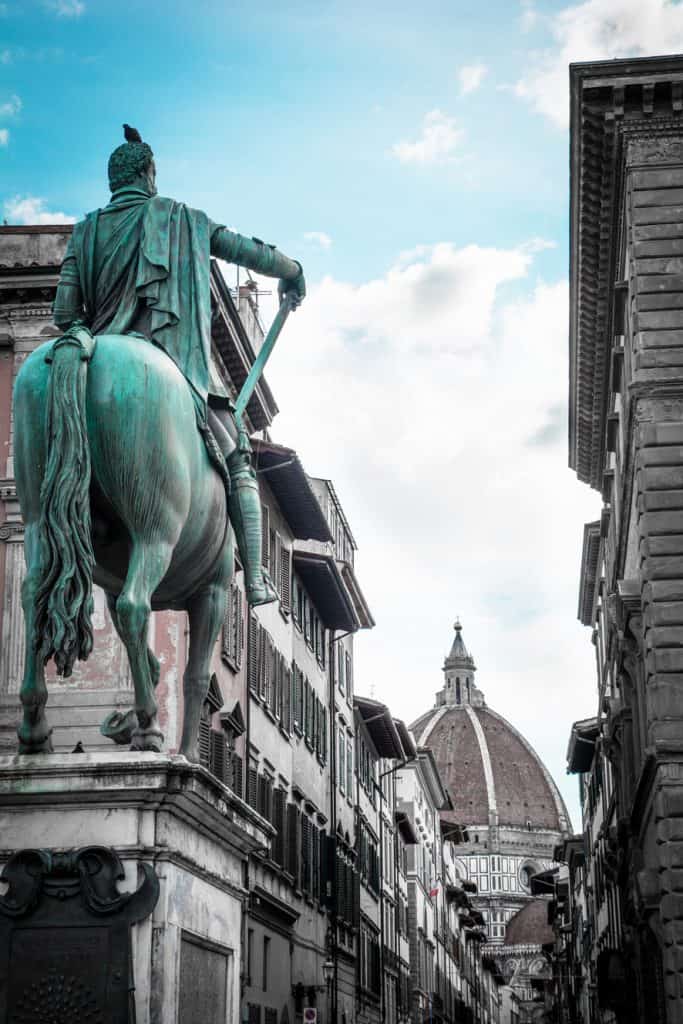
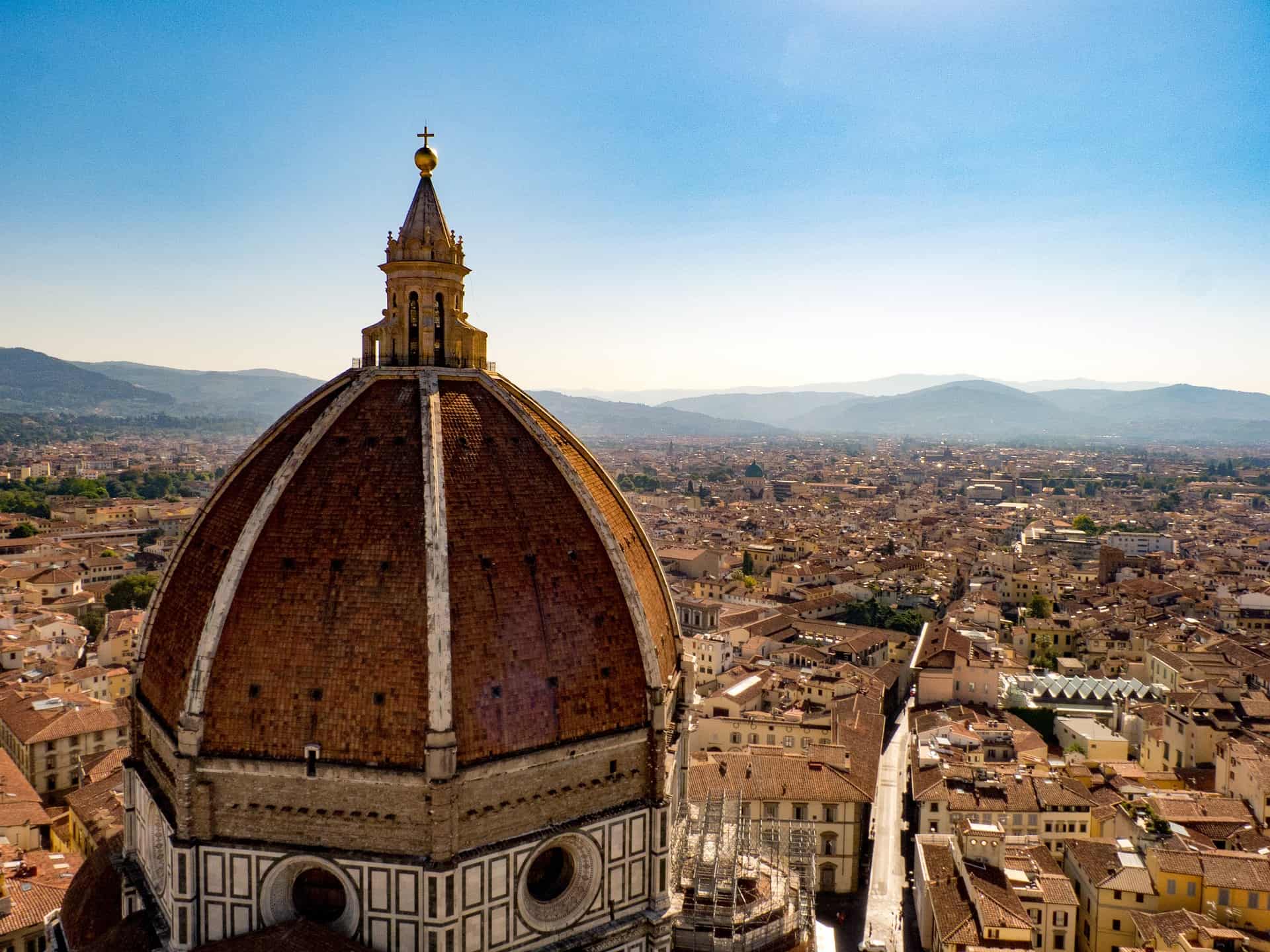
And so, while Ghiberti, the Wardens of the Works and all of Florence wondered how it was possible that the dome did not collapse in on itself — for it seemed to defy the laws of physics — at a snail’s pace and at a rhythm of thirty centimeters a month, the most majestic work of architecture ever built rose into the vault of heaven, reaching, sixteen years after the work began, a height of fifty-five meters above the ground. On March 25, 1436, the stairway to the firmament was complete, and the Middle Ages gave way to the Modern era.
To this day people still debate how Brunelleschi managed to bring the dome — now the very symbol of the city — to completion. There are theories that explain the master’s secrets: the herringbone brickwork, vertical bricks locking the horizontal ones in place; ropes and plumb lines fixing the exact position of each course; contraptions and cranes to hoist the materials; an extreme care for detail — great truths uncovered by scholars. But no demonstration will ever be enough to grasp the mad genius of an incredible man who climbed the steps of the sky, carrying the secrets of his knowledge with him.
Photos by Francesco Sani; illustration by Antrasat.