Cellini’s Perseus: The Secrets Behind a Bronze Masterpiece
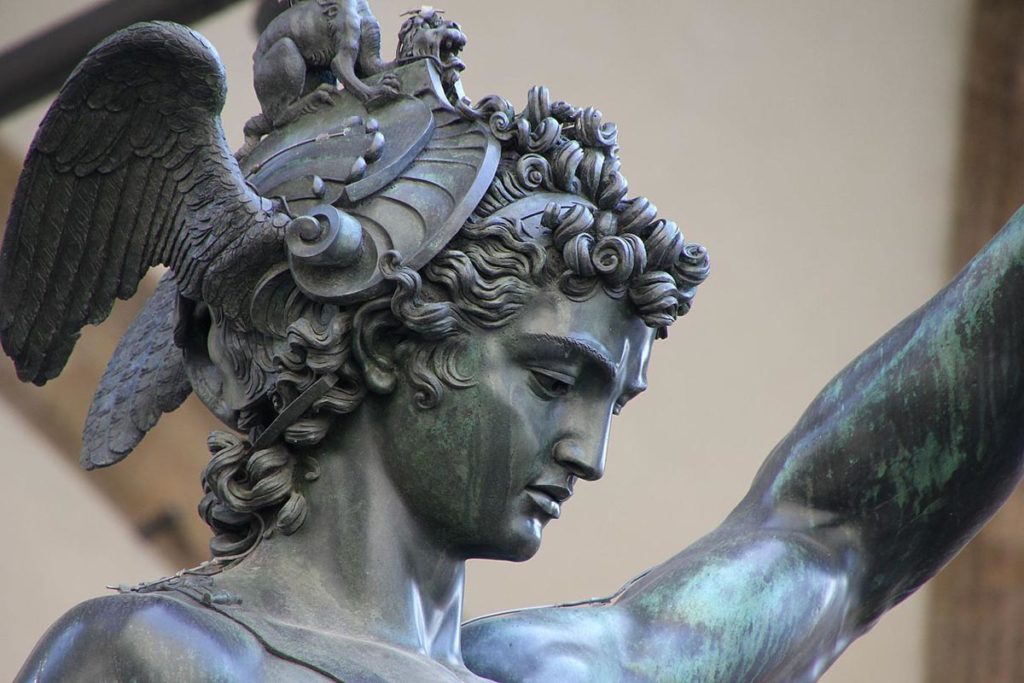
Cellini’s celebrated bronze Perseus tells, in allegorical terms, a chapter of the past in which Florence itself was the protagonist. That is fitting: most of the works displayed beneath the Loggia dei Lanzi draw on mythological themes, chosen to celebrate an event of significance for the city.
In the case of Perseus, the original myth is the Greek hero’s triumph over Medusa. The sculpture was made to represent the victory of Cosimo I over the republican experiment of sixteenth-century Florence. Perseus managed to slay Medusa, the only mortal of the three Gorgons, monstrous creatures with a petrifying gaze and serpents in place of hair, with the help of a special shield given to him by Athena. In gratitude, the hero presented the goddess with the Gorgon’s head, and she chose to set it upon that very shield.
Though the difference is invisible to the naked eye, did you know that Perseus and the head of Medusa are not made of the same materials? According to studies carried out by Bruno Bearzi, Perseus is 95.5% copper, 2.5% tin, 1% lead and 1% zinc, while Medusa is 90% copper and 10% tin.
The reason for the different alloys was explained by the artist himself. During the notoriously difficult casting of the work, Cellini was forced to throw even his own household objects into the furnace, tin bowls and plates among them, some 200 pieces in all. When he presented a bill for 10,000 scudi, Cosimo I decided to pay him 3,500.
But the surprises do not end there. Benvenuto Cellini, one of the most celebrated figures of Mannerism, is said to have hidden another work inside the Perseus. Next time you pass through Piazza della Signoria, step around to the back of the statue and study the upper part: at the joint of the nape and on the rear of the helmet, the artist created a remarkable optical effect. Look closely and you will seem to make out the face of a man, and not just any man.
The face, in fact, is thought to be his own.
Cover image via this link.