David LaChapelle, the Photographer of the Unphotographable
The last time we had the chance to see David LaChapelle’s work in Florence was during his participation in the group show devoted to “The Pinocchio Enigma” at Villa Bardini, between 2019 and 2020. At the fourteenth edition of the Florence Biennale — the international exhibition of contemporary art and design held at the Fortezza da Basso — the world-famous American photographer and film director was awarded the Lorenzo il Magnifico Lifetime Achievement Award. The prize was conferred as “a tribute to one of the most talented and influential photographers of our time, in recognition of his unique style and exceptional artistic output — built on imagination, experimentation and creativity — that carries profound social messages. Through his visionary, original and courageous perspective, he has inspired many other artists and audiences around the world.“
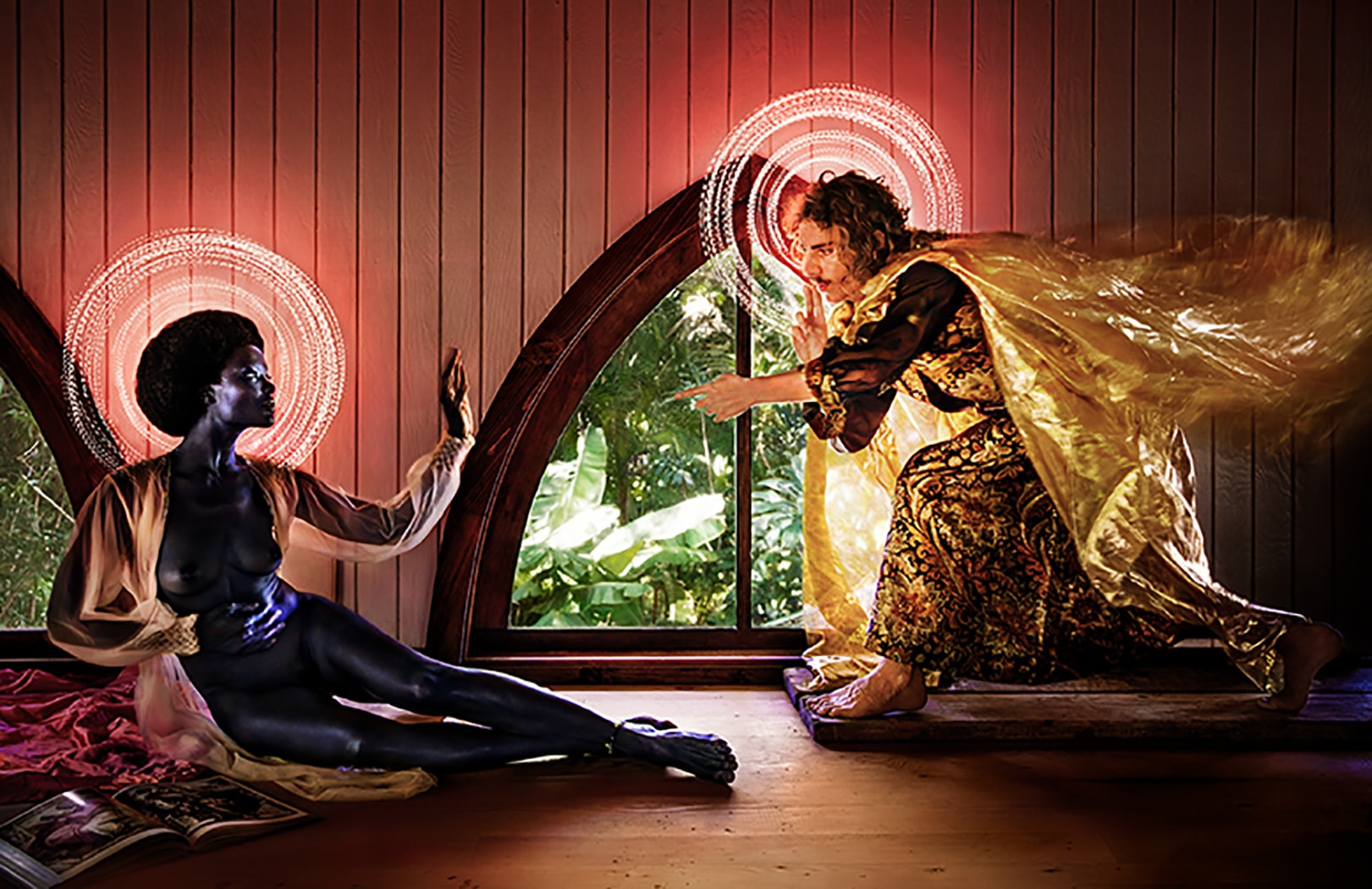
As Guest of Honour in the Fortezza’s pavilions, under the 2023 theme “Am You – Individual and Collective Identities in Contemporary Art and Design,” LaChapelle showed a body of work made between 2009 and 2023: photographs that are a downpour of colour, meticulous and dense with detail — surreal, seductive, at times almost grotesque paintings. LaChapelle is one of the most celebrated, debated and controversial artists in contemporary art, and people generally either love him or hate him. His photography is about as far from the traditional as you can imagine: it is not about “seizing the moment,” but about building the stories his tireless, prolific imagination produces, “painting” them onto the photographic canvas through an obsessive construction of the scene and lavish, uninhibited post-production. As he has said himself: “I try to photograph the unphotographable.
The images just appear in my head and I create them.” The result is work in blazing colours, with fairy-tale, surreal figures, always poised between the frivolous and the profound. Provocation is without doubt one of his favourite tools, and every shot catches the viewer’s eye and leaves them off balance — caught between a vague, familiar unease and the urge to step into that apparent chaos of images and colour, masterfully orchestrated by the studio hidden behind the curtain of each of his photographs.
Who is David LaChapelle, and what is the world he creates?

Born in Connecticut in 1963, David LaChapelle loved to paint from childhood but left school after being bullied, moving at just fifteen to New York’s East Village. He later attended the North Carolina School of the Arts, which accepted him despite the two years of school he had yet to complete. Enrolled at first as a painter, he learned to draw while developing an analogue technique of his own: hand-painting his negatives to achieve a sublime spectrum of colour before processing the film.
After a brief stint in the Marines and a marriage in London, LaChapelle returned to the Big Apple to devote himself entirely to his talent as a photographer — one in which painting, long the hallmark of his style, was destined to become a true “signature.” What the young LaChapelle did not expect was that a new fascination with the city’s chaotic, sophisticated social life would forever transform his outlook and ambitions. From his first showings in friends’ homes and then his first photographic exhibition at Gallery 303, LaChapelle got people talking — even piquing the curiosity of Andy Warhol, one of his idols, who reached out to have him work for Interview magazine, then the most famous art-and-culture publication in the world.
At that point the opportunities were many, and the photographer faced a fundamental choice: work for magazines or for galleries — that is, choose between fashion and art. He chose magazines, which gave him the freedom to do what he wanted and to express his creative world at its best. So began an explosive career across all the most important magazines of the era, and the first portraits of the stars of the celebrity system, in which his distinctly painterly technique was evident from the outset, making him a star among stars. The company, friendship and trust of celebrities allowed him to photograph dozens upon dozens of famous names: from Elton John to Dua Lipa, Michael Jackson, Eminem, Whitney Houston, Muhammad Ali, David Bowie, Amy Winehouse, Cher, Travis Scott, Leonardo DiCaprio, Tupac Shakur, Britney Spears, Naomi Campbell, Pamela Anderson, Kurt Cobain and Courtney Love.
It was clear from early on that LaChapelle, with his absolute command of colour and his singular compositions of fantastical narratives, was launching a new genre of photography, made of tableaux, portraits and still lifes — so much so that, as early as 1991, the New York Times wrote that LaChapelle would surely influence the work of a new generation, to the same degree that Avedon had pioneered what is now commonplace. The Times was not wrong, but it would have to wait a little longer. The real revolution in the American’s career came only when he felt a need to grow and to take on new subjects. With new awareness and a different personal and artistic maturity, LaChapelle realized that the themes he wanted to address through his photographs no longer fit the pages of magazines, and that working in that world no longer satisfied him; he felt he had given everything there, and decided to stop.
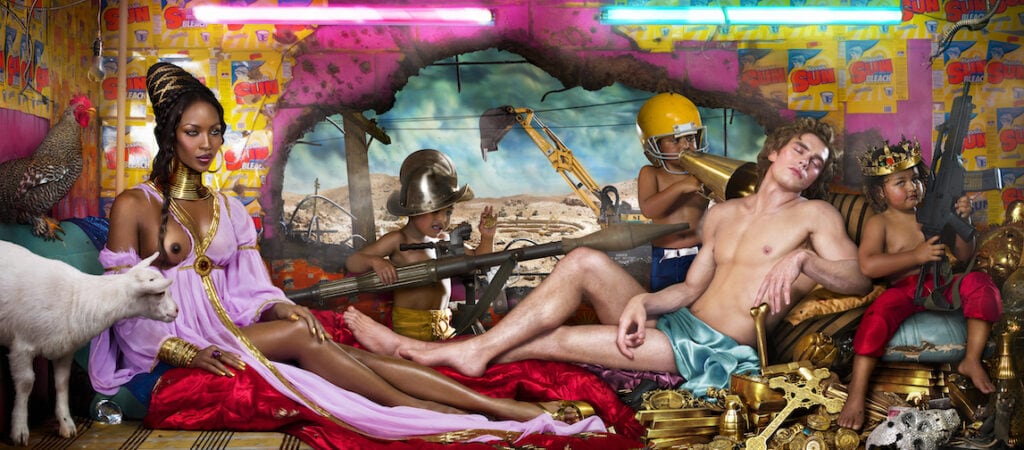
So in 2006 he moved to Maui, Hawaii, and started a farm with the intention of becoming a farmer, declaring that “nature is where I find the truth and where I feel closest to God,” convinced that his chance to work with galleries had passed for good. Yet it was while he was in Hawaii that he received a call from the Rafael Jablonka Gallery asking him to mount a show — for David, the perfect opportunity to fulfil a dream: to realize his own version of The Deluge, now known as the monumental photograph of a contemporary flood peopled by today’s individuals and idols, a portrait of modern humanity adrift.
A few weeks later he was in Rome for a private visit to the Sistine Chapel — an experience that overwhelmed him with the sheer force and grandeur of the place and of Michelangelo himself, whom LaChapelle calls a pop artist “because he is known all over the world, and everyone recognizes his David or the image of the finger of God and Adam almost touching, like a vox populi that speaks to people.” There he understood that art is made to reach everyone, and that when it does so it is far more interesting than art made for the art world. Working for magazines had taught him a language he went on using ever after; what changes from this point on are the subjects: “I didn’t become a different artist — I evolved, following the changes that life sets before you, staying true to myself,” he said in an interview in Rome during “David LaChapelle, After the Deluge,” the major show held at the Palazzo delle Esposizioni in Rome in 2015.
What LaChapelle put on the table is a new way of making photography — one that shows art can be the perfect means to confront taboos and to make social critique and analysis, blending perfectionism, an obsessive pursuit of the perfect image, and the ability to build scenes where reality and the absurd blur into one. Such is the case with “The Last Supper,” an unmistakable yet surreal version of the biblical scene that turns first of all on the question of race, confronting us with a reality we believe settled — the product of our cultural conditioning — and using provocation to prompt reflection.