Fyodor Dostoevsky in Florence
From the diary of Anna Grigor’evna Snitkina.
I will try to condense into a few pages the frantic writings of these months of love and grief, of dramas and fears, of serenity and torpor. We arrived here at the end of an autumn spent fleeing from death. Little Sonja slipped away with a sigh, just one hundred and twenty days after she was born. Our little girl, the fulcrum of our lives — lives now crushed by helplessness.
We came from Milan, a gray, austere city; I had imagined Italy differently. Fyodor believed he would find there precious pages to feast on and a special illumination to go on writing his novel, but it was not so. So we set off for Florence, the Capital of the Kingdom, a crucible of History and of stories, the cradle of the Renaissance, which became the destination of our longed-for rebirth. Florence, after all, is an ode to art and beauty, its streets steeped in romance, and I knew that these timeless places have always exerted a powerful pull on sensitive souls and on travelers in search of inspiration.
Fyodor had already stayed here, years before, and had told me every detail of his journey with eyes burning with passion. It was August 1862, and at the Santa Maria Novella station two strange tourists speaking Russian stepped off a train. They asked a coachman to take them to some inexpensive lodging in the city center, and the carriage stopped at the Pensione Svizzera. The porter took several minutes to write down correctly the names of the two new guests: Dostoevsky and Strakhov. Strakhov — a dear and esteemed friend, philosopher, and consummate literary critic — shared with Fyodor his dreams and visions. Driven from his beloved homeland, my husband loved Florence at once: the Arno with its breathtaking bridges reminded him of the Neva and the Fontanka; St. Petersburg had never felt so far away and yet so close as in those happy days. Amid thundering discussions on existence and loud laughter over bottles of Tuscan red wine, they strolled, admired, took notes, drew inspiration. A few days ago, just after we finished the draft of the novel, I wrote a letter on Fyodor’s behalf to Strakhov. He dictated these words to me:
“Do you remember our evenings with the Florence bottles? You were always more provident than I: you would get yourself two bottles and I only one, so that, once I had finished mine, I would lay my hands on yours — though I am not proud of it. All the same, we spent those five days in Florence well…”
When we arrived, Fyodor and I, the city welcomed us with its majesty and its beauty beyond compare; the works of art spoke to our souls. The masterpieces kept in the Uffizi Gallery and the Accademia enchanted us with their grandeur and perfection. The art of Botticelli, of Michelangelo, and of all the Renaissance masters awakened in us a sense of astonished wonder and admiration. We were wrapped in an atmosphere thick with magic, which quenched our creativity and released in us an even deeper passion for art. I remember clearly Fyodor’s words before the dome of Santa Maria del Fiore.
«My love, don’t you feel something extraordinary in the air? It is as if the city itself were a spell that envelops us, awakening emotions and sensations one cannot explain. Every corner breathes timeless beauty. Walking these cobbled streets, my dear Anna, do you feel your heart beating in unison with the pulsing rhythm of the city?»
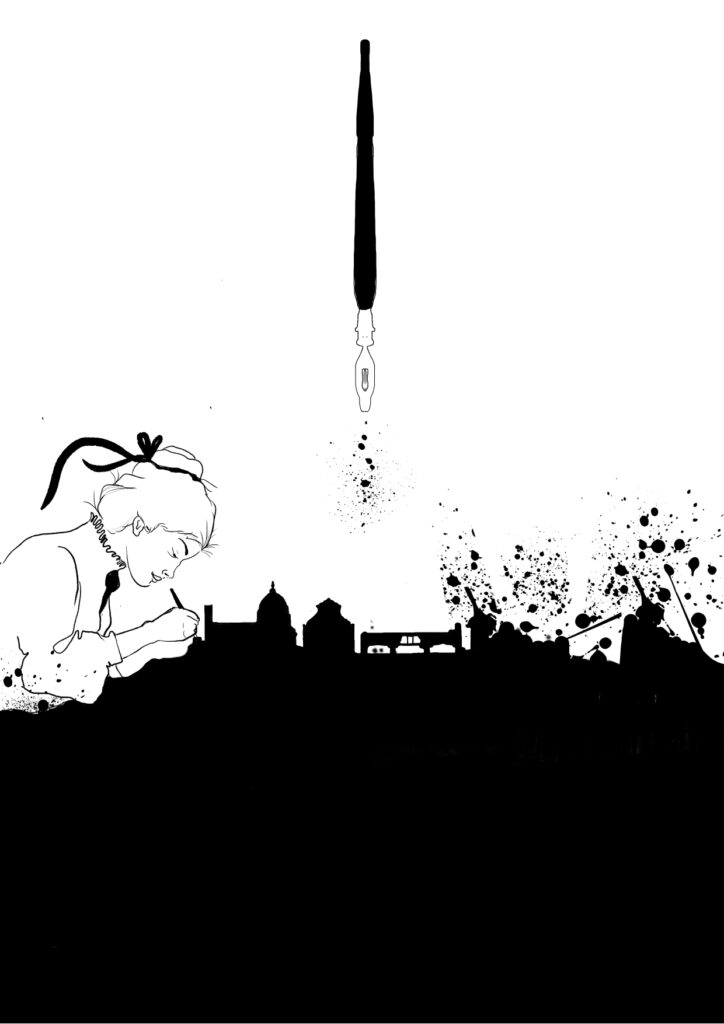
Florence gave voice to our passions, inviting us to seize every instant, and gave me a love that would last a lifetime. Heavens…! From acting as his stenographer and giving voice to his narratives, I have started writing just like him — how embarrassing! To ape his style — not even his beloved would be worthy of it! And to think how bored I was the first times my father spoke to me of the works of Mr. Dostoevsky! Instead I soon fell in love with his writings, and then with all his flaws, until I became his wife.
Love, as I was saying, swept over us in Florence; the despair over the loss of little Sonja softened gently as we watched the sun slip into the red air upon the surface of the river, sitting hand in hand on the steps of Piazzale Michelangelo. But there was more.
Florence was a mirror for Fyodor, in which to reflect his complex and tormented soul. He would lose himself in the labyrinths of the alleyways, moved to tears before the immensity of the historic monuments and the ancient churches. The Basilica of Santa Croce, the eternal resting place of Michelangelo and Galileo, stirred in him reflections on the fragility of life and on the perpetual struggle between human greatness and the inevitability of death. The city’s profound spirituality nourished his inner search and helped shape his new literary masterpiece.
The Idiot will be remembered forever! Fyodor portrayed a nineteenth-century Jesus Christ, a man infinitely “good.” When we spoke of it with Italian friends in Florence, they did not grasp the sense of this word as we understand it. In Russian the word “prekrasnyj,” which translates roughly as “good,” in fact denotes the splendor of goodness and beauty together. In truth it is a novel deeply rooted in the Florentine setting: the city itself comes alive in the story, embodying the moral dilemmas and the overwhelming passions of its protagonists. When we visited Basel, Fyodor became infatuated with that painting, The Body of the Dead Christ in the Tomb. Holbein had painted the drama of life; he had immortalized the eternal struggle between the infinite and the end. My husband kept staring at it from every angle, telling me how the artist had captured the ultimate meaning of existence, how a single image could distill millennia of reflection on the human soul.
Yes, The Idiot will be remembered forever. I wrote like a madwoman at a relentless pace, while he let the words pour out in thundering cascades, and everything took shape in those incredible days. Right here, in this magical city we will never forget, we took refuge, found comfort, warmed ourselves, and fell in love once more — with ourselves and with the future. We will remember it forever. And it will remember Fyodor Dostoevsky, sublime novelist, illustrious thinker — and who knows whether one day, among the statues of the immense men one meets along the city’s streets, that of my husband too might appear. Perhaps in “our” Parco delle Cascine, the setting of endless walks of love.
Illustration by Bea Donati