The Electress Palatine: The Princess Who Saved Florence’s Art
History is full of episodes in which art collections were stripped away — carried far from the places they came from and were kept, once the family that owned them fell into decline. In Florence this did not happen, thanks to the foresight of the only daughter of Cosimo III, Grand Duke of Tuscany, and Marguerite Louise d’Orléans: Anna Maria Luisa de’ Medici. The princess drew up the so-called Family Pact, which bound to the Tuscan state the artistic collection that had belonged to the Medici for centuries. But let’s start at the beginning and get to know this woman of remarkably modern mind.

Who was the Electress Palatine
Anna Maria Luisa de’ Medici was the last representative of the Medici dynasty. She was especially beloved by her father, who felt immense affection for her and set great store by her opinion. She is also known as the Electress Palatine because she married Johann Wilhelm, Elector Palatine — one of the princes who chose the king of Germany. The marriage came after several failures: Anna Maria had first been promised to the Duke of Savoy, then to the Duke of Modena, and there had been negotiations to wed her to King Charles II of Spain. For one reason or another all of these plans came to nothing, and the princess married Johann Wilhelm, moving to Düsseldorf. When, at the end of the War of the Spanish Succession, her brother Gian Gastone had no heirs, Anna Maria Luisa — with her father’s backing — asked Emperor Charles VI to be named heir to the Grand Duchy of Tuscany. The nomination was denied, but after her husband’s death she returned to Florence in 1717, where she remained until her own death.

The Family Pact
For years it was she who kept the Medici name aloft, smoothing over the general discontent: Cosimo III was by then old, and Gian Gastone was busy leading a life of vice and luxury. The Electress Palatine formed bonds with the Tuscan nobility, devoted herself to charity and helped govern the council; but when, on her father’s death, Gian Gastone became his successor, she withdrew to the Monastero della Quiete. It was in 1736, during the negotiations for the passage of the House of Medici to the House of Lorraine, that Anna Maria came back into play. On her brother’s death it was she who signed the act naming Francis of Lorraine universal heir — but on one condition: that all the artistic masterpieces her family had collected over the centuries remain in Florence. In this way the Electress Palatine also prevented the future ruling families of the city from removing the artistic patrimony whose immense value she had grasped. She also understood the drawing power Florence would gain through art, as written in the Family Pact: “…nor to take out of the Capital and of the State of the Grand Duchy the Galleries, Paintings, Statues, Libraries, Jewels and other precious things belonging to the succession of the Most Serene Grand Duke, so that they may remain for the ornament of the State, for the benefit of the Public, and to draw the curiosity of Foreigners.“
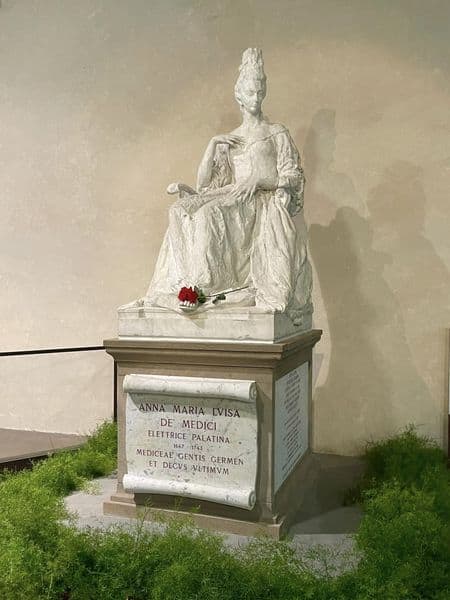
To this day, every February 18 — the anniversary of her death — a procession marches in her honor to the Medici Chapels, where her tomb and a statue of her can be found. It is a tribute to a figure who holds a central place in the history of Florence. It is, in fact, thanks to the Electress Palatine that the work and the artistic patronage the Medici carried on were not lost; and it is thanks to her wisdom, too, that Florence can be considered the city of art par excellence, proud to guard timeless masterpieces.
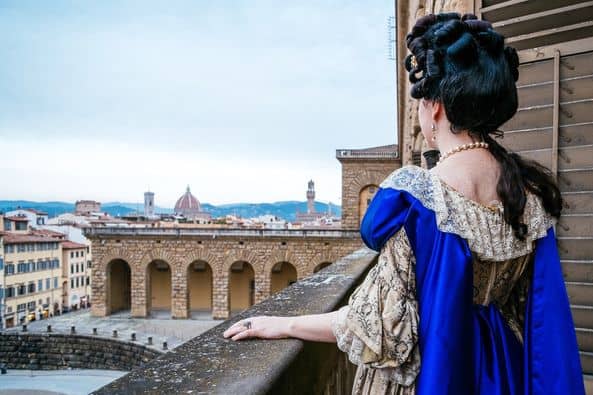
Cover photo from the Facebook page of MUSE Firenze.