Femicide, the political question Italy refuses to see
On September 3, Federico Vella abducted Lorena Isceri, tied her up, shut her in the trunk of her own car and drove north on the A1 toward Bologna. She was 45. From inside the trunk she managed to call 112 and stay on the line so the police could track her location, while he drove toward an overpass near Barberino del Mugello. He threw her off it, then jumped himself. By the time the patrol cars arrived, it was over.
A mechanism with a name
Every femicide has one person’s precise responsibility behind it. It is the endpoint of a pattern of control that turns into extreme violence at the exact moment a woman tries to get free — a separation, the end of a relationship. It grows out of the idea of ownership, out of the will to decide another person’s life. Calling it “femicide” interrupts the story usually told about it: a woman is not killed because she was loved too much, but because she claimed the right to stop belonging to the man who thought he owned her. And because the same pattern repeats, it is also a social fact — those deaths cannot be filed away as isolated tragedies. In the single act it concerns one man; in its recurrence it concerns everyone.

And the way institutions step into that power relationship with new laws is never neutral. Which instruments are chosen, how they are applied, what they are meant to achieve — all of it is a political answer. When a femicide is downgraded to a fit of madness and violence reduced to jealousy, it is tempting to think the speaker simply doesn’t understand the country he lives in, that he is stuck in another era. It isn’t a failure of understanding. It is a choice. Recognizing that the violence is structural would come with a bill: welfare to fund, and consent to lose among those who still recognize themselves in the old order.
The unfinished revolution
Over the last century, women drove one of the deepest social transformations in recent history. They won education, work, economic independence, sexual freedom, access to the professions, the right to abortion and to separation. From the 1960s on, their lives were less and less defined by family and children.
It was a fast, deep revolution, and a substantial share of men did not manage to adjust to it — unable to accept the loss of ownership and control that women’s new independence implied. Femicide sits inside that historical fracture: on one side a female autonomy that is now irreversible, on the other the resistance of those who still treat a relationship as an inalienable claim on another person’s life. So it is not the distant residue of a vanished world.
It is a present reaction to a present change.
The State and the untouchable family
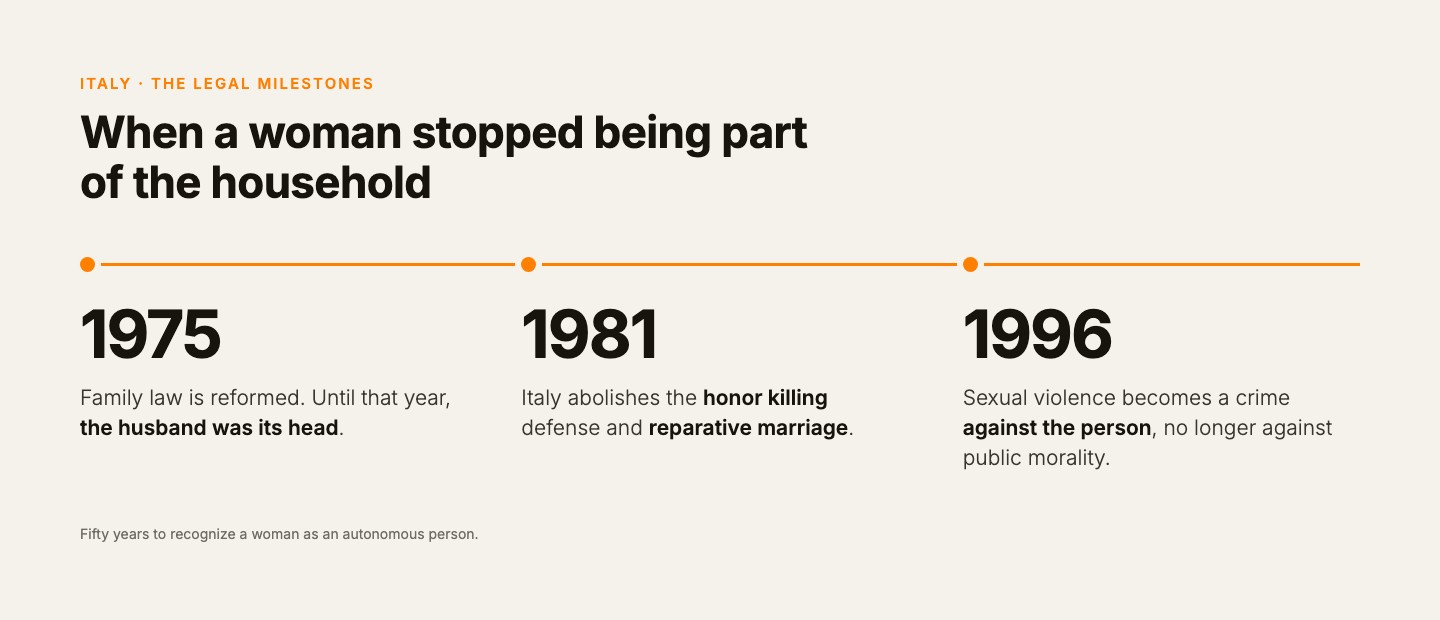
That resistance was matched, in Italy more than elsewhere, by how slowly institutions came to recognize a woman as a fully autonomous person. Until the family law reform of 1975, the husband was the head of the household.
The honor killing defense and reparative marriage were abolished only in 1981, and until 1996 sexual violence was a crime against public morality and decency, not against the person.
This is exactly where the political question surfaces. These were not merely legislative delays: those rules reflected a precise social order, built on the man’s authority and on the woman’s labor — hers were the children, the house, the elderly, the sick, and the husband himself. The family was an economic and hierarchical structure that the law and the dominant story worked to preserve, and the job of holding it together, by working and by putting up with it, fell almost entirely to women. “The family,” people used to say, “is made by the woman.”
That model also had a precise economic function: women’s unpaid labor sharply reduced what the State would otherwise have had to provide and fund through welfare. It is a model some would like to bring back today, and one the media keep endorsing. Reporters and commentators go on romanticizing the stories of murdered women, mistaking jealousy for love, stalking for persistent courtship, violence for an ordinary couple’s quarrel — and femicide for the breakdown of a poor betrayed man.
Convenient denial
No political force today could openly defend women’s subordination. So the resistance works more carefully, through denial: it denies that inequality and patriarchal dynamics persist, and tries to isolate each case as the product of one man’s madness or despair. It plays up the cases where the killer is a foreigner, so that every form of domination over women can be blamed on someone else’s religion or culture — as if Italy did not have centuries of its own history running the same way.
Control, the refusal of female autonomy, the inability to accept a separation, the demand that a woman stay available even after she has chosen to leave: these are the elements of the common matrix of femicide. Erasing that matrix means reducing them to individual inadequacies and cutting away their social origin. The goal of conservative politics is to preserve the traditional family and social order. Recognizing the violence as structural would mean a long series of interventions: dismantling the stereotype through serious relationship and consent education, proper training for police, magistrates and social services, and stable funding for anti-violence centers. In short, a deep shift in mentality and in everyday power relations.
The hidden price of welfare
Defending the traditional family is not only a moral position. It has a very concrete economic function. The Italian State still hands the family an enormous share of the care that public services ought to guarantee. It is mostly women who look after children, the elderly, the sick, people who cannot care for themselves — and adult men — for free. Their work fills the gaps in the system every single day.
A woman who is economically independent, free to leave and not forced to carry the weight of care alone, needs a State that shows up: nurseries, home care, disability services, income support, affordable housing, shelters, a justice system able to move quickly. All of that costs public money. Keeping the woman inside the family, making her the one responsible for care, saves those resources instead — and lets the country present as love, devotion or natural female vocation what is in substance unpaid work.
This is why economic dependence is not a side issue of violence. A woman with no income, no home and no network of services formally holds the right to leave, but not the means to exercise it. If the State grants her the freedom without the material conditions to use it, that freedom stays incomplete.
So the absence of resources is a political choice too.
A public budget always reveals which freedoms, and which lives, a country has decided to actually protect.
Punishing without changing
Faced with femicide, the political answer is almost always the criminal one: raise the sentences, write new offenses, call for zero tolerance. Such measures project strength and gather consent, but they act downstream, not upstream.
The partner or the ex-partner is punished, most of the time, once the woman is already dead. What stays underfunded is prevention, education for the young, economic independence, shelters, and the ability of institutions to recognize coercive control in time.
Afterward, politics commemorates the victim without asking why she was not believed, not protected, not put in a position to save herself. A country can declare itself unbending against violence and, at the same time, keep refusing the explanation for it.
A tailor-made culture war
Conservative politics also uses stigma, turning the whole question into an ideological fight. Talking about “gender ideology,” about the excesses of feminism or the criminalization of men, makes it possible to frame any cultural initiative as an attack on the family, on motherhood, on national identity. The attempt to fight structural violence — the kind that sometimes sits inside the relationship between the sexes — gets speciously recast as a blanket accusation against all men, instead of what it is: a defense of every woman’s freedom.
Admitting that many women are killed precisely when they decide to leave would mean admitting that the rights already won have not erased, in some men, the idea that they can still decide about a woman’s life, her body, her work. It would mean admitting the thing the denial exists to avoid: that female emancipation is not complete, and that femicide is not a battle already won.
Femicide is not foreign to the social order. It grows, more often than not, inside that order’s most celebrated institution, the family — and it is a political act to decide that preserving it matters more than the freedom and the life of the people inside it. Lorena Isceri called 112. She did exactly what women are told to do: ask for help, trust the institutions, try to save herself. It was not enough. And it will not be enough as long as politics keeps looking only at the last gesture and never at everything that made it possible. The real test is not the firmness shown after the tragedy, but the courage to step in before — while it is still possible to decide whether a woman truly has, and not only on paper, the right to walk away.
Elisabetta Digiugno
Cover photo: Depositphotos