Gino Bartali: The Man Behind the Hero
Oh, quanta strada nei miei sandali
quanta ne avrà fatta Bartali
quel naso triste come una salita
quegli occhi allegri da italiano in gita.
E i francesi ci rispettano
che le palle ancora gli girano
e tu mi fai: “Dobbiamo andare al cine”.
E vai al cine, vacci tu!(In English, roughly: “Oh, how much road under my sandals — and how much Bartali must have covered — that nose as sad as a mountain climb, those merry eyes of an Italian out on a jaunt. And the French respect us, because it still galls them, and you say to me: ‘We should go to the movies.’ Well, go to the movies yourself!”)
So sang the great Paolo Conte in one of his classic songs, a piece that captured an age, portrayed a national hero, and painted the whole social and political backdrop of the world.
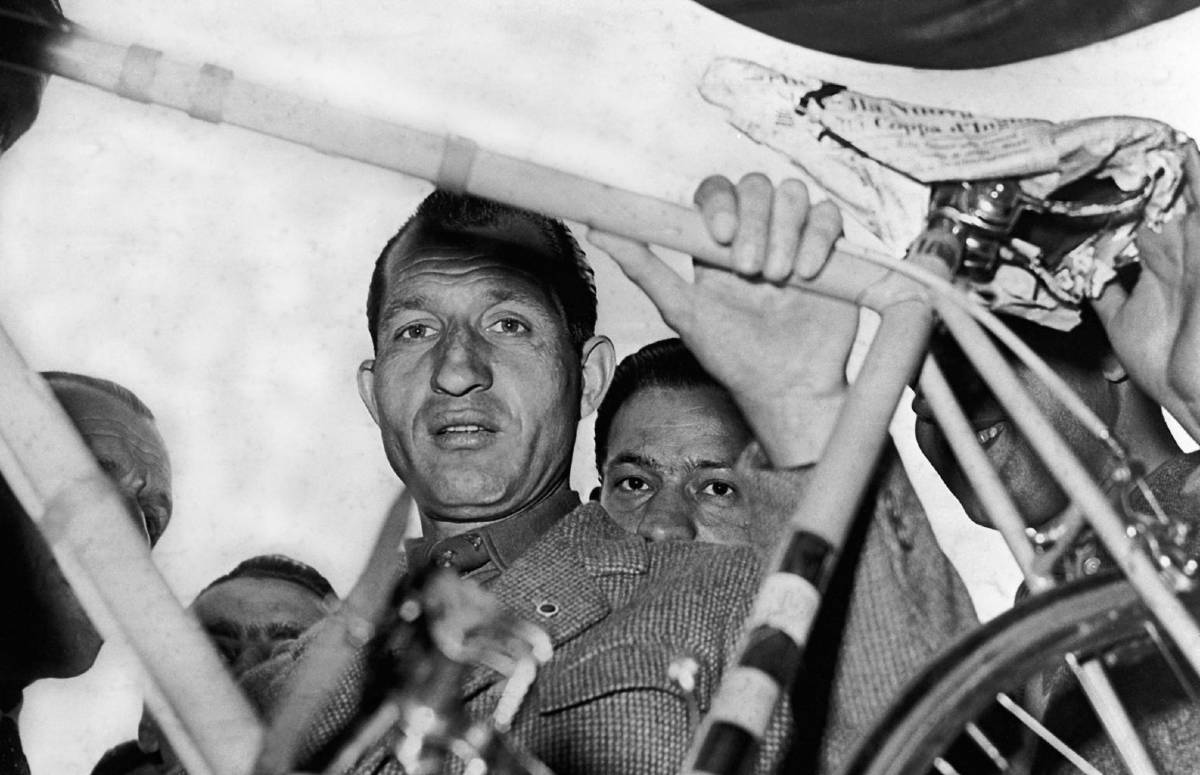
“The French respect us, and it still galls them,” because Gino Bartali stormed the Bastille and conquered Paris, winning the Tour de France. The rivalry — born back when Julius Caesar subdued the Gauls — flared up again in the aftermath of the war, and sport became a metaphor for national power. “Go to the movies yourself!” The cinema: an Italian passion, a social ritual, mirror and reflection of a return to life after years of horror and tragedy. How could anyone go to the movies while the radio was broadcasting Bartali’s historic feat? And to think that this cyclist with the sad nose and the merry eyes would go on to make cinema, to live it, to inspire it — indeed, his whole life would turn out to be one great, immense film.
For once, we would like to relive the making of that film, to speak of the man behind the hero, the person behind the legend; we would like to tell the story of a Tuscan, a Florentine, one of us, a man with the heart of a lion and legs of stainless steel.
On the set of Gino Bartali’s film, all the great masters of cinema came and went. Alberto Sordi was captivated by Bartali’s sharp, unmistakably Tuscan wit, mining his priceless anecdotes for lines in his films. Sophia Loren was spellbound by the champion’s exploits. The maestro Federico Fellini, a keen cycling fan, recalled meeting him at a society evening in Rome; Fellini spoke of him as a true gentleman, with a charm and charisma that reached far beyond the world of sport, leaving an indelible mark on everyone he met.
“Ginettaccio” — roughly, “Gino the Terrible,” his gruffly affectionate nickname — leapt off the screen with his disarming naturalness. It was Antonio Ricci, the driving force behind Silvio Berlusconi’s revolution in television, who made the gamble of asking Bartali to host Italy’s most famous satirical news show, Striscia la Notizia. From 6 to 18 January 1992 the Tuscan champion, nearly eighty but still full of energy and charisma, won over millions of Italians with the ease of a seasoned television professional.
The man who lived across the eras: he was not quite a year old at “the passing of the first infantrymen, on the 24th of May” — a nod to Italy’s entry into the First World War — and he lived through two world wars, finding himself flung into a world that changed day by day in the name of technology.
Technology, that goddess, the undisputed queen of the modern world. Gino Bartali stood open-mouthed before the new training methods of today’s cyclists — he who raced in an age when the “exercise bike” did not even exist, invented by an American researcher in 1968. He who, to stay in shape through the winter, would attach his bicycle to a grinding wheel in a mill in the Florentine countryside, pedaling against the resistance of the running water and simulating the conditions of a steep climb. A forerunner, an innovator, an inventor: not everyone knows that Bartali contributed to the technology of cycling by devising a new kind of braking system, proof that his boundless passion and talent rode in a sprint alongside his extraordinary intelligence.
His was an intelligence matched by a deep religious faith; Pope John Paul II called him “a man of incomparable humanity,” alluding also to his deeds beyond the world of sport. One wonders whether the Holy Father knew that Gino Bartali was also a man who defied superstition. The number 13 was thought unlucky by nearly everyone. In ancient times the Vikings worshipped twelve gods, and legend has it that one day a thirteenth appeared on Earth, bringing evil to humankind — to say nothing of the Last Supper of Jesus, at which 13 sat down to eat. Ginettaccio wore the number 13 in all his most thrilling victories.
And what of the superstition of the “black cat”? The story goes that, during a stage of the Tour de France, the Tuscan champion suddenly found a black cat sitting on the handlebars of his bicycle. Rather than take fright, he decided to carry the creature with him for the entire route, treating it as a good omen. Astonishingly, the tale has it, the cat stayed calm for the whole race.
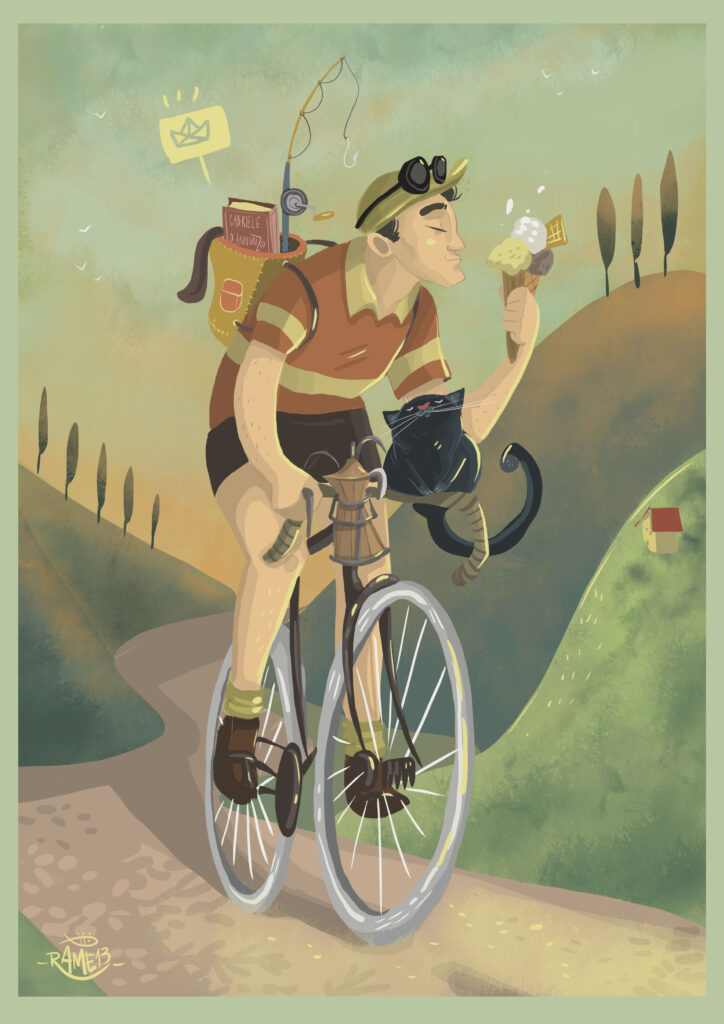
This is the poetry of and about Gino Bartali — poetry that was for him a singular, at times indispensable passion, so much so that before the great races he would withdraw to a quiet, secret hotel room to read the verses of Gabriele D’Annunzio, through which he found the inspiration of a champion and the concentration of an athlete. On his longest and most grueling races, Bartali always carried a most unusual survival kit: besides food and water, his bag might hold a small fishing rod and a book of poems, so that the long waits during breaks would never leave him bored.
But a real man is made of small things too — hidden habits, quirks, vices, and unusual passions, like his special pre-race coffee ritual. Before every big race, Bartali had a peculiar habit: to drink a long espresso, brewed by his own hand in a personal moka pot he always carried with him. This ritual gesture not only helped him focus, it became a moment of calm and reflection before the challenge ahead. Or else the ice cream at the end of a climb.
After scaling the toughest peaks, Ginettaccio had a very distinctive tradition: to stop at the summit and enjoy an ice cream. It was said to be his secret for recovering his strength and tackling the descents with fresh vigor. And what of his bizarre secret about speed? Legend has it that Bartali had a trick for going faster on the descents: spreading honey on the saddle of his bicycle. The viscosity of the honey, so the story goes, reduced air friction, letting the champion descend faster and with greater confidence.
Gino Bartali was also a superb cook, surprising his fellow racers with tasty, wholesome dishes, and he loved spending time in his garden of rare exotic plants, which he collected in abundance. But plants were not the only thing he guarded jealously: he was mad about hats, too. He wore a different one for every occasion — one for sunny days, one for the rain, and even one for his most memorable victories.
Gino Bartali’s is the epic of a superhero — and the facts bear it out, as when, during one especially fiery race, he showed up at the start line dressed in a superhero costume, complete with mask and cape. The surprise threw all his rivals off balance, and he triumphed in his own unique, inimitable style.
It is said that Gino Bartali was the man who turned the bicycle into a dream. On that note, the story goes that Bartali had the gift of foresight through his dreams. Before some of his most memorable victories, he would have premonitory dreams that guided him through the race and gave him the strength and determination he needed to succeed. And then? Do you know what that strange Florentine cyclist “with the nose as sad as a mountain climb and the merry eyes of an Italian out on a jaunt” actually did?
One day he was contacted by Monsignor Elia Angelo Dalla Costa, the Archbishop of Florence, who asked him to join the clandestine organization DELASEM, the Delegation for the Assistance of Jewish Emigrants. Between September 1943 and June 1944 he took part in the most important race of his life. Setting out from the station of Terontola, near Cortona, and sometimes riding as far as Assisi, he made numerous journeys on his bicycle, carrying documents and passport photographs hidden inside the tubes of his frame, so that a secret printing shop could then forge the papers needed for Jewish refugees to escape.
But that is another story — the story of a legendary man with the heart of a lion and legs of steel, the tale of a life that will forever inspire great, immense films.
“A silent hero,” to borrow the words of Primo Levi.
Illustration by Rame 13.