The Biancone: Anecdotes of Florence’s Neptune Fountain
Known to everyone as the Biancone, the Neptune Fountain, honoring the Roman god who ruled the flowing waters and the sea, stands in Piazza della Signoria in Florence. The work holds a few intriguing curiosities, not all of them happy, that begin even before the sculpture itself: with the choice of the artist who would be commissioned to make it.
It was Cosimo I de’ Medici who pushed hard for the Biancone to be built. The work was brought to life by the artist Bartolomeo Ammannati, but the choice of sculptor was anything but smooth and straightforward. At first, Duchess Eleonora di Toledo pressed Cosimo to accept her protégé, Baccio Bandinelli, while Cosimo I favored Benvenuto Cellini, whose magnificent Perseus with the Head of Medusa stands in the very same square.
The Duchess got her way, though Bandinelli’s sudden death reopened the rivalry between the two. A competition was then announced but ultimately came to nothing, since it was another of the Duchess’s favorites who took on the work: Ammannati. From the artist’s surname sprang the famous Florentine saying “Ammannato, ammannato! Quanto bel marmo t’hai sciupato” (Ammannati, Ammannati! What fine marble you have ruined), which swept through the city as soon as the work was finished, in 1559.
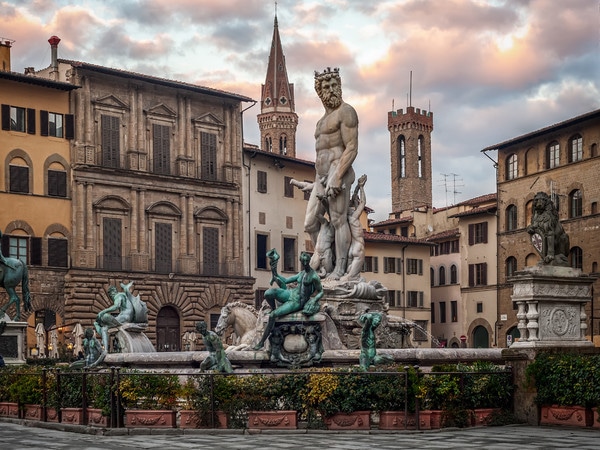
The subject, Neptune, is a symbolic representation of the maritime supremacy the Grand Duchy of Tuscany had achieved in the years just before the fountain was made. Surrounded by bronze tritons, satyrs and nereids, crafted by Giambologna, and by four horses, it commands attention just a few meters from Palazzo Vecchio through its sheer power. It was carved from prized Carrara marble, famous the world over for its whiteness. For that very reason, Florentines were quick to rechristen it “I’ Biancone” (the Big White One).
Used during the sixteenth century as a public washing basin, the statue has repeatedly been the target of vandalism. Among the saddest episodes was the one in 2005, the most recent, when a vandal trying to climb the statue broke off one of its hands.
Cover image here.