Eleonora di Toledo and the Origins of “Pitti”
The whole world knows the phrase “Pitti Uomo,” yet few really know the story behind the name. “I’ Pitti” — as it’s known around town — is one of the most important menswear trade shows in the world. Held twice a year in Florence, it draws designers, stylists and buyers from every corner of the globe: against a backdrop of elegance and extravagance, the latest menswear trends are unveiled.
But why “Pitti”? Because it was originally held at Palazzo Pitti, many would answer — overlooking the real (in every sense) royal origin of the name. It’s true that the event takes its name from its earliest home, Palazzo Pitti, which was bought by Eleonora di Toledo in the sixteenth century. A passionate patron of art and letters, Eleonora used her role at court to turn the palace into a major center of the cultural and artistic life of the age.
Today the great fashion showcase is no longer held in the royal palace — for logistical reasons it moved to the Fortezza da Basso — but the name has stayed the same, honoring the figure of Eleonora: the woman who changed the fortunes of Palazzo Pitti. The palace’s name still evokes elegance, beauty and refinement, standing for the cultural and artistic legacy of the nerve center of Renaissance Florence. The world flocks to the city, which once again becomes an international capital of fashion and art, echoing the tradition of the Medici court.
All that’s left is to dig into the story of this remarkable woman, and grasp just how much she did to make Florence a banner of style — a trendy, à la page city, a trait that has endured across the centuries.
So then: Eleonora di Toledo is one of the most important and influential figures of the Medici court during the Renaissance, wife of Cosimo I de’ Medici, Grand Duke of Tuscany. In those days marriages were dictated chiefly by family agreements — genuine contracts meant to shore up ties of political and commercial power. This one, at first, was no different; reaching terms both sides could accept took great effort, above all because Eleonora’s family was among the wealthiest of the time.
Her father, Pedro Álvarez de Toledo, was Viceroy of Naples and answered directly to Charles V of Habsburg, ruler of the famous “empire on which the sun never set.” Cementing the bond between the Florentine Signoria and a branch of the most powerful dynasty in Europe was a formidable undertaking, but in the spring of 1539 Cosimo I and Eleonora di Toledo were married in the church of San Lorenzo, amid lavish festivities. Their marriage would prove one of true and lasting love, built on respect and equality.
Eleonora went on to give birth to no fewer than eleven children, all without neglecting her calling as a genuine influencer of the early modern age. An artist, patron and shrewd, able diplomat, her authority over the courts, culture and fashion of Tuscany was immense, and her contribution to the history of the whole region is still evident today, hundreds of years on. Eleonora had received an education worthy of a princess — rigorous and complete, with special attention to art, music and religion. A fervent Catholic, her passionate, intense faith shaped the fortunes of the city, encouraging the building of churches and monasteries across Tuscany.
She quickly became a crucial ally to her husband in managing the court and the politics of Florence. Her great diplomatic skill let her negotiate with the other Florentine noble families and keep good relations with them. Her support for Cosimo was fundamental to the growth of the Grand Duchy of Tuscany. But Eleonora was also a brilliant, discerning artist and patron with exquisite taste: her passion drove her to fund the creation of works of art and the building of sumptuous edifices, such as the basilica of San Lorenzo.
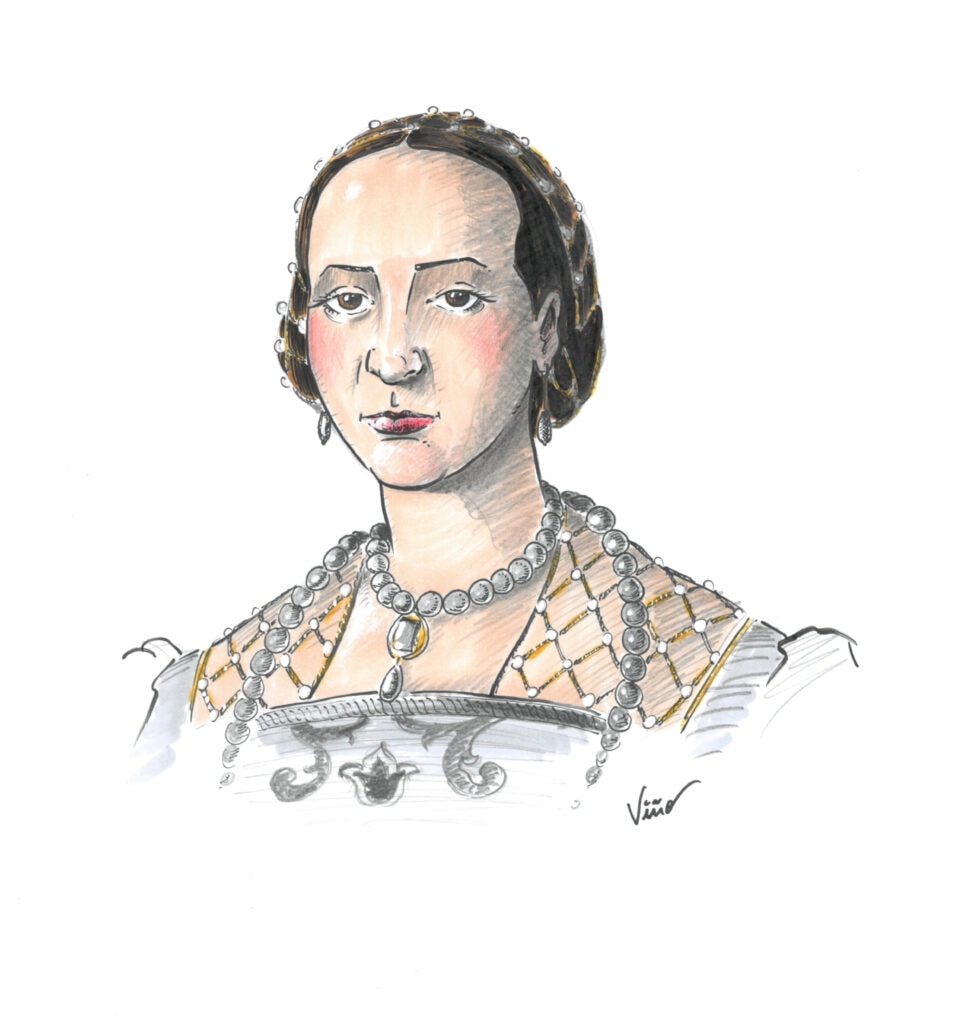
Her contribution to Renaissance art was decisive for the flourishing of a culture of beauty. But the most striking quality of the Spanish princess was that she was a true queen of fashion. The elegance of her style and the refinement of her taste were widely admired and literally influenced the fashion of the Florentine elite. Her reputation as a symbol to be imitated still resonates for many women today, and her role feels remarkably contemporary. No one conveyed that iconic image better — letting us see with our own eyes just how much “Queen Eleonora” was the fashion influencer of the Renaissance — than the Florentine painter Agnolo Bronzino.

He painted a portrait of the queen posed in elegant dress: a tribute to the beauty, austerity and strength of the woman. Bronzino’s technique — rich, luminous brushwork — heightens Eleonora’s beauty and brings out her unmistakable elegance. The painting is a showcase of Renaissance craft, an undisputed contribution to the history of art, recognized the world over. Influential, powerful, alluring, irresistible: Bronzino’s portrait expresses the femininity, the fertility and at the same time the resolve of a woman who mattered to her king and to all the people of Florence.
But how does all this connect to Palazzo Pitti and the international fashion fair? It’s far simpler than you might think…
Palazzo Pitti was bought by Eleonora di Toledo herself, as a residence for the family — that is, for the entire illustrious Medici court — in 1549. It was the ideal choice for the queen, since it flaunted the wealth and power of the Medici, reinforcing their political and moral dominion over the city and over all of Tuscany. At the time, Palazzo Pitti was a grand seigneurial residence in the heart of Florence, ringed by lush gardens and spectacular fountains. Eleonora and Cosimo I de’ Medici chose to acquire the great palace as a dazzling show of power, making it the center of the political and social life of the Grand Duchy. The queen used it to host great parties and society events, frequented by the artists, writers and eminent figures of the day.
Palazzo Pitti remained the Medici family’s residence for many generations, and today it is a museum housing a vast collection of art and historical treasures. This brilliant move by Eleonora di Toledo was a pivotal event in Medici history, and still stands as testimony to the splendor and dominion of the Medici court in the Renaissance. Iconic, regal, radiant, influential, viral — the image of the Spanish princess who came to the city to marry its ruler echoes down to our own time. She loomed over sixteenth-century Florence and Italy the way actresses, singers and fashion bloggers hold sway today, dictating the laws of universal fashion. Such was Eleonora di Toledo: the fashion icon of the Renaissance.
Illustration by Alessio Vignozzi “Il Vigno”.