An Itinerary Among Florence’s Most Beautiful Fountains
Since antiquity, dynasties and peoples have sought control of the waterways, understanding how vital they were to economy and politics. And in a city, easy access to water meant wealth, well-being and health. Basins and cisterns, in fact, appear in the urban landscape from the earliest times. But water also became the protagonist of monuments meant to display a city’s majesty and power: fountains. The first fountains with a monumental, artistic function appear in the Hellenistic age, fade away during the Middle Ages, and come fully into their own during the Renaissance and the Baroque. Florence is a perfect example of this: the city is dotted with fountains that carry symbols and anecdotes woven into Florentine history. And so it’s rewarding — just as we do with paintings and sculptures in museums — to trace an itinerary of the city’s most important and beautiful fountains.
The Fontane del Caciucco
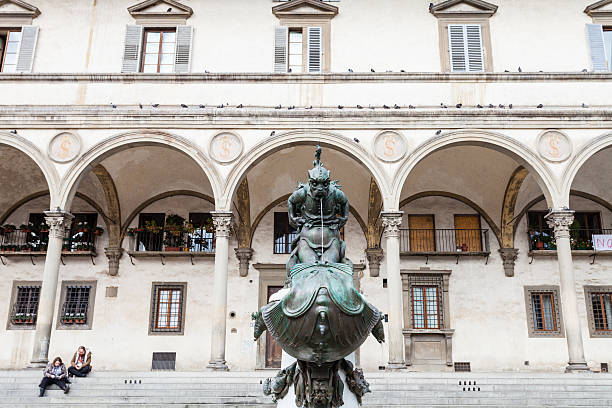
We begin in Piazza Santissima Annunziata, where between 1627 and 1629 Pietro Tacca created two twin bronze fountains crowned by sea monsters. They had actually been commissioned from the artist by Ferdinando I for the city of Livorno, but the grand duke died before they were finished, and Cosimo I decided to keep them in Florence. Their name — Fontane del Caciucco — was given by the Florentines after the famous Livornese soup of fish and shellfish. The two works were placed on either side of the equestrian statue of Ferdinando I, who loved Livorno and had grasped its strategic importance.
The Fontana di Nettuno
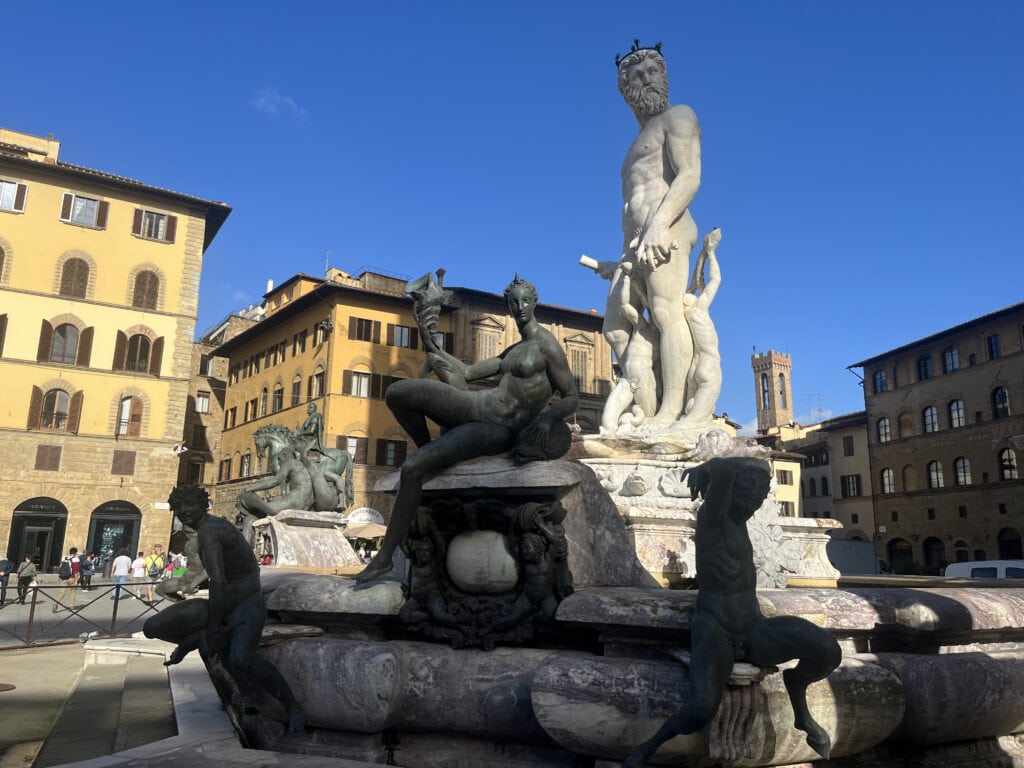
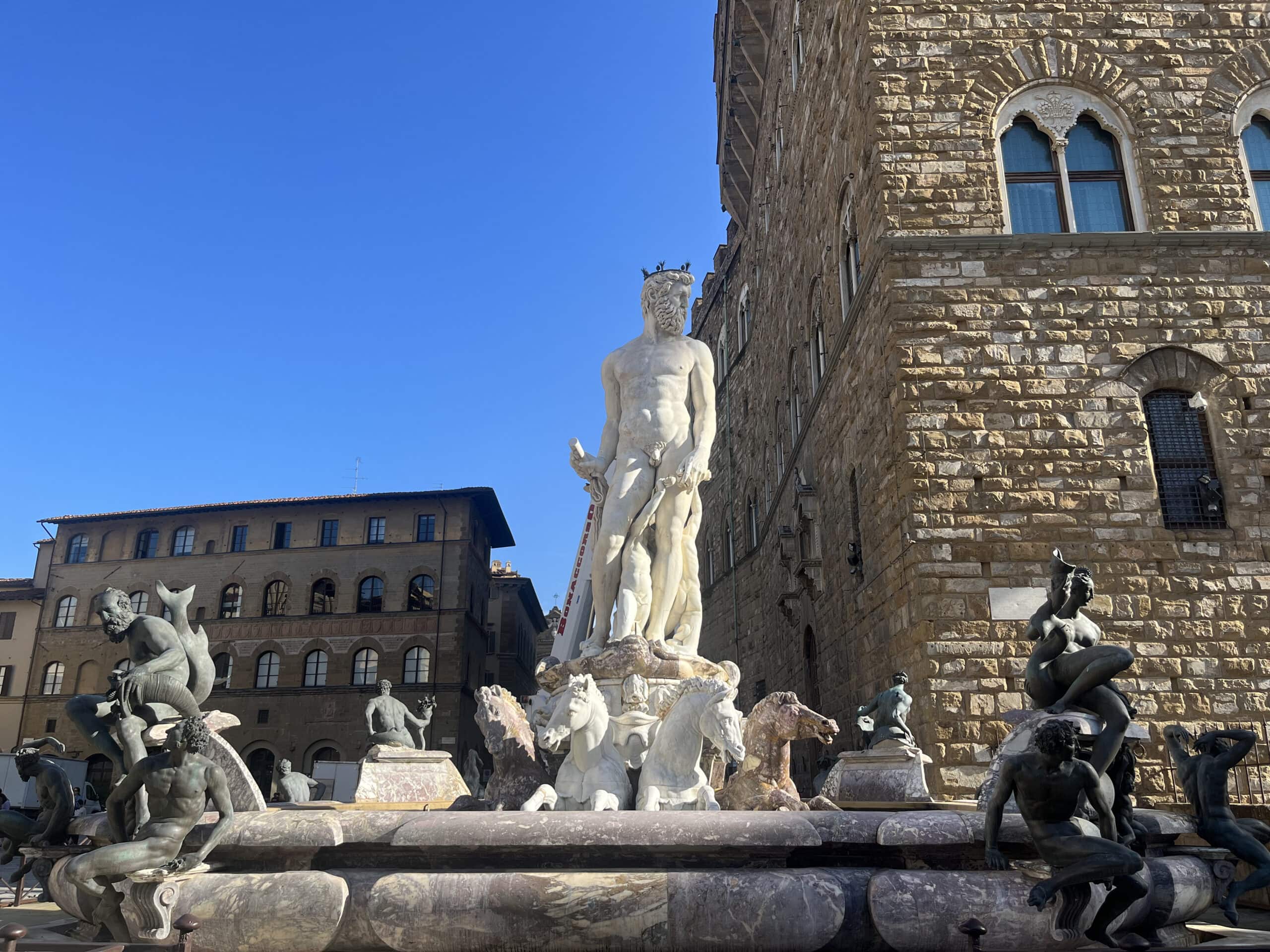
No visit to Florence is complete without a stop in Piazza della Signoria — and not only for the David and Palazzo Vecchio. Here you’ll also find the city’s most famous monumental fountain, the one nicknamed the Biancone (“the big white one”). That is the name Florentines gave to Bartolomeo Ammannati’s statue of Neptune, for the white marble that defines it. The sea god is surrounded by a whole cast of figures — nymphs, fauns, satyrs and other marine deities — part bronze, part marble. The entire work brought together several artists who set out to honor Florentine power, and in particular Cosimo I de’ Medici, master of the seas. The fountain in fact also had a practical purpose: this area suffered from a shortage of water, which meant poor hygiene and, in turn, disease — something even the Medici family experienced firsthand. If the overall sight of the monument catches the eye at first, we’d urge you to linger over the details as well: the chariot’s pedestal is decorated with reliefs of Scylla and Charybdis, symbolizing the dangers one meets at sea, while the wheels of the horses’ cars bear the signs of the zodiac. One last curiosity about this fountain: to carve the Biancone’s face, Ammannati took his inspiration from that of Cosimo I.
The Fontana dello Sprone
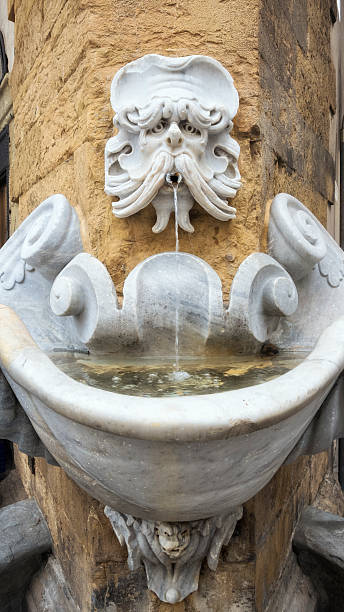
Around the city there are many curious fountains, such as the Fontana dello Sprone. It takes its name from its position on the corner of Via dello Sprone and Borgo San Jacopo, in the Oltrarno district — sprone (“spur”) being the very term for two streets meeting at an acute angle. From the wall juts a grotesque mask (mascherone) that spouts water into a shell-shaped basin, the whole crowned by a shield bearing the Medici coat of arms. The work was built by Francesco Generini after the completion of the aqueduct commissioned by Ferdinando II in 1638–39. A truly unusual fountain that catches the eye of passersby, intrigued by its shape and its unexpected placement.
The Fontana del Carciofo
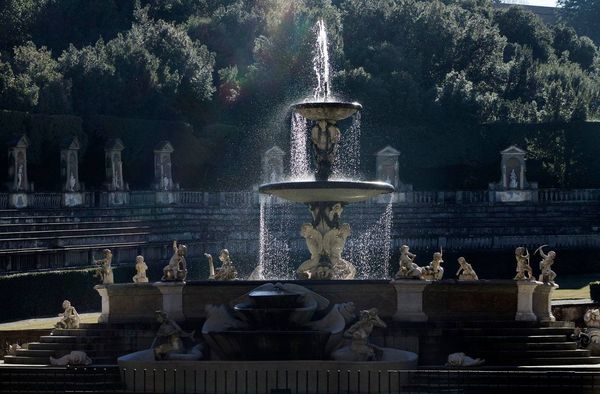
Photo from the official Facebook page of the Uffizi Galleries
Another singular fountain is the Fontana del Carciofo (Artichoke Fountain), on the northeast side of the Ammannati courtyard at Palazzo Pitti. It was built between 1641 and 1642 by Giovan Francesco Susini, who assembled sculptural elements drawn from other works in the garden. Blending Mannerism and Baroque, the fountain rises vertically on a marble shaft decorated with tritons and nereids holding up two circular basins of granite and marble. The octagonal base is completed by putti wrestling as they sit on shells, swans or turtles, while on one side the whole monument is rounded off by three smaller basins, again composed of marine elements such as satyrs, nymphs and dolphins. There are two versions of how the fountain got its name: the first is that it derives from a bronze lily that once stood at its top but has since been lost; the second is that it recalls the resemblance between artichoke leaves and the shell decorations along the sides of the steps at its base.
The Fountains of the Rampe del Poggi
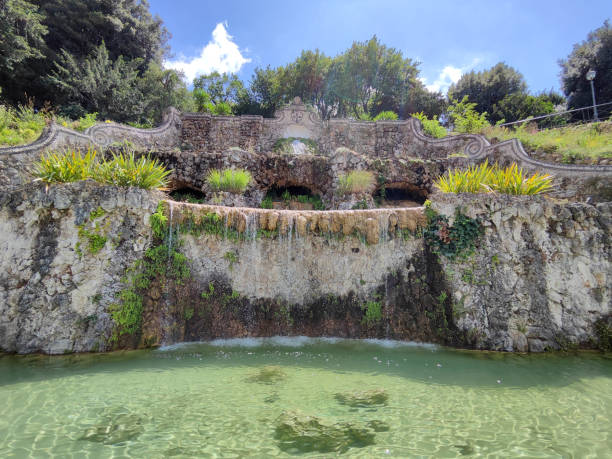
A cluster of grottoes and pools marks the route that climbs from the San Niccolò district up to Piazzale Michelangelo. Known as the fountains of the Rampe del Poggi, they take their name from the engineer who designed them as part of an urban-renewal project meant to improve everyday life. Built in 1876 and arranged on several levels, the fountains are wrapped in greenery and complete with water games and cascades. These works fit perfectly into the bucolic setting that leads up to Piazzale Michelangelo, helping to make the ascent special and pleasant. Not long ago, the restoration of this complex was completed, restoring its former splendor and setting the water flowing once more.
And so our itinerary of Florence’s fountains comes to a close — though it certainly doesn’t end here, and many more could be added. This is a city that shows how the purpose of these monuments is far deeper and more complex than we often imagine: from water supply to urban renewal, from the purely decorative to the symbolic. They’re well worth getting to know, then, because they open one more window onto the cultural, political and artistic history of the city.
Follow us for more itineraries exploring Florence.