Jenna Tatham, Mother Expressionism
I met Jenna Tatham at the opening of the Eros and Ashes exhibition at Spazio Sassetti last May; after the customary introductions, the painter invited me to visit her creative space on Via dei Serragli. I seized the opportunity, and Jenna was gracious enough to show FUL her works – some of which were still in progress – and answer a few questions for the magazine.
Your background brings together incredibly fascinating worlds: the rigor of sight-size drawing at the Charles Cecil Studios in Florence, receiving a place to study Theology and Religion at Oxford, and, going even further back, a defining encounter at the age of four with Dalí’s art at the Museum Ludwig. How do these distinct souls integrate into your journey, and how have they shaped the artist you are today?
Standing before La Gare de Perpignan by Salvador Dalí at the age of four is one of my earliest memories, and certainly my first encounter with a work of art that imprinted itself upon my psyche. Years later, all I could remember was an overwhelming brightness, the vastness of the canvas, and a figure falling through the sky. My mother tells me she would leave me standing there for long stretches while she wandered through the rest of the museum. Looking back, I can only describe it as finding a vision in which to rest.
There was something strangely comforting about that surreal world, somewhere I could disappear into. I was lucky to be surrounded by art as a child and drew almost every day by my older sisters side. In many ways, I have always inhabited an imaginative realm alongside the visible one.
My years at the Charles Cecil Studios offered a very different gift. Although I had begun studying academic drawing at thirteen, the intensity of daily practice refined my eye, taught me patience, and gave me confidence in the language of oil paint. More importantly, it cultivated an understanding of the flow of light, the rhythm of form, and the beauty of the body’s natural contours.
It taught me to continually step back, to see a painting as a unified organism, and to understand how every individual mark contributes to the movement of the whole. At the same time, I became increasingly aware that I was constructing a technical foundation for ideas that extended far beyond representation. My fascination with religious traditions, mythology, philosophy, and metaphysical questions was becoming inseparable from my artistic practice.
My interest in the intersection of spiritual literature, science, and mysticism has shaped my work since my A Levels, when I first encountered the Buddhist concept of the Stream Enterer and began using water as a visual metaphor for surrender.Across Sufism, Neoplatonism, Buddhism, Taoism, and strands of Christian mysticism, water repeatedly emerges as an image of unity and emanationism, expressing how individual forms arise from, and remain inseparable from, a greater whole.
Before turning fully toward the figure, I experimented with abstract sea inspired paintings that sought to function as energetic mirrors. First moving on to depict a body dissolving into a contemporary reimagining of Ophelia, in 2022, a narrative I understood less as a story of physical death than of ego dissolution.
I spent time solo travelling in Indonesia, where life in ashrams and the practice of mantra meditation became part of my daily rhythm. During this period, I also visited Villa Vrindanava in the Florentine hills, whose sacred art collection left a profound impression on me. A quote that stayed with me was one by Niels Bohr “The fact that religions have spoken in images, parables and paradoxes means that there is no other way of grasping the reality to which they refer; it does not mean that it is not a genuine reality”.
Rather than seeing myths, symbols, and religious imagery as primitive attempts to explain the world, I became interested in them as sophisticated languages capable of expressing realities that exceed ordinary speech. My desire to deepen my understanding of the philosophical and theological foundations of Buddhism and Hinduism grew steadily, eventually leading me to apply to study Theology and Religion at the University of Oxford in 2023.
While preparing my application, I became particularly interested in the historical conflict between patriarchal monotheisms and older nature-based traditions, a tension I believe continues to echo today in the imbalance between masculine and feminine principles, spirit and matter, and humanity’s destructive, detonating relationship over the natural world.
While researching feminine archetypes, I was struck by how autonomous women repeatedly appear as figures of danger throughout mythology and religious history. Whether goddess, widow, witch, or temptress, female independence is so often associated with forces that must be feared, controlled, or demonised. This became a lasting thread within my practice. My paintings seek not simply to depict women, but to restore equilibrium. I understand the feminine not merely as a gendered identity, but as an elemental principle of creation, dissolution, intuition, embodiment, and transformation.
In January of 2024, I was offered a place to study Theology and Religion at Harris Manchester College. Initially I was overjoyed and accepted the offer. Yet as September rolled in and the time came to take out my student loan, I found myself unable to proceed, my whole body revolted and I could not ignore that this was not my path.
It was an extraordinary opportunity, but I realised I was seeking authority to validate my voice, institutional permission to investigate questions I was already exploring through my creative practice. To abandon my creativity and ignore the true direction I was being guided on would have gone against everything I had come to believe in, so I leaped into the void.
More recently, while working on my latest collection of paintings, I found a book on the early christians and Byzantine world in the market, it’s full of depictions of sacred places and objects. I’ve been really inspired by the colour combinations, yet to me these structures are symbolic of the disconnect between humanity and the sublime.
Built in an age when faith was weaponised to control populations, the church was positioned as an access point to god, and a direct personal relationship to the divine was scrutinised. So I pull from the undeniable beauty of these structures, yet seek to dissolve them; for nature is my altar, my body a priest and I see the divine flowing freely through as things.
In that sense, art, philosophy, theology and even quantum science have never felt separate to me. I see them as different modes, methods and languages for approaching the mystery of existence. They ask how we relate to the unseen, how symbols or conceptual maps give form to what cannot be spoken, and how we might rediscover wholeness within an interconnected world.
These days, I still take a great deal in, but I refrain from trying to translate ideas directly into paintings. Inspiration leaves its immeasurable traces, yet it is the foundation rather than the guide of what emerges. I think of it as light passing through a kaleidoscope.
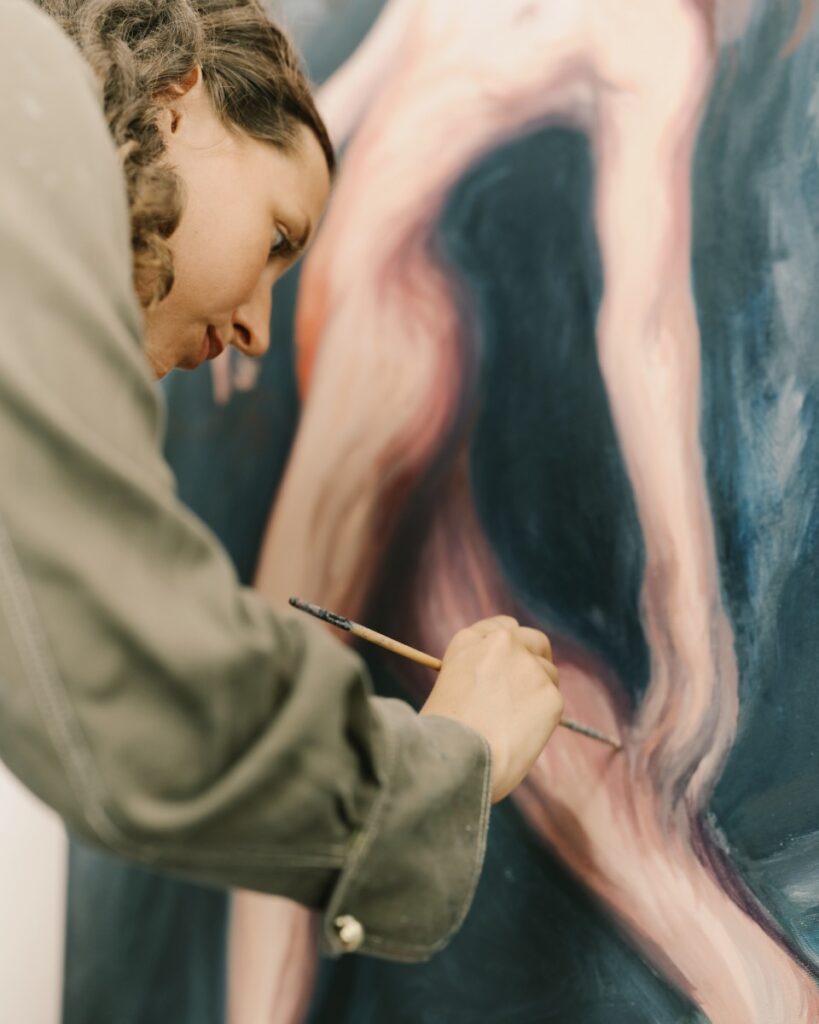
Looking at your work, one notices a unique handling of the medium: you apply paint, then “strip” and dissolve it using white spirit, allowing chance and intuition to play their part. In this process, the boundaries of the human body seem to dissolve, merging with natural elements like tree bark or flowing water. Could you share how you experiment with these techniques, and what this total fusion between the body and nature means to you?
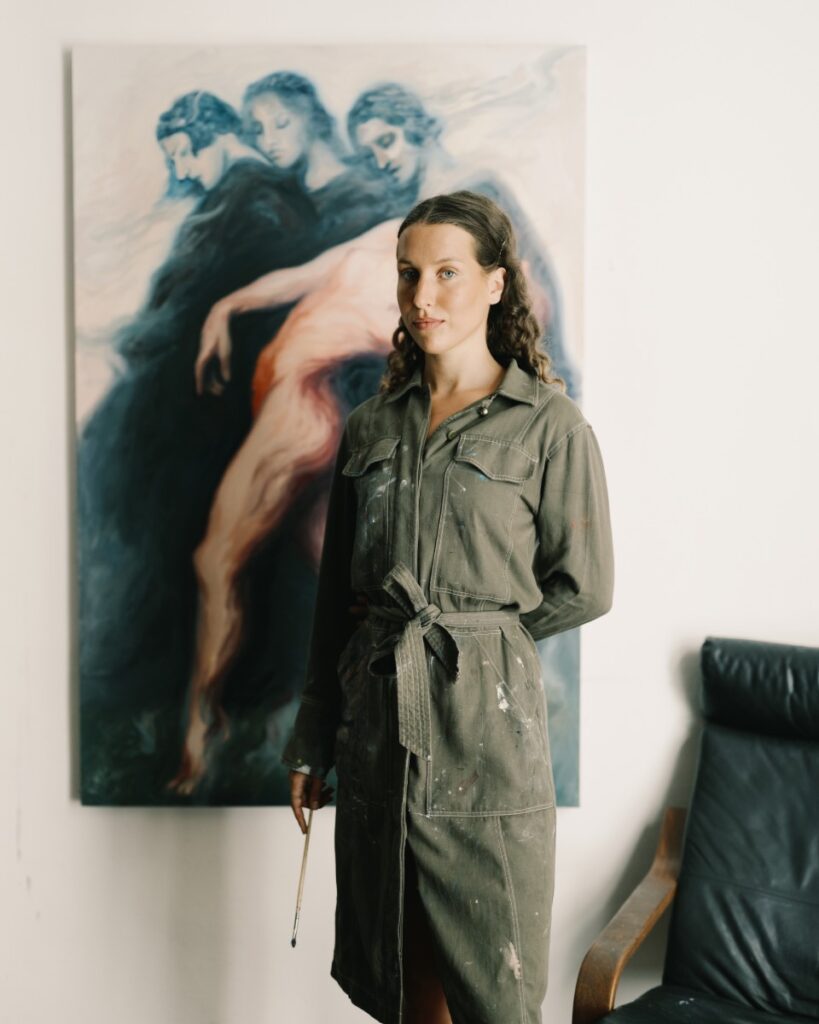
My painting Decaying Sapling (2024) marked a turning point in my practice. It was the first work in which I moved away from a predetermined collaged composition towards a process of progressive layering, allowing the image to come into being gradually while experimenting with thinning oil paint to a translucent, almost watercolour-like quality.
I was initially drawn to these possibilities through the work of Helen Frankenthaler and her soak-stain technique, as well as the paintings of Hu Jundi, whose oils often possess the luminosity of watercolour. Beneath the final surface of Decaying Sapling lie several earlier compositions, including an entire abandoned painting and a self-portrait of myself standing amongst the trees, which I later painted over to create two perspectives of the same tree. The title refers to the simultaneous existence of the seed and the oak. It reflects an eternalist conception of time, where past, present, and future coexist within a single field of being.
From there, I began developing a process of stripping back paint with white spirit whenever a composition felt too fixed or complete. Fully resolved forms often seemed to obstruct the movement or energy of a painting, so I would partially dissolve them, allowing fragments to remain.
I value these traces as records of the painting’s evolution. They retain the memory of structure while remaining ambiguous, inviting the viewer’s imagination to complete what has been left unresolved. I am continually surprised by the forms people discover within these passages, much like watching images appear and disappear within shifting clouds.
Underlying this process is the idea of entelechy, Aristotle’s concept of the unfolding of inherent potential. I see painting, as well as the way I choose to live my life, as an act of surrender to that unfolding. Rather than imposing an image upon the canvas, I try to listen, respond, and allow the work to become what it wants to become. Each painting develops according to its own internal logic, which means no two are conceived in the same way.
Yet every painting becomes a record of transformation: an energetic imprint of lived experience distilled through the body and expressed through pigment. Humming Bark (2025) began the day before I made the first mark, when I found myself crying in the branches of my favourite tree in Florence. As I rested there, I became acutely aware of the tree’s presence. Its bark seemed to hum beneath the fading light and, rather than appearing simply brown or rust-coloured, it was surrounded by a soft haze of lilac as the sun set.
My phone had run out of battery, so instead of reaching for a photograph, I remained with the experience, allowing it to imprint itself as an emotional and visual memory. That moment became the source of the painting. I am transfixed by dichotomy, moments of spaciousness where seemingly opposing emotions coexist; in this instance, the dance of grief and gratitude.
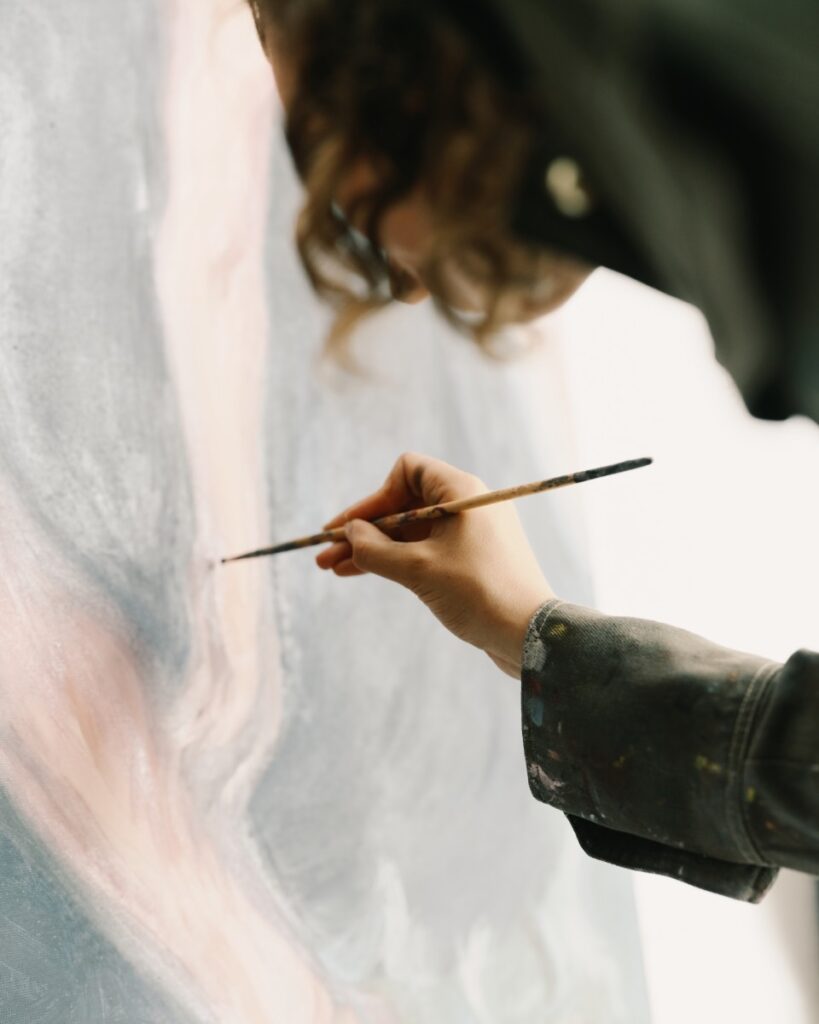
Roots of Breath began from a similar place. Its first layer was an internal landscape: a blue field containing a tree whose roots appeared to metabolise the blue into golden branches. Six months later, I returned to the same canvas and painted a nude torso over it. The skin thinly glazed so the subterranean tides gleam through. The chest became the site of that transformation because it is where I most viscerally experience emotional transition: through breath, I am in reverence of release.
I was born in a bath, so I often joke that I’ve spent my life trying to return to the water. I realise how consistently water has shaped my experience. I grew up in Pewsey Vale, then lived in Cologne, later by the River Kennet in Marlborough, and now in Florence, where the Arno has become part of my daily life. From the age of four, I spent a couple weeks of the year sailing, and I’ve always found a profound sense of tranquillity at the water’s edge, am enamoured by impressionist scenes depicting water and felt drawn to transmit that quality through my artworks.
The fusion between the body and nature that recurs throughout my work is therefore not symbolic so much as experiential. I do not experience human beings as separate from the natural world, but as expressions of it. Just as rivers, trees, fungi, and weather systems participate in continual processes of transformation, so do we. Allowing bodies to dissolve into bark, water, roots, and landscape is my way of painting that underlying continuity. It reflects a belief that the boundaries we perceive between ourselves and nature are often conceptual rather than real.
On your website, you introduce a powerful and highly personal concept: Mother Expressionism™, a philosophy that views existence as a perpetual flux, a constant metamorphosis between creation and dissolution. How was this manifesto born, and how does it visually translate when you stand before the canvas?
Mother Expressionism was not conceived overnight. It is the culmination of years of artistic practice, philosophical inquiry, and personal transformation. The philosophy draws from many sources: Heraclitus’ vision of reality as perpetual flux, Jung’s process of individuation, mystical traditions that emphasise surrender, and inherent wisdom of the natural world itself.
I am interested in the idea that each of us contains an innate potential seeking expression. Like a seed becoming a tree, we are continually unfolding into what we already are. Looking back, I can see that I was always circling around the same ideas through different languages— painting, sustainable fashion, spirituality, psychology, and movement. Eventually, I realised they were all expressions of a single underlying philosophy.
In 2020, it felt like coming up for air after years of being caught in a rip tide. I found the deepest contentment in solitude. Paradoxically, I was less alone than I had ever been, because I discovered an affinity with minds across millennia.I became immersed in ideas surrounding epigenetics, intergenerational trauma, and generational healing. I was fascinated not only by how we inherit histories, wounds, adaptations, and survival strategies from our families and cultures, but by the practical ways we might liberate ourselves from these internal fortresses.
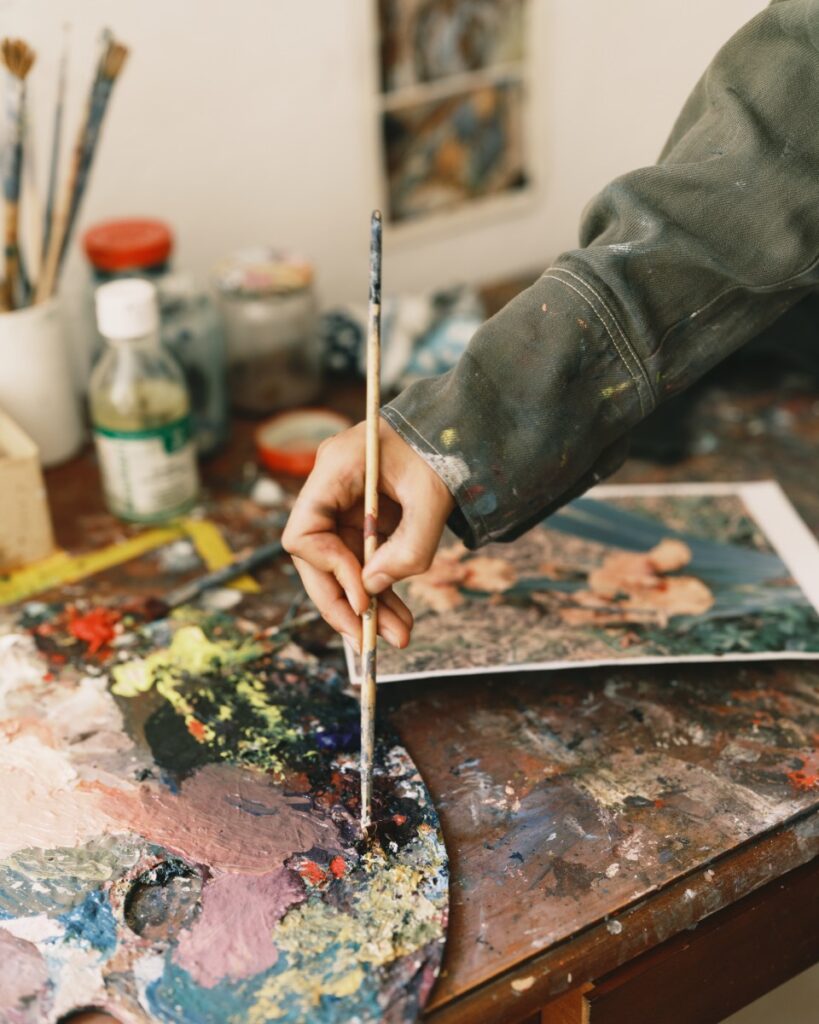
Yet it was lived experience, more than theory, that inspired and sewed the seeds for where my practice is today. Working with such as breathwork, EFT tapping, and mantra meditation, alongside the profound simplicity of running freely through the woods and along the river of my hometown brought me back to the awe of childhood. There was a quiet irony in finding peace in the very landscape I had spent years plotting to escape.
At its core, Mother Expressionism is an embodied philosophy. It emerged from a growing understanding that transformation does not occur through thought alone, but through somatic healing and harmonising the mind body connection. While many of the motifs I use arise from my own experiences, they point toward something collective. Through connection, expression, and conscious action, we gain the capacity to rewrite inherited stories, dissolve unconscious patterns, and cultivate new ways of being. I truly believe that the revolution begins in the body.
I spend a great deal of time researching the stories of female saints, mythological figures and goddesses, not to recreate them, but to awaken in me the aspects of the feminine that have been hidden, feared or condemned. What the true capacity of feminine power looks like, a vision that propels me forwards. I see the power of narrative, they set or dissolve the barrier of what we believe to be possible, important to take these stories. Painting has become an act of unpicking and recultivating my inner garden. It has meant recognising where I inherited shame around my sensuality, and understanding that it was never truly mine.
Growing into adulthood, I became increasingly aware of what it meant to be sexualised and, at times, dehumanised; to feel my body reduced to an object of desire rather than experienced as something I inhabited from within. I carried the belief that expressing my sensuality was somehow incompatible with being respected. Much of this work has been about learning to discern the difference between genuine intimacy and the allure of projected desire.
It was through this gradual transformation that Mother Expressionism emerged. Less an aesthetic than a way of being, it grew from a longing to cultivate a nourishing place to rest in, an environment conducive to growth, both within myself and within the paintings. I cannot speak about Mother Expressionism without speaking about the community I am woven into. Nights spent dancing with women, the poems written in reflection, and the simple act of witnessing one another have become as much a part of the practice as painting itself.
Brigitte Alberghini Davis wrote, “How could I not dance for the rain to water my sister’s garden? You water mine so well”.
To me, those words capture something essential about Mother Expressionism: that our flourishing is not separate but shared. You can travel to the ends of the earth or spend months on silent retreats, but more often than not, what we need is to be lovingly witnessed and held, both by ourselves and by a community. It is such a simple thing, a return to something tribal and deeply human, yet it feels increasingly rare in contemporary culture.

Art historically, Mother Expressionism sits within the lineage of both Abstract and Figurative Expressionism. Like the Expressionists, I am interested in art as a vehicle for inner transformation rather than mere representation. My practice is, in many ways, an exercise in entelechy. When I stand before the canvas, I try to get out of the way and allow the work to become what it wants to become.Although the process is deeply intuitive, it is grounded in observation. I often begin with reference photographs, whether images from mythic fashion editorials that I have art directed, photographs taken by friends, or studies of the body. More recently,
I have found great inspiration in The Nude: A Photographic History, a collection of nude photography spanning from 1817 onwards. These images provide points of departure rather than destinations. Moreover, despite my training at Charles Cecil Studios, my approach to constructing figurative form owes more to Leonardo than to the strict sight-size tradition. Rather than fixing contours immediately, I work through a process of searching lines, allowing form to be discovered through movement and fluidity.
As the painting develops, I move away from description and towards sensation, allowing the body to dissolve into landscapes of water, bark, light, and movement. The figure is never fixed but continually becoming. Because of this, dance has become an integral part of my daily studio practice. Before making my first marks, I need to become free, fluid, and fully expressed. I follow rhythm, movement, and what I can only describe as a life force moving through the image. The painting reveals itself alongside me.
Florence is universally known for its Renaissance, geometric, and idealized aesthetic. Your painting, by contrast, celebrates imperfection, fluidity, and the cycle of time. What does it mean to you to live and create in a city with such an imposing history? Is it a stimulus, a contrast, or a source of subterranean inspiration?
I feel more at home in Florence than I would in any modern metropolis. There is enough beauty here to sustain me as someone who grew up surrounded by nature. Living here has deepened my appreciation for architecture as more than functional shelter. While not biophilic in the contemporary sense, its architecture reflects many of the same principles: human scale, organic materials, visual richness, and a profound harmony between the built environment and the living world. You only have to remember to look up in Florence.
A ceiling opens into a fresco, a carved cornice catches the afternoon light, a sculpted figure emerges from a façade. There is always another layer of beauty waiting to be discovered if you remember to be attentive. That attentiveness has become part of my own practice. Florence has taught me to see more slowly, and that way of seeing has shaped not only what I paint, but how I paint.
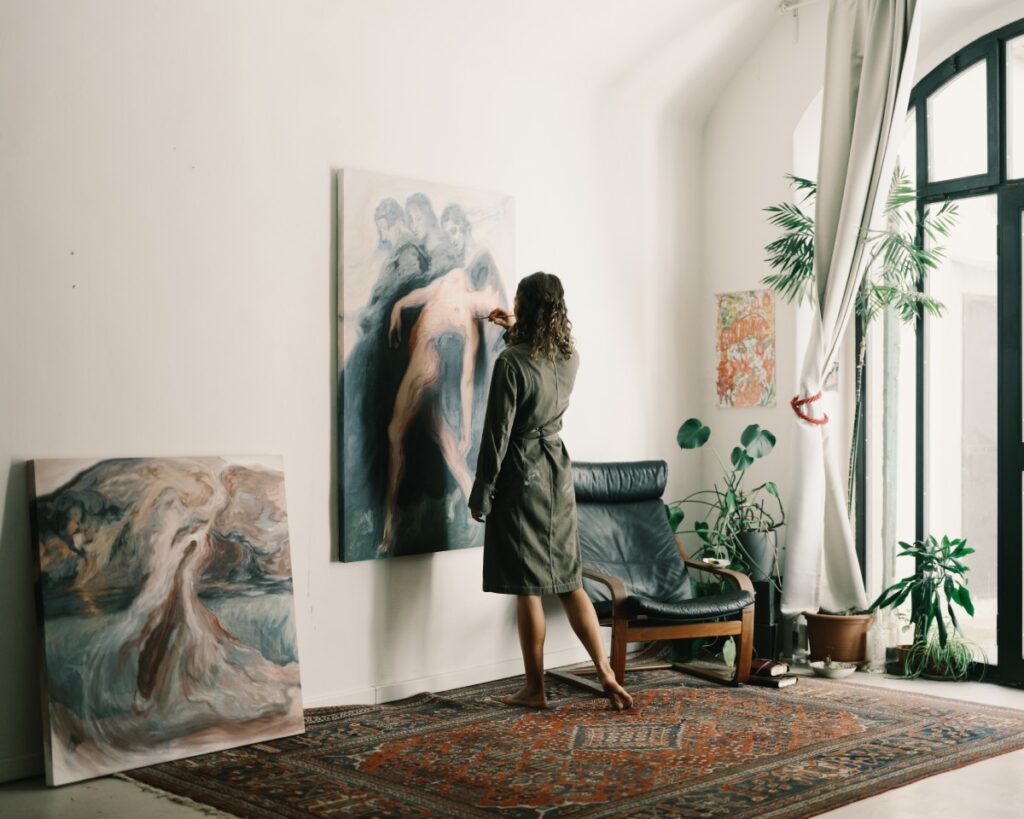
The more time I have spent here, the more I have realised that it is not only Florence’s visual language that resonates with me, but its philosophical one. I have come to realise that my artistic worldview shares much with the Neoplatonic currents that shaped Renaissance Florence. Like the thinkers of the Florentine Platonic Academy, particularly Marsilio Ficino, I see artistic creation as a spiritual act. Beauty is not merely decorative; it is a means of elevating consciousness and orienting us toward something greater than ourselves. I also share the Renaissance affinity for allegory.
Classical myths, religious narratives, and archetypal figures frequently find their way into my work, not as illustrations of doctrine, but as living symbols that help us navigate periods of transformation. I am interested in what images transmit: what they amplify, propagate, and make imaginable. Every aesthetic decision carries a philosophy, whether consciously or unconsciously. What I love most is that this legacy has not disappeared.
Florence is not only a city of inherited ideas but a living creative community, continually attracting people who bow to Venus. Some of my greatest sources of inspiration here have been the artists I have met. Conversations with photographers, sculptors, musicians, poets, and craftspeople have continually expanded the way I think about image-making.
Their ways of seeing have enriched my own, and the exchange of ideas has become as important to my practice as the hours I spend alone in the studio. There is something about Florence that still encourages this kind of cross- pollination. The city feels small enough that disciplines naturally overlap, yet rich enough that every encounter carries the possibility of opening a new way of seeing. In that sense, Florence is less a contrast than a source of subterranean inspiration.
My paintings may embrace fluidity, impermanence, and transformation, but they emerge from a similar desire to explore the relationship between the visible and the invisible, matter and spirit, the individual and the whole. Perhaps where I differ from Renaissance imagery is that I am less interested in perfection than in becoming. My work embraces dissolution as much as form, process as much as completion.
Yet even that feels at home in Florence, where the Renaissance humanists understood that art could participate in the continual cultivation of the human spirit.
Cover and photos by ©Riccardo Svelto
https://www.jennatathamart.com