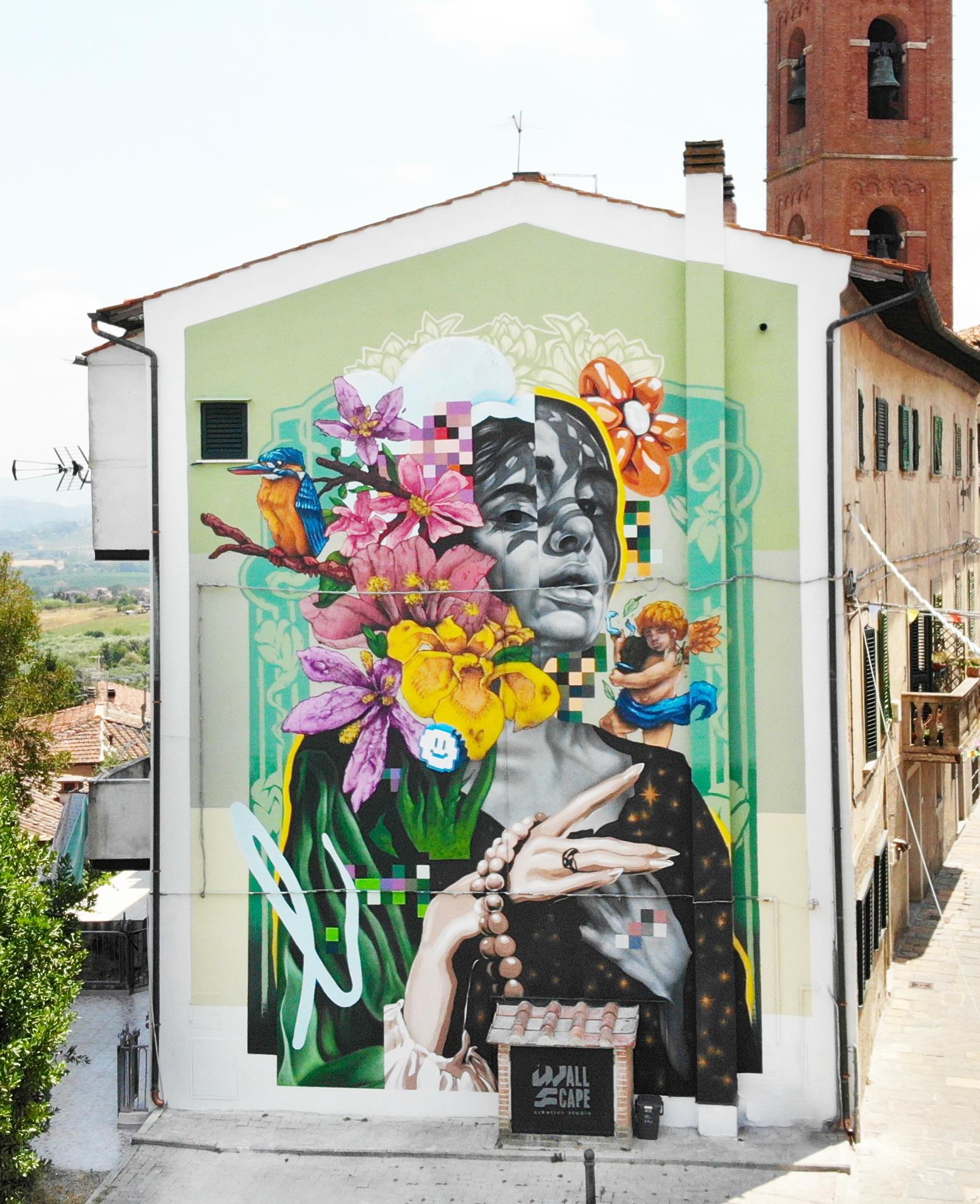
Who Owns a City’s Walls?
A wall can change the way a building looks. It can make it recognizable, shift how a street is perceived, tell something about the neighborhood it stands in, or become part of a company’s identity. But when can we really talk about public art?
It’s one of the questions that come up in conversation with Andrea Montagnani, aka MozzArt, one of the founders of Wallscape Creative Studio, a Florentine studio born from a meeting of backgrounds in graffiti, writing, street art, photography and graphic design, whose key figures also include Vincenzo Di Martino, aka Ninjaz, and Cosimo Grandoli, aka Cionsi.
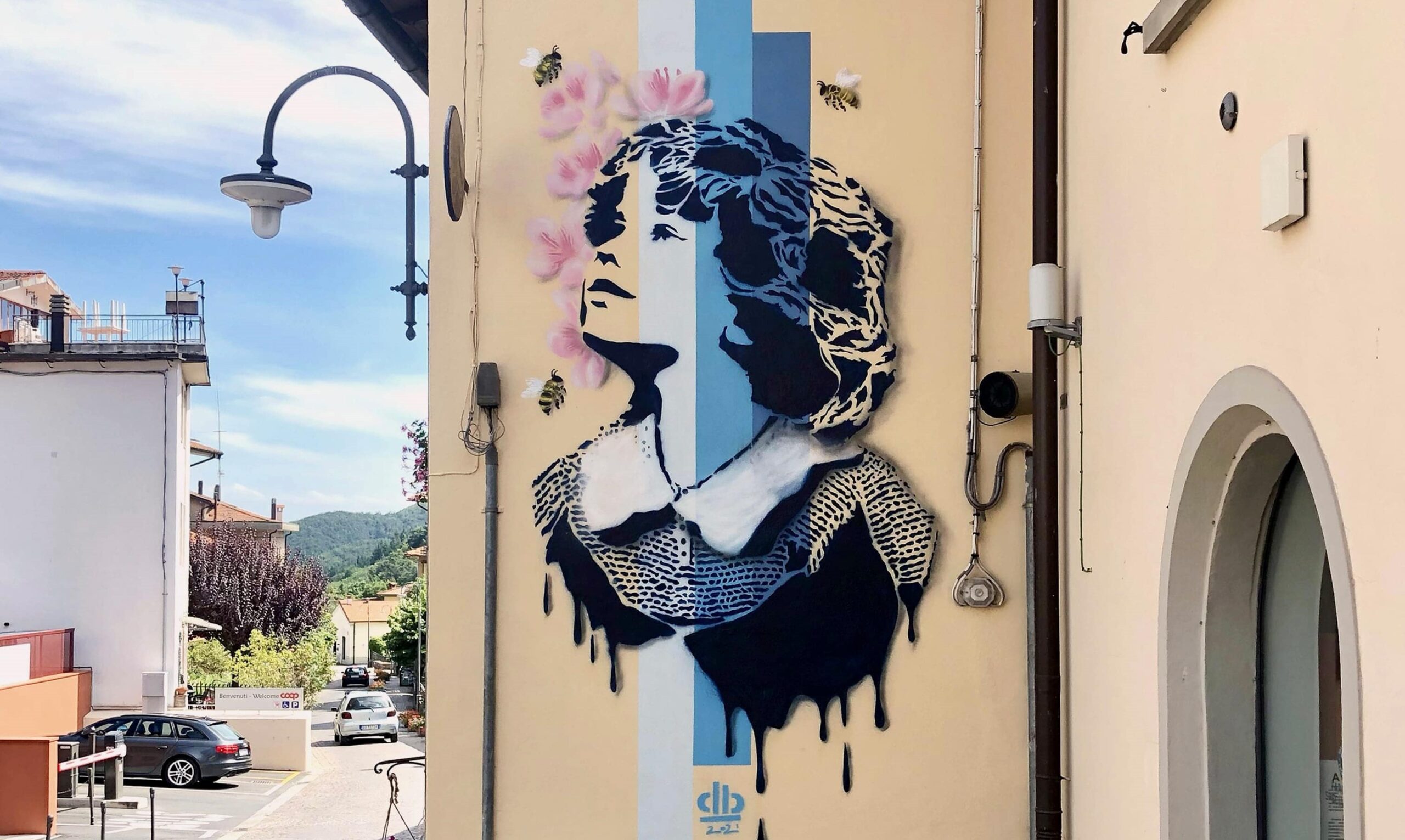
Today Wallscape works between urban art and wall design, collaborating with public bodies and private companies on surfaces that can reach monumental scale. Its track record includes the large-scale work in Bibbiena, the open-air museum in Capannoli and, more recently, the urban design project on Via Pacinotti in Florence.
At the heart of the studio’s work is the relationship between an artwork and the place where it is made. It’s a theme that inevitably leads to questions about what we mean today by urban regeneration, and about the role art can play in changing not only how a space looks, but also how it is perceived and lived in.
We talked about it with Andrea Montagnani.
From graffiti to Wallscape
Let’s start with Wallscape. When we see one of your big murals, we see the finished result, but there’s a much more complex process behind it. Who are you, how did the studio come about, and how does a project actually unfold, from the first meeting with the client to the finished work on the wall?
We come from graffiti and writing, from photography and graphic design, from street art. Wallscape is the result of many years of research and collective work.
Over the years our approach evolved, and the ideas of graffiti and crew were no longer enough for what we wanted to do. That’s where the idea came from to set up a creative studio that could also step outside strictly artistic conventions and take on commercial projects.
We focus on urban art and wall design for public and private clients, following the client’s needs every step of the way. Every art project has a precise goal: to speak about the area and the history of the place where we work, to send a positive message that can inspire both younger and older generations, and to make the work a direct testimony of the community.
Your works are often very large in scale and necessarily have to engage with the architecture and the setting around them. How is the subject of a mural born? How much of it comes from your own artistic identity, and how much from the history of the building, the neighborhood or the people who live in that space?
Our artistic identity is always present in every work. We love to experiment and not get stuck in one groove, so we make some works that are more graphic and simple and others richer in detail, in a realistic, figurative style. Let’s say we like to adapt to the building in front of us and to the kind of goal the work needs to achieve.
In the case of the largest mural in Tuscany, which we painted in Bibbiena in 2023, the need was to bring color back to the building and create an abstract work. So we tried to tell a story through colors and simple graphic elements.
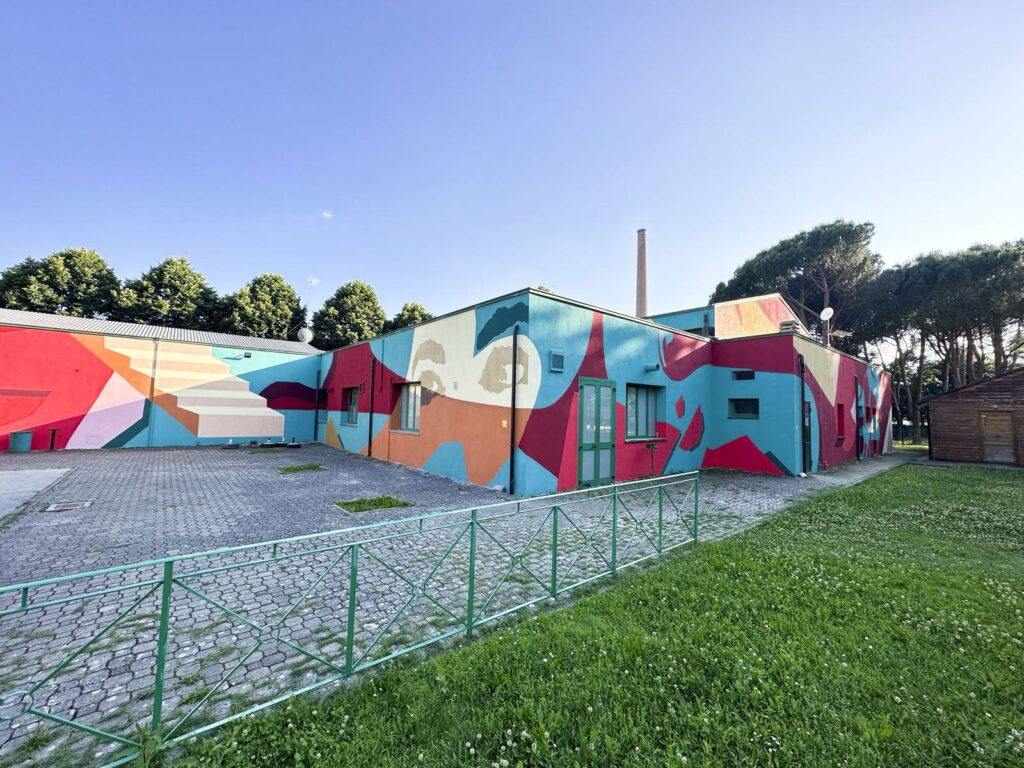
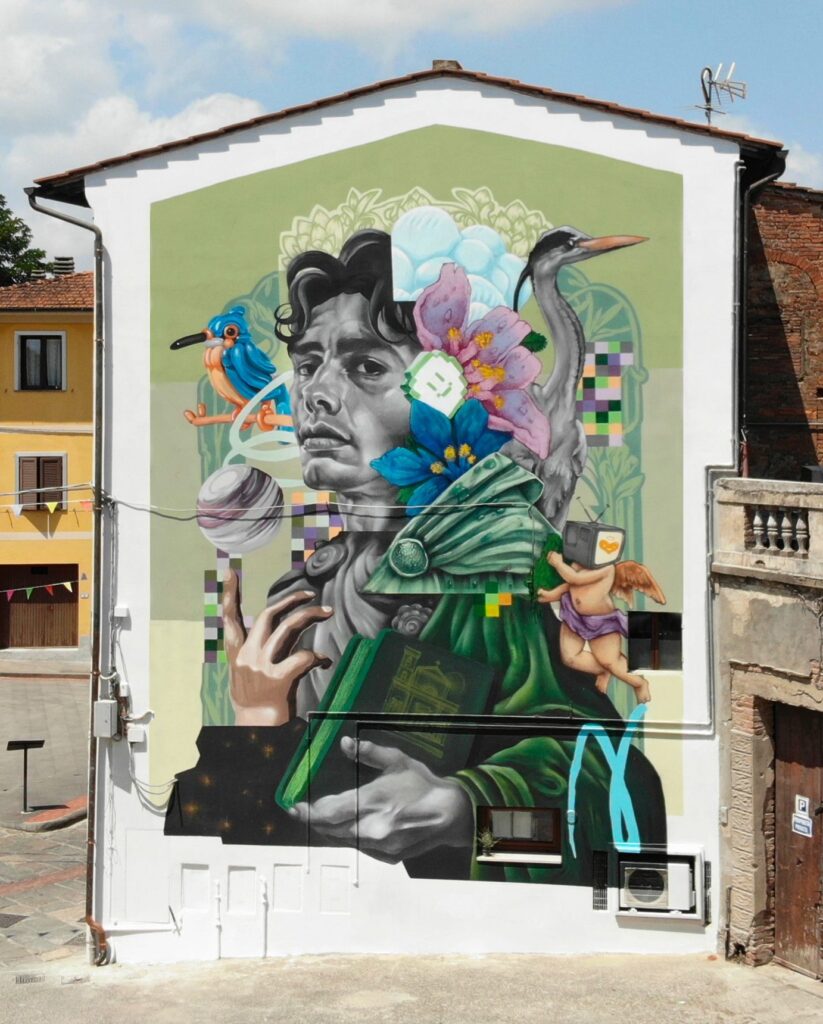
With “Eden”, the works we created in Capannoli, we speak instead about the land and about the bond with one’s roots, through a collage of graphic, illustrative and realistic elements. In that case we were immediately inspired by the walls of the building.
When art becomes regeneration
There’s a lot of talk about urban regeneration, sometimes with the phrase used almost on autopilot. From your point of view, when does an art project truly manage to regenerate a space? Is it enough to transform how it looks, or does it also have to change the relationship people have with that place?
Every art project has a precise goal: to speak about the area and the history of the place where we work, to send a positive message that can inspire both younger and older generations, and to make the work a direct testimony of the community.
Unfortunately, public art is too often a testimony only of the artist and the curator, and doesn’t represent the community. That’s also why our art and our projects try to stand apart: for us, the work and the community have to become one great participatory work.
We need to understand that there’s a big difference between public art and private art made on public walls. Unfortunately, more and more often projects are carried out following only the tastes of whoever curates them, producing works that are anything but a testimony of the place and of its bond with the community. This risks creating a social disconnect, which is exactly the opposite of what urban art should be.

Regeneration, though, isn’t necessarily only about public spaces. There are warehouses, factories, company headquarters and large private buildings that can have an enormous impact on the urban landscape. How far are companies coming to understand that an urban art project can turn an anonymous or run-down building into something that communicates an identity and, at the same time, gives quality back to its surroundings?
Many companies are starting to commission works on their own walls, for a variety of reasons. Projects like these certainly make company spaces more livable and attractive, both for customers and for the people who work there, and they also help a company stand out from the competition.
Company buildings are very often gray and anonymous, and a painted makeover that speaks of the company’s identity sets it apart from the others. On top of that, the company gives something back to the place where it operates, helping to beautify the urban fabric and the landscape.
When the client is a private company, communication inevitably comes into play too. Where is the line between a work of urban art and a large-scale branding operation? How do you keep a mural from simply becoming an advertisement painted on a facade?
Very often it’s inevitable that a project for a brand lacks an element of pure art and turns out to be mainly commercial. Creativity and the artistic side are always there, but in different forms.
The creative studio was born precisely from the need to keep commercial work separate from the artistic research our artists pursue individually.
From Tuscany to Florence
In recent years you’ve worked a lot in Tuscany, in settings that are often very different from one another. Which projects do you consider most significant for understanding the way you work, and what changes have you seen take shape, concretely, once the works were completed?
Yes, we’ve worked a lot in Tuscany. Since we’re based in Florence, we focus mainly on this region, although we’re also doing well abroad and in the rest of Italy.
In the studio’s three years, the projects we consider most important are definitely the largest work in Tuscany, in Bibbiena, in the province of Arezzo, and the open-air museum in Capannoli, in the province of Pisa. Two projects completely different from each other, but both very significant.
In truth, every work has its own importance. Every job is unique and meaningful, and always brings a professional, personal and artistic transformation with it.
Let’s come to Florence, the city where you began an important part of your journey and where you’ve recently returned with new works, including the one on Via Pacinotti. Can you tell us about these latest projects? How did they come about, what did you find before you stepped in, and what did you want to leave for the people who walk past those walls today?
Our studio was born in Florence, even though our work isn’t focused only here. It’s always interesting to work in Florence, but unfortunately it’s also very difficult. Over the years, a certain kind of urban art has been favored that doesn’t really represent us.
We hope to create more works in Florence and to give the city back something of real, intrinsic value.
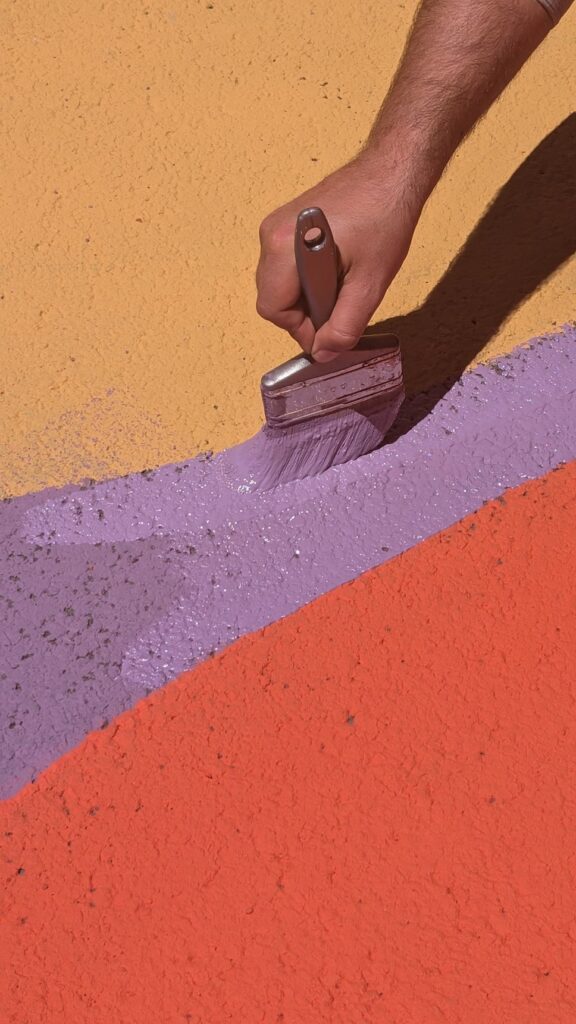
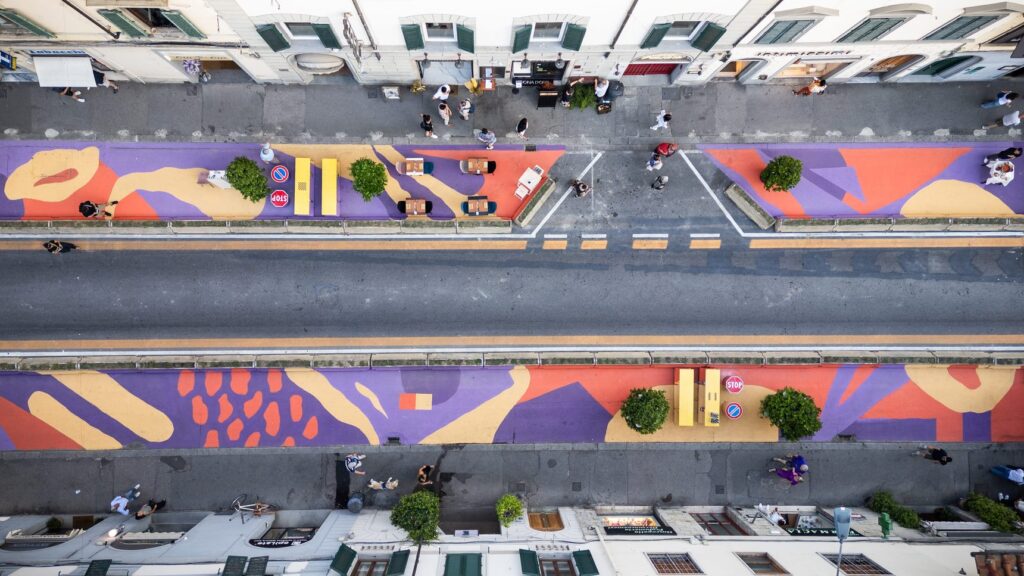
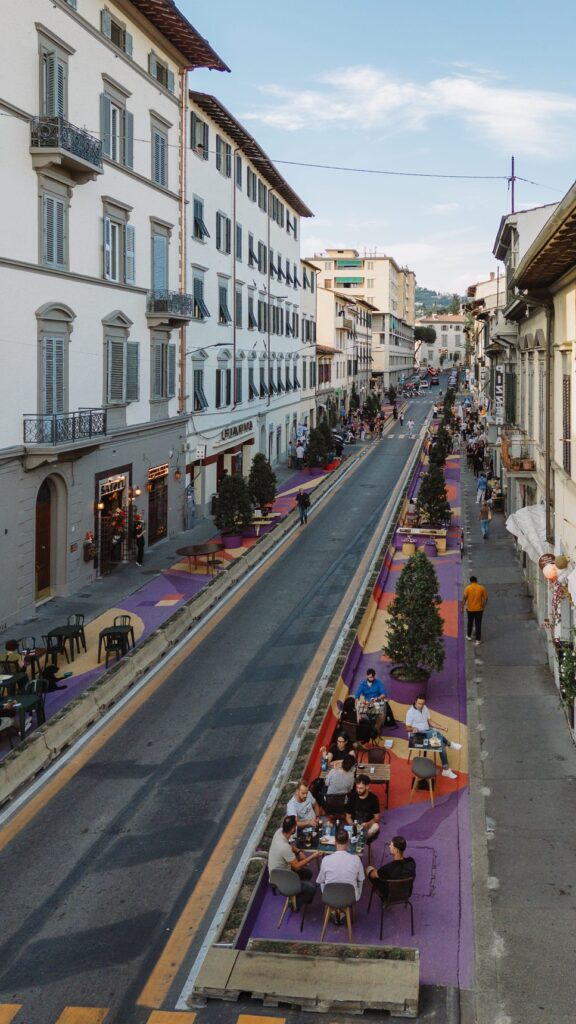
On Via Pacinotti, the pavement was the centerpiece of the urban design project curated by Lumen. We wanted to depict, in an abstract way, the games we used to play as kids, when looking down at the ground, a few shapes were all it took to start imagining something.
Simple shapes and colors thus become an invitation to play, not just for children but for everyone who passes through that space.