The Day UFOs Stopped a Soccer Match in Florence
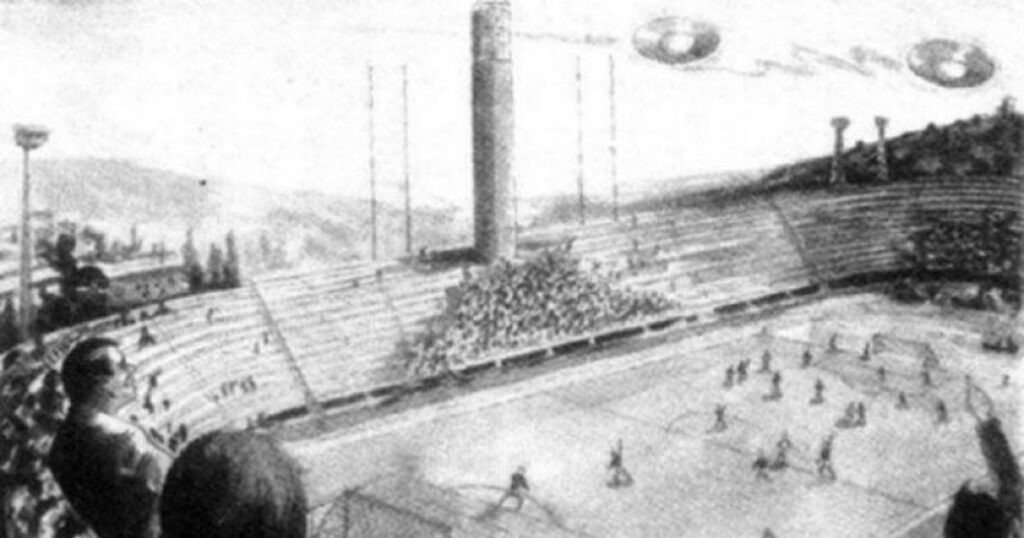
Everyone starts looking up, toward two mysterious flying objects chasing each other across the sky: roughly ten thousand people, spectators and players alike, freeze all at once. Some describe them as cigar-shaped, others as gull-winged or shaped like a “Chinese mandarin’s hat” — but all agree on the whitish color, the same shade as the mysterious flakes that suddenly begin drifting down from above, described at the time as “siliceous cotton wool” and better known in UFO circles as “angel hair.” Among the many eyewitnesses were La Nazione‘s chief reporter Giorgio Batini and the footballers Ardico Magnini, Romolo Tuci and Ronaldo Lomi. In the end, the match was suspended. And yet the stadium sighting, for all its fame — thanks to the sheer number of people who witnessed it at once — was not actually the first of that day. The first apparition had come around 2:20 p.m., over the Duomo, where the flying objects remained visible for some fifteen minutes. Their course seemed to run from northwest to southeast, along an axis linking the Cascine park to Rovezzano. But what really happened on that Wednesday in 1954?
The “ballooning” phenomenon — was it the spiders’ fault?
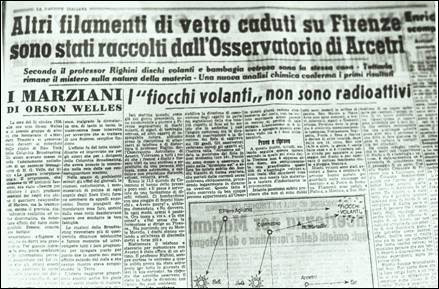
The first investigation is owed to Alfredo Jacopozzi, a student with the presence of mind to gather a few samples of those strange filaments and pass them to the University of Florence’s Institute of Analytical Chemistry, where they were analyzed by Professor Giovanni Canneri. The verdict: a compound of boron, silicon, calcium and magnesium. One of the explanations offered was “ballooning,” a migration technique used by certain spiders at particular times of year — especially in October. Using their silk glands, the spiders spin long whitish filaments that instantly form a large triangular web acting as a parachute; clinging to it, they can rise into the air and travel for thousands of kilometers, riding air currents and the Earth’s electric fields, sometimes as high as four meters off the ground. But the explanation doesn’t quite add up: the chemical makeup of “ballooning” silk doesn’t perfectly match what was found in Florence.
The chaff hypothesis and the military exercises
Vincenzo Gassi, a researcher at CICAP (the Italian committee for the investigation of claims of the pseudosciences), offers a better fit: he found that during that very week, military exercises were under way using chaff, an electronic anti-missile countermeasure that jams and deceives enemy targeting radar by scattering clouds of radar-reflective material. The chemical composition of chaff, it turns out, is the same as the one identified by Professor Canneri — and it, too, dissolves on contact.
A new sighting: the “Lotti case”
Sightings of alleged UFOs over Florence and its surroundings recurred in the following days, accompanied by falls of that gleaming cotton-like filament: Pontassieve, Scarperia, San Mauro a Signa and many other towns were affected — but above all Calenzano, where on October 29, a few minutes after 1 p.m., the strange filaments were reported falling in the wake of a group of UFOs heading toward Florence over Monte Morello.
What added an extra jolt to the affair, just a few days later, was the so-called “Lotti case,” also known as the “Cennina case.” The chronicles tell of Rosa Lotti Dainelli, a forty-year-old farmer, married and mother of four, who lived with her family in a farmhouse on the “La Collina” holding, in an isolated area between Capannole and Cennina, a hamlet of Bucine in the province of Arezzo. That day Rosa Lotti Dainelli was on her way to the All Saints’ Day Mass, walking a path she knew well, when near a clearing about 20 meters off she glimpsed a pointed object among the bushes: “a kind of double cone, more than two meters tall and about one meter wide in the middle […]. The outside of the object shone like well-polished metal. In the lower part of the cone there was an open glass hatch, and inside you could see two little seats, small like the ones children use. In the wider central part of the spindle there was a kind of rounded, curved glass following the round shape of the mysterious machine,” as reported by La Nazione Italiana on November 2, 1954.
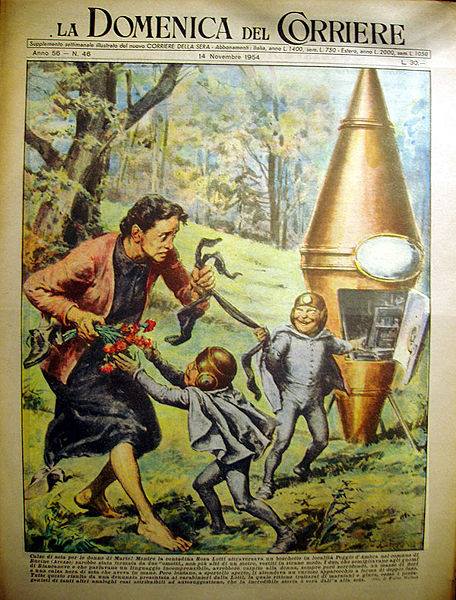
As the story goes, two humanoid beings, but only a meter tall, suddenly emerged from the bushes (“almost like men, but the size of children”). They wore tight gray suits with shining buttons, a short cape over the shoulders, “a helmet, apparently of leather, that also covered the ears with two little discs,” and a leather band around the forehead. “They had magnificent eyes, full of intelligence. Their noses were of normal shape, their mouths like those of men, but the upper lips were slightly curved in the center, so that even when they weren’t laughing you could see their teeth. They had teeth like ours — broad, strong teeth, but short (as if they had been filed) and rather protruding, like a rabbit’s.”
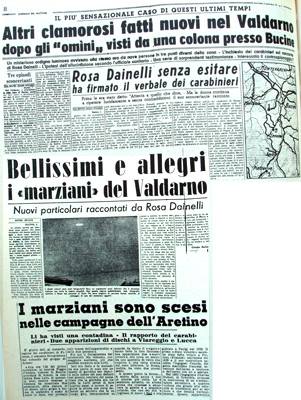
After she reported the encounter, the Carabinieri inspected the site and found a hole, presumably made by the point of the object driven into the ground. The woman’s account was backed by several other sightings of unidentified flying objects that matched it in timing. The reports appeared in the Tuscan dailies Il Giornale del Mattino and La Nazione between November 2 and 5: in all, 24 witnesses reported “daytime disc” sightings.
Other episodes occurred across Italy in those same days. On October 28 in Rome, shortly before dusk, many people saw a UFO in the sky — observed even by the U.S. ambassador to Italy, Clare Boothe Luce. As in Florence the day before, a fall of siliceous cotton wool followed. On November 6, again in Rome, several people, including the consul and ufologist Alberto Perego, watched a formation of small luminous globes over Vatican City. And on November 14, UFOs were observed at Gela, in Sicily, once more with a fall of siliceous cotton wool.
That year came to be known as the “1954 flap“: in that period sightings clustered above all in Europe, which, according to a study by Donald Johnson, accounted for roughly 75% of the world’s sightings. Most were reported in the west and south of the continent.